
Getting problem relationships through Christmas

According to the latest Office for National Statistics (ONS) figures, the overall divorce rates are continuing to fall. There were 111,169 divorces in 2014, a decrease of 3.1% compared with 2013 and 27% lower than 2003. Compared with 2004 data, divorce rates were lower for all age groups except women aged 55 and over. As younger people look to have fewer problems in the first decade of marriage, ONS has attributed this to more couples cohabitating before marriage, suggesting that only stronger relationships and not problem relationships make it through to the wedding day.

But, those working at the front line say the apparent improvement should not obscure the increasing difficulty faced by couples looking to separate. Although the process of securing a divorce is relatively straightforward, the associated negotiating over finances and children is proving an increasing challenge.

Faced with the cuts to legal aid and higher Court fees (the cost of applying for a divorce increased from £410 to £550 in March 2016) and the difficulty in setting up two homes, many couples are turning to increasingly desperate measures.

For some, it involves continuing to live together, even when officially separated, or even post-divorce, including so-called ‘bird nesting’ arrangements, where the children stay in the family home and the parents come and go. Others turn to online help or untrained mediators, only to discover later that they may have agreed to financial or childcare outcomes that leave them at a significant disadvantage when professional advice and representation could have reached a fairer outcome.

Our own family lawyer, Pippa Marshall, said:

“Unfortunately the workload of the family lawyer is not reducing. Dealing with problems arising from self-conducted negotiations, or where negotiations have been managed by an untrained intermediary, is becoming more common.

DIY can seem a sensible option when trying to keep the lid on costs and people around you are saying the process is simple. Whilst it’s true that the application process itself is relatively straightforward, that’s only one small part, it is by no means fool-proof. If you get it wrong it could lead to paperwork being sent back, which could mean additional court fees.”

Pippa added:

“It’s tough sorting things out between the two of you when emotions are running high, but talking things through is always the best way and having someone help you with those conversations is a good idea. That person doesn’t have to be a professional, but you should have expert input at some stage in the negotiations, to make sure that what you have agreed is fair, that neither party is pushing the other into a corner, and that it is in line with what you could expect as a reasonable outcome if you had gone to court.”

Such encouragement for couples to talk reflects recent research findings in the United States. This suggests that couples who share their problems with each other are more likely to overcome difficulties than those who share problems with their friends. As reported in the Journal of Social and Personal Relationships, researchers found that sharing concerns with a friend increased the odds of a breakup by 33%, but talking it out with a partner doubled the chances of them staying together.

Further, Pippa added:

“Ending a marriage is one of the toughest things anyone will ever deal with, and what’s needed is a well-informed, collaborative approach. The couple, and anyone supporting or advising them, need to be focused on achieving an outcome through positive negotiation that is more talk, less war.”

Contact Pippa Marshall today for expert advice and guidance on problem relationships.

Note: This article is not legal advice; it provides information of general interest about current legal issues.

The Bribery Act: The one time you should look for the price tag

If you’re worried there are too many bottles of wine bearing “Happy Christmas” messages from your suppliers, it’s worth checking out the facts and ensuring staff know the right and wrong way to go about corporate gifting to comply with the Bribery Act.

The Bribery Act came into force in 2011, simplifying and consolidating existing laws on corruption and creating a new crime of failing to prevent bribery. When it became law, many commentators thought it might end all corporate hospitality. That wasn’t the case, with the Ministry of Justice’s later guidance saying: “hospitality is not prohibited by the Act”, but any gifts must be reasonable and proportionate. So, companies who splash out and are over-generous in their gifting could break the rules and get themselves and the recipient into deep water.

Bribery is defined as giving or offering a person a financial or other advantage to induce them to act improperly. It is also a crime to ask for or to receive an inducement in return for acting improperly.

Our white-collar crime expert, Vinay Verma, said:

“When it comes to gifts or any form of hospitality, the simplest thing is to have a clear threshold that’s appropriate to the sector you’re operating in, whether giving or receiving. Then, if anything offered has a value beyond that, employees must obtain permission. It’s also sensible to make sure everything, however small, is logged in a central register.”

As well as looking at the price ticket on gifts or hospitality, companies must demonstrate that they do it with the right intentions. A gift given at Christmas time is less likely to be problematic than something offered during contract negotiations or when an extra invoice has been submitted. Similarly, hospitality that doesn’t involve any opportunity for business development on the giver’s part is likely to raise questions.

Vinay added:

“Entertaining your customers at a Christmas party, or providing a modest bottle of wine, is unlikely to cause problems. But if you offer a pair of theatre tickets and a dinner reservation for two at a high-end restaurant to a key contact and their spouse, that is much less likely to pass the “reasonable and proportionate” test. Where there’s a clear opportunity to promote the company supplying the hospitality, it’s more likely to be seen as reasonable business development.

“Preventing bribery is important for any business, whatever their size, and every company must demonstrate they are taking it seriously. That includes undertaking risk assessments, making sure staff know the procedure, and setting everything out in writing.”

Since introducing the Bribery Act, the Serious Fraud Office has shown a tough attitude to enforcement and seeking out corruption. In one recent high-profile case, a construction and professional services company was ordered to pay £2.25 million due to a conviction arising from a failure to prevent bribery. In short, where bribery has occurred, it is a separate offence to fail to have adequate measures to prevent it in place. We can help you ensure that those measures are in place and effective.

Call partner Vinay Verma today for more information.

Note: This is not legal advice; it provides information of general interest about current legal issues.


How employers can say no, without saying a word

The warning comes after an employer was found to have failed to take the necessary steps to facilitate rest breaks despite the employee not having made any specific request.

The case was brought by an employee who was running a roadside traffic management system. He argued that he had been denied his legal entitlement to rest breaks under the Working Time Regulations 1998.

The job with Abellio London Ltd involved regulating bus services to match road traffic conditions. Mr Grange, the employee, had a working day of 8.5 hours, including a half-hour lunch break. When it proved difficult for him to take a break because of the nature of the job, his employer changed his working day to 8 hours. The idea was that he would work without a break but finish half an hour earlier.

All workers are entitled to a 20-minute rest break after six hours of working under the Working Time Regulations, and if the entitlement is breached, an employee can make a claim if the employer ‘has refused to permit him’ to exercise the right. The key question, which took Mr Grange’s case to appeal, was whether an employee could make such a claim when he had not actively requested the break and so had not received a direct refusal from the employer.

Although the Employment Tribunal first held that there had to be an actual refusal of a request, the Appeal Tribunal held that workers should be positively enabled to take breaks by the employer.

In making the decision, the Employment Appeal Tribunal highlighted that minimum rest periods are essential for protecting health and safety. It said there should be no distinction between entitlements and obligations.

Employment expert Karen Cole said:

“The important thing to take away from this is that employers should not wait for rest breaks to be requested, instead they must be proactive in making sure that working arrangements enable workers to take those breaks. Otherwise, where the arrangement of the working day makes it difficult or prevents workers from taking a break, this may be taken as a denial of a right.”

She added:

“It’s important to have a clear policy, and to make sure that everyone in the company knows and understands how to take their break. This is particularly relevant to employers in sectors where employees often work long shifts and it is difficult to stop and take a break, such as social care, where continuity of care is vital. But it is equally important that all employers take it into account at busy periods, such as the run up to the Christmas holiday, and make sure that workers can take the required rest breaks, even if they choose not to.”

For more information, call Karen Cole from our employment team.

Note: This is not legal advice; it provides information of general interest about current legal issues.


Making a date with service charges?

JW Dirge, bachelor and property litigator, is waiting expectantly in his office at Nice and Nice Solicitors of London W1 for his encounter with a legal journalist, Felicity Longhand Shaw. He has googled Felicity and noted that she is interested in art, plays bridge, and likes the opera. JW’s pulse is racing. Unsure of what prompted her to request the meeting, he assumes it must be down to the efforts of the Nice and Nice Marketing Department. The interview gets underway with JW Dirge, who is eager to make a good impression.

FLS: “So Mr Dirge, I understand you specialise in residential service charge litigation. How did you get into that?”

JWD: “Oh, please call me JW, and yes, it was when I was a young solicitor with a provincial practice – Small Print and Sleep Solicitors in Axmouth. I was what was known as an articled clerk in those days – some would say the lowest form of legal life. I was paid a pittance but had, through family, been able to buy a flat in a small block. The owner of the building billed me for decorating the exterior, and I thought I would check to see if he had complied with the legal requirements. He had not, and I got out of paying the costs – quite a tidy sum. My boss at Small Print and Sleep, Mr Oid (initials AV), learned of this, and thereafter, every time a residential service charge dispute came in, he would say, ‘Give it to Dirge,’ and before I knew it, I became an expert.”

FLS: “Looking back now at your own experience do you think you used the law to achieve an unjust result?”

JWD: “I must confess to some feelings of guilt. The building looked a lot better after the landlord decorated it, and it helped me achieve a good price when I sold the flat. After that experience, the landlord passed the management of the building to a professional firm of managing agents, and the service charges increased significantly. I suppose I was being pedantic and possibly opportunistic, but it was my right. It is a lesson I pass on to my landlord clients.”

FLS: “So do residential service charge disputes differ from commercial service charge ones?”

JWD: “Oh yes. By and large, the body of statute law relating to flats and service charges does not apply to commercial real estate. My old boss, A V Oid, would not hesitate to make a wide swerve when he saw a residential service charge case come in. He quite liked commercial service charge disputes because they largely turned on the wording in the leases (and they paid better).

He could not bear the detailed regulation of residential service charges. He used to say, “it had Dirge written all over it”. I used to remonstrate with him about not being competent to advise landlords who had multi-let mixed residential and commercial buildings, but old AV Oid remained true to his name.”

FLS: “Would you say we have a skewed set of laws for regulating service charges?”

JWD: “Possibly – our laws are a reaction to wicked landlords who took advantage of vulnerable flat owners in the past. We have created a detailed body of rules and regulations which must be observed by landlords of flats. The red tape threshold is high. Below it sits a complex labyrinth that is daunting even for some lawyers. Certainly, I think it is beyond most lay people to engage with it.

In my view, the appointment of a managing agent is a must for all residential landlords. Managing agents make it their business to be familiar with the rules, and they have systems and software programmes to guide them through the complexity to ensure compliance.”

FLS: “Is it true that the most important protection for flat owners is that a landlord cannot recover building expenses exceeding £250 if he has not complied with the consultation requirement?”

JWD: “Possibly the most well-known, but I think the consultation requirements can distract one from the basic standalone rules in Sections 18 and 19 of the Landlord & Tenant Act 1985. Namely, the sums payable are limited to costs which are “reasonably incurred, and the relevant services or works must be done to “a reasonable standard”. These are highly interpretable expressions which provide a panoramic scope for disputes. An interesting spin on the consultation requirements is the thought that if they did not exist and there was little consultation, the First Tier Tribunal would be choc-a-bloc with tenants litigating over what are “reasonably incurred” works and services and whether they were done to a “reasonable standard”.”

FLS: “Really JW? Oh, do explain.”

JWD: “Paradoxically, observance of the consultation requirements by the landlord may assist him by clothing the recoverability of the service charges with an extra layer of protection. If the rules require no consultation, the reasonableness tests may act like stark lightning rods for disputes, and one can argue about reasonableness until the cows come home. In our world, compliance with the consultation procedure is by itself a mark of reasonableness and may blunt any attack by a tenant who ignored the various consulting letters from the managing agents.

Pausing slightly… I must say it is very kind of you, Felicity, to show such an interest in my subject. Usually, people start to glaze over when I start talking in detail about service charges.”

FLS: “Actually, JW, it is very interesting – entrancing even. Ahem, it just so happens that I have some service charge issues myself. In fact, I am heavily involved in a dispute over the sums that have been demanded of me for my flat. I have some papers with me. Would you have time to briefly review them – possibly over a glass of wine…”

John Gillette can answer all your queries on service charges today.

Note: This article is not legal advice; it provides information of general interest about current legal issues.


Dismissing employees with under two years’ service

Generally, employees can only claim unfair dismissal against an employer if they have a minimum of two years’ service. In 2012, the qualifying period increased from one to two years. This presents employers with some level of flexibility in managing and dismissing staff with less than two years’ service.

Employers should be mindful of the start date for new employees and keep an eye out for any concerns. If dissatisfied, it is easier for employers to dismiss employees during the first two years of service (subject to some caveats below).

The minimum

It is sensible to meet with the employee to outline any concerns. Take notes during the meeting. Notes are important because they record what was discussed and are useful if issues arise further down the line. For instance, the employee may be given a short period to improve if the issue is performance-related. If the employer remains unhappy, there is the option to dismiss quickly and efficiently.

It is important to check whether any company policies and procedures are contractually binding. If so, the employer must ensure capability and disciplinary procedures are followed. Ideally, a company’s policies and procedures should not form part of an employment contract since this enables change without consultation.

Exceptions

Employers must exercise caution when contemplating a dismissal. No qualifying length of service is required for a dismissal which is deemed automatically unfair. Examples include dismissal for pregnancy-related reasons, discrimination or acting as a trade union representative. The full list is set out in the Employment Rights Act 1996.

Note an employee whose termination date is the day before the second anniversary of their start date will have two years of service and qualify for an unfair dismissal claim.

Irrespective of unfair dismissal claims, employees can claim wrongful dismissal for breach of contract if the employer does not provide the relevant notice period or makes a payment in lieu of notice. In such cases, fairness is not an issue. The sole question is whether the contract has been breached. Employees are also entitled to be paid for any untaken accrued holiday at the termination date.

Best practice

Employers should follow the ACAS Code of Practice on Disciplinary and Grievance Procedure. If the employer has unreasonably failed to follow the code, they risk facing a 25% uplift on any compensation. Therefore, a dismissal without notice may be met with an unlawful deduction from wages claim or breach of contract, along with an uplift. A capability termination may be met with a discrimination claim with the risk of an uplift. Employers following the Code add robustness to any claim on an evidential basis.

If you need advice on dismissing an employee, regardless of their length of service, or if you have been dismissed and want advice on your rights, call Karen Cole today.

Note: This article is not legal advice; it provides information of general interest about current legal issues.


Termination Payments & Tax

The tax implications of termination benefits and/or payments must be individually assessed. Any payments stemming from an employment contract are fully taxable and subject to National Insurance Contributions (NICs) unless they form an ‘exempt payment’. Therefore, some sums described as payments for “compensation for loss of office” may be subject to tax.

The £30,000 exemption

The first £30,000 of a termination payment is tax-free (unless it is otherwise taxable as earnings). Payments over £30,000 are subject to income tax but not NICs. However, from April 2018, the government has proposed that termination payments over £30,000 will be subject to employers’ NICs (not employees).

Note any individual only has one £30,000 tax-free threshold. If several payments/benefits are received, these are aggregated when considering the ultimate tax liability.

Ex-gratia payments (made where there is no legal obligation to make a payment) and awards from the Employment Tribunal for wrongful or unfair dismissal can fall within the £30,000 exemption, as can payments made on redundancy.

The tax treatment of compensation for discrimination claims depends on the nature of the payment. Some will fall within the £30,000 exemption, and some are entirely tax-free.

Other tax exemptions

Death, injury and disability exemption

No tax is payable on death benefits payments.

HMRC interpret the exemption for termination on injury or disability very narrowly.

Pension contribution exemption

If, as part of the termination package, the employer agrees to contribute to a tax-exempt or approved pension scheme, the payment will not be subject to tax if it is not a right granted under the employment contract.

Foreign Service exemption

Full and partial exemptions apply to payments made regarding Foreign Service, where an employee was non-resident and non-ordinarily resident in the UK. However, the government intends to abolish this.

This exemption only applies if the following conditions are satisfied:

  • the employer meets the employee’s legal costs directly; and
  • the payment is in response to a Court/Tribunal order or according to a settlement agreement.

Outplacement and counselling costs exemption

This exemption only applies if the employee satisfies certain requirements. For example, they must have been employed for a certain length of time. If the specific requirements are not satisfied, the payment will be taxed.

Contractual Rights and tax implications

Payment in lieu of notice (PILON) payments

An employment contract will include the period of notice an employer or employee must give to terminate employment. In many employment contracts, the employer will have the right to make a PILON payment. This enables the employer to make a lump sum payment to the employee instead of requiring them to work out their notice.

Where an employment contract contains a PILON clause, and the employer makes a payment pursuant to that clause, the payment will be taxable (i.e., subject to deductions of income tax and NICs).

Under the current rules, if a PILON is:

  • provided for in an employment contract and a PILON payment is made by the employer, that payment is taxed in full (subject to income tax and NICs);
  • not provided for in an employment contract, it can fall within the £30,000 exemption. However, from April 2018, the government intends to remove the distinction between contractual and non-contractual PILONs, so all payments will be subject to income tax and employer and employee NICs.

Gardening leave

PILON provisions differ from gardening leave provisions. Garden leave payments are not payments in lieu of notice. They are simply salary due for the notice period (even when paid in a lump sum) and are taxable.

Retirement

Payments made by an employer into a non-HMRC-approved retirement benefits scheme for providing benefits are taxable. The term “scheme” has a wide meaning. It can simply be a decision or a payment made in accordance with a policy. Retirement payments are taxable. Therefore, care must be taken with payments to employees who retire on or shortly after the termination of their employment.

Ex-gratia payments

Where a termination payment is not contractual or is a payment of damages, it is generally referred to as an ex-gratia payment. An ex-gratia payment can benefit from the £30,000 tax-free threshold, but remember, an individual only has one £30,000 tax-free threshold.

Restrictive covenants

Where employment is subject to a settlement agreement, it is usual for any restrictive covenants to be repeated or perhaps even amplified within the agreement.

As restrictive covenants are taxed separately, it is important to allocate separate payments within the settlement agreement for them. This should reduce the risk that HMRC will argue that all payments are attributable to the restricted covenants and taxable.

Non-cash benefits

In many termination situations, there are simply cash payment(s). However, if an individual has a company car or access to a laptop or mobile phone, they may be entitled to keep them after termination. These non-cash benefits receive the same tax treatment as cash payments. Accordingly, if the individual has a contractual entitlement to the benefit, it will be taxed. If no such provision exists, such benefits can fall within the £30,000 tax-free threshold.

Non-cash benefits must be valued based on the cash equivalent of the benefit.

Individuals may have the right to exercise share options or be awarded shares before or shortly after termination. The tax treatment will depend on the rules and the type of scheme.

Reporting to HMRC

An employer must account to HMRC for any tax due when making a termination payment to an employee. Suppose a termination payment exceeds £30,000, but no non-cash benefits are included. In that case, it is simply a matter of accounting for the tax due through payroll and no specific written report is required (usual PAYE reporting will apply).

If there are non-cash benefits but these, together with any cash payments, do not exceed £30,000, there is no need to send a separate report to HMRC.

However, suppose there are non-cash benefits, and the termination package exceeds the £30,000 threshold. In that case, it is necessary to provide a report to HMRC detailing the cash payment, non-cash benefits and the tax deducted in relation to those payments and benefits.

Employers can seek advance clearance from HMRC on payments to be made in some circumstances.

Note: This is not legal advice; it is intended to provide information of general interest about current legal issues.

Contact Karen Cole for further information.

Note: This is not legal advice; it provides information of general interest about current legal issues.


Discrimination: from hot air to bra sizes

Other recent discrimination headlines have ranged from EasyJet flight attendants fighting for family-friendly working practices that support them as new mothers to uproar after the Matching Models recruitment agency specified a bra size and requirement for ‘attractive’ applicants in its recruiting material.

The Supreme Court is due to decide whether a bus company discriminated when a disabled user was unable to travel because the wheelchair space was already occupied by a passenger travelling with a buggy in Paulley v First Group Plc.

And thousands of female shop floor workers with Asda have brought equal pay claims against the supermarket in a claim for equality with their male counterparts in the company’s distribution centres.

It highlights the need for businesses to keep their recruitment and working practices under constant review if they are to be in step with the continuing developments in this area of the law.

The Equality Act 2010 prevents direct and indirect discrimination based on protected characteristics, which include gender, age, disability, race, sexual orientation, personal relationship status, and religion or belief. The protection of the Act extends to consumers, the workplace, education, public services, private clubs or associations and when buying or renting property.

Questions can be asked about health or disability only in certain circumstances, such as whether someone may need help to take part in an interview, whether disability covers both mental or physical impairments, and whether an employer should make ‘reasonable’ adjustments to accommodate disabled applicants and employees.

In addition, the Act makes it unlawful to discriminate or treat employees unfavourably because of their pregnancy or because they have given birth recently, are breastfeeding or are on maternity leave. On this basis, staff at EasyJet brought an employment tribunal claim against their employer for failing to offer arrangements that would enable them to continue breastfeeding when they returned to work after maternity leave. An employment judge ruled that EasyJet’s actions were unlawful indirect sex discrimination, and it is likely to mean that employers must be more accommodating in their working arrangements for female staff who are breastfeeding.

On the Airbnb website, hosts can see headshots and chat before approving a guest who may be staying in the home. It’s a screening process that far exceeds what is available to a hotel, and many African-Americans in the USA reported they were having bookings rejected, leading to accusations of racism and pressure on Airbnb to take action to demonstrate good practice in the matching process it enables between hosts and users.

“As the facilitators of the bookings, rather than decision-makers, Airbnb held themselves apart from the problem for a while, but now have had to respond to public pressure and take a stance. It reflects the growing pressure on companies to keep up with the far-reaching developments in this area. It demands a new mindset for many. For example, it’s important not to use language that may imply age discrimination, such as talking about young, old, Millennials or Baby Boomers, or to ask about retirement plans now the default retirement age has been abolished.

Similarly, you may be breaking the law if any discrimination happens during recruitment, even if you use a recruitment agency. The recent advertisement for so-called ‘attractive’ applicants by Matching Models drew a stinging rebuke for being ‘appalling, unlawful and demeaning to women’ from the Chief Executive of the Equality and Human Rights Commission.

Next on the horizon for employers is the requirement to publish gender pay gap data and businesses need to prepare now, with their pay audits and communication plans, to be ready to publish against the anticipated April 2018 deadline.

Embracing equality and diversity needs to be at the top of the agenda, whatever the company size.”

Employment lawyer Karen Cole

If you’re concerned about discrimination, speak to Karen Cole today.

Note: This article is not legal advice; it provides information of general interest about current legal issues.


Safety checking the school run

This year marks the centenary of daylight saving, a practice introduced during the First World War to save on energy costs and offer people more time outdoors.

But even though it’s been around for 100 years, the change still catches many people out, particularly when it comes to the darker ends of the school run. For kids heading home alone or in charge of older children and for the huge numbers of children using push scooters and bikes, it’s a good time to make sure they all feel safe and out of danger.

The law does not set out an age when it’s OK to leave a child on their own or a minimum age for a babysitter. Instead, parents are legally responsible for their child’s safety and must make decisions that will protect their child from the risk of injury or emotional suffering. Parents who fail to keep their children safe can face prosecution for neglect and a fine or even imprisonment.

Guidance from NSPCC, the child protection charity, suggests that under-5s should never be left, even for a few minutes, and between five and 12, children should be left for only very short periods. Older children may be left alone during the day or evening, but while they are still under 16, they should not be left alone overnight. It’s also recommended that babysitters are at least 16.

“Guidelines are helpful, but age should not be the determining factor. Much more important is whether the child feels happy about the situation. Much depends on the circumstances, and a young person may be happy if they know that they have neighbours or friends who are close enough to call for any help or if they simply feel uneasy, but the same child may not be happy in different circumstances, where they may feel isolated and vulnerable.

Similarly, if an older sibling or babysitter is being left in charge, it’s important they feel confident that they can exert authority if it’s needed and know what to do if there’s an emergency.”

Family law expert, Pippa Marshall

The same considerations come into play when deciding about travel to and from school to ensure children are confident and understand how to stay safe if they travel alone, what to do if they get lost and how to handle themselves around traffic.

Children travelling doing the school run on two wheels is another thorny issue for parents. It is against the law to cycle on a footway set aside for pedestrians unless you are using a designated cycle track, and there’s a fixed penalty system to deal with the issue. Similarly, cycling on footpaths and through parks may be restricted by local by-laws. In practice, however, a fixed penalty notice cannot be issued to anyone under the age of 10 as they cannot be held criminally responsible, and Home Office guidance recognises that children and young people may be afraid to cycle on the road. The guidance says the fixed penalty notices should only be used where a cyclist is riding in a way that may endanger others, as the aim is not to penalise responsible cyclists who show consideration to other pavement users.

It’s even more confusing when it comes to the current craze for push scooters, as their use has not been categorised and set out in the rules of the road. The general view is that they should not be used on the road, as they are propelled by foot, but using one on the footpath is likely to be treated like a bike.

Pippa added:

“…the lack of clarity certainly leaves parents in a difficult position. A sensible approach is to make sure young people have good road safety awareness, have sensible protective and reflective kit, and that they understand about taking care around pedestrians and giving way.”

If you’re concerned about the change of hour, speak to Pippa Marshall today.

Note: This article is not legal advice; it provides information of general interest about current legal issues.


Risks of varying an employment contract

An employment contract can only be amended in accordance with its terms or by mutual consent. You cannot change an employment contract unilaterally; simply changing an employment contract without consent could result in either a breach of contract and/or a repudiatory breach.

Damaged relations and bad publicity are also potential outcomes, and if a loss of pay occurs, the employee may bring an ‘unlawful deduction from wages’ claim.

Not all changes require an employment contract to be amended. Some changes may occur in practice as opposed to the physical amendment of the contract. In other cases, the contract will already allow for the proposed change.

Contractual right to vary?

If the proposed change affects the existing terms of the contract, you will not need to amend the contract if:

  • the existing terms are sufficiently broad to accommodate your proposals;
  • there is a specific right for you to vary the contract in this way; or
  • the contract gives you the general power to vary its terms.

THE RISKS: Any ambiguity in the terms of the contract will be construed against you. Any specific flexibility clauses will be given a restrictive interpretation by the courts and may be limited by an implied term, for example, an obligation to exercise the clause reasonably.

THE REALITY: By and large, general flexibility clauses can only be used to make reasonable or minor administrative amendments that are not detrimental to an employee.

THE ALTERNATIVES: If your proposals involve altering the existing contract, but you have no contractual right to do so, you could:

  1. get express agreement to the new terms (either from the employee or through a binding collective agreement);
  2. terminate the existing contract and offer continued employment on the new terms; or
  3. unilaterally impose the change and use the employee’s conduct to establish their implied agreement to the new terms.

The risks of unilaterally imposing a change

If you impose a contractual change without the employee’s express or implied consent, you will be in breach of contract, and the original terms of the contract will remain in place. The employee can respond to the breach in one of the following ways:

  • work under the new terms in protest whilst bringing a claim for breach of contract or unlawful wage deductions (known as ‘standing and suing’);
  • in respect of a fundamental breach (i.e. that it goes to the root of the contract), employees can resign and bring a claim for constructive dismissal;
  • where possible, i.e. when there has been a change in duties or working hours, employees can refuse to work under the new terms; or
  • do none of the above and accept the change.

If you provide a new contract to an employee, and they do not sign and return it, the question arises as to whether the employee is bound by the new contract. The burden will be on you to show an “unequivocal act implying acceptance”. The test of whether the employee has impliedly accepted is objective and depends on the employee’s conduct rather than his intentions.

C for consideration

Any agreement that varies the terms of an existing employment contract must be supported by consideration (see below) and/or executed as a deed.

Consideration is where the variation can either benefit or prejudice a party. For instance, if you are varying an employment contract, consideration could constitute a pay rise, bonus payment, promotion or continuous employment (except in the case of economic duress or fraud). The performance of an existing duty may provide consideration if it offers a practical commercial benefit, such as saving time or inconvenience.

The issue of consideration becomes more problematic when the proposed change will not take effect until sometime in the future. Changes of this type often relate to termination, for example, notice periods and restrictive covenants. In these cases, it may be more difficult to rely on the concept of continued employment as a consideration for the change.

ADOPT A CAUTIOUS APPROACH: allot some form of consideration to any change, for example, expressly tying the change into an annual pay rise.

IN PRACTICE: many employers document their permitted variations by deed or by referring to the payment of a small sum (a ‘peppercorn’) by way of consideration. These methods attempt to alleviate the risk of disputes over whether valid consideration was, or had to be, given for the variation.

Practical considerations

In reality, you are undertaking a selling exercise and should always look for ways to ‘sell’ the proposed change to your employees, even if it is to their detriment. You should bear in mind the following points when communicating a proposed change:

Is the change necessary?

Often, the answer will be a resounding yes due to the company’s financial position. If the alternative to the suggestion is a more formal restructuring (resulting in job losses), you should make your employees aware of this. That way, they are more likely to view the change as the lesser of two evils.

Can staff be offered any incentive to help them accept the change?

Offering an additional benefit in return for a detrimental change is often an effective way of securing agreement. This does not have to be financial. You should consider other innovative benefits to induce staff to agree to the proposed change.

Does all of the change have to be implemented at once?

It is possible to make some changes over time or put in place transitional arrangements. This may make the ultimate change easier, particularly as employees often find the timing of a change more disconcerting than the change itself.

The timing of a proposed change

You should consider linking the introduction of a change to something beneficial which will happen to employees at a certain time. For example, it may be easier to introduce a change to a contractual commission structure at the same time as annual salary reviews. The salary increase could be presented as a trade-off for a less favourable change in the commission structure.

Contact Alex Deal today for more information on varying an employment contract.

Note: This article is not legal advice; it provides information of general interest about current legal issues.


Sudden death – What to do

When someone close to you dies unexpectedly, you are often left in a state of shock and bewilderment.

We aim to set out some of the immediate steps to be taken when sudden death occurs and highlight a few topics you should consider discussing with a solicitor, depending on your unique circumstances.

Immediate steps

If you are with the deceased when they die, you will need to phone the emergency services, who depending on the circumstances of the death, may organise a post-mortem to find out its cause.

Shortly thereafter, you must contact a local funeral director to make arrangements. Note the body can only be released to them once the authorities are satisfied with the post-mortem results and a death certificate has been provided.

The hospital will provide the next of kin with the necessary papers to take to the Registry Office for Births, Marriages & Deaths. The death must be registered within five days unless there are exceptional circumstances. Note, if the death is reported to the coroner, the death cannot be registered until the coroner gives permission (although, in some cases, an “interim certificate” may be provided pending the final decision of the coroner.

The Registrar will issue the death certificate and provide you with as many copies as you wish (for a nominal fee). Once the funeral directors have a copy of the certificate, they can collect the body from the hospital.

The family must then consider various questions. Who has the right to decide how the body is disposed of? Burial or cremation? The answer to these questions can raise sensitive issues. It is best to try and resolve these matters amicably rather than risk a breakdown in family relations and incur legal costs arguing over this.

Strictly speaking, the legal position is that there is no property in a corpse, so the estate’s beneficiaries cannot “claim” any rights over the body. The personal representatives (the PRs) of the estate are responsible for disposing of the body.

If the deceased made a will, the executors are the PRs. If they died intestate (without a valid will), the PRs are the administrators of the estate (persons chosen in accordance with the Intestacy Rules).

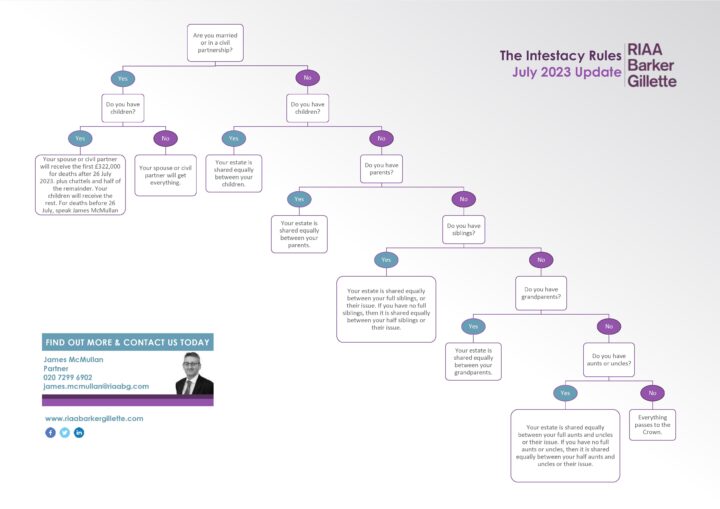
Infochart The Intestacy Rules 2023 Update

The deceased’s true wishes are often expressed in their will or a side letter which may be kept with it.

Is there a will?

It is important to check for a will by going through the deceased’s personal papers, making enquiries with their bank, building society, or family solicitor and/or carrying out a search of the National Wills Register to see if there is a valid will. We can, of course, do this for you.

If there is a valid will, it will confirm the executors’ details and how the estate should be distributed and may confirm any funeral directions. If no will can be found, the deceased’s estate will be distributed in accordance with the Intestacy Rules, which are not always as straightforward as one would think.

The estate

Once the PRs have been identified and have agreed to act, they will need to uncover all of the details of the estate (all of the deceased’s assets and debts). This will involve gathering up their papers and providing the details of any assets (bank account statements, pension fund details, savings and investments, life insurance etc.) and any debts (mortgages, loans, HP agreements, etc.). The PRs must notify the deceased’s bank and any other financial institutions of the death.

  • Bank accounts: If a bank account is in the deceased’s sole name, the account will be frozen. If a joint account, the deceased’s name will be removed from the account, and the survivor will usually be entitled to the funds in that account.
  • Funeral expenses: The PRs will usually incur the costs of making the funeral arrangements. Such expenses, provided they are reasonable in relation to the deceased status in life and the size of his estate, will be deducted from the estate before other unsecured debts. Although the deceased’s bank accounts may be frozen, this is one instance where the banks are permitted to release funds to pay the funeral directors directly.
  • Administration of the estate: Once the funeral has taken place, the PRs should progress the administration of the estate and implement the wishes of the will (or process the estate in accordance with the Intestacy Rules).
  • Now, the difficult bit… Inheritance Tax: If Inheritance Tax is payable on the estate (any estate worth over £325,000 (but subject to other exemptions and reliefs that may be available), a complete and accurate Inheritance Tax account should be prepared and lodged with HM Revenue & Customs as soon as possible. This is usually the most difficult part of the process. The Inheritance Tax account must be completely accurate. HM Revenue & Customs are now levying penalties against PRs where care has not been taken to provide an accurate Inheritance Tax account. Interest starts to run on the Inheritance Tax liability six months after the end of the month of death, so the clock is ticking.

Rest assured, we draft, advise on and assist with Inheritance Tax accounts as part of our service.

James McMullan, Head of Private Client, RIAA Barker Gillette (UK) LLP

All told, the probate process contains many traps and pitfalls. In all but the most straightforward of cases, you should consider taking advice from a solicitor.

For more information, contact James McMullan today.

Note: This article is not legal advice; it provides information of general interest about current legal issues.

Intestacy Rules QR Code for online interative quiz

Stay in touch

Subscribe to our newsletter

Stay in touch

By completing your details and submitting this form you confirm you are happy for us to send you marketing communications and that you agree to our Website Privacy Policy and Legal Notice and to us using Mailchimp to process your data.


Sending

News/Insight

  • Renters’ Rights Act: why process and paperwork matter more than ever for landlords
    The Renters’ Rights Act has now passed into law, marking one of the most significant shifts in the private rented sector in a generation. Most of the new measures will take effect in May 2026, with a national landlord database to follow later in th


    Read more
  • Understanding the Roles of Executors and Trustees
    When making a will, you place significant trust in those appointed to carry out your wishes. Executors and trustees are key roles, often held by the same people, but their responsibilities differ. Understanding these roles and their obligations helps


    Read more
  • Assigning or Subletting a Commercial Lease: What Tenants Need to Know
    This article explains the key differences between assignment and subletting, outlines the legal framework in England and Wales, and highlights the practical issues tenants should consider before taking action.


    Read more
  • Completion and post-completion steps in a sale: Final steps for sellers
    A guide to completion and post completion steps in a corporate sale including exchange, stamp duty, Companies House filings and key administrative requirements.


    Read more
  • How to protect your brand: A beginner’s guide
    Trademark protection for businesses explained, including how to register a trademark in England and Wales and the key steps to protect your brand.


    Read more

What they say...

  • Paul Woodman, March 2026
    Will writing “Excellent service from start to finish. Efficient and good value. Charlotte was very professional, knowledgeable and understanding.”

  • Client, March 2026
    Great Service “Contacted RIAA to update my will and other things. Charlotte and James provided an efficient, friendly service, and the process was dealt with quickly. Much appreciated.”

  • Client, March 2026
    Expert knowledge and support “Pippa was invaluable in her insight, knowledge, and support. Through what is a very difficult time, she gave me hope that there is something to be done. Very solutions-oriented!”

  • Eve, March 2026
    Professional, compassionate and seamless legal support “I would like to express my sincere gratitude to Charlotte, Solicitor at RIAA Barker Gillette (UK) LLP, for the outstanding support she provided to my father during the creation of his will

  • Laura Kelly, February 2026
    Review of legal guidance received “I recently worked with Patrick Simpson on my settlement agreement. Patrick guided me through every stage with exceptional care and diligence. He kept the process moving efficiently, always updating me promptly

Read more