
Seven things to consider before you let through Airbnb

Sub-letting

Your lease will more than likely have tenant covenants restricting sub-letting and requiring you to use the property as a dwelling house only (i.e. not for trade or business). Letting space out through Airbnb will likely put you in breach of these covenants.

In the 2016 case of Nemcova v Fairfield Rents Ltd, the lease contained a tenant covenant not to use the flat other than as “a private residence”.

The tenant granted a series of short-term lettings of days and weeks and the Upper Tribunal held that the user covenant had been breached.

There needed to be a degree of permanence for the use to be considered as an occupier’s private residence, and that could not be demonstrated by an occupier residing for just a weekend or a few nights during the week.

The Upper Tribunal made it clear that the interpretation of each case will depend on the individual facts and covenants.

Nuisance

There is likely to be a tenant covenant not to cause any nuisance. Frequently different occupiers coming in late at night, making noise and, in the case of secured blocks, having access to common areas and creating security concerns could well put you in breach.

Breach of these covenants could result in your landlord seeking forfeiture of your lease. However, it would seem unlikely that a Court would not grant relief from forfeiture if you ended the Airbnb rentals, although you may end up with a large legal bill as a result.

Mortgages

If your property is mortgaged, the mortgage will likely have a condition requiring the lender’s consent if you want to let out part or whole. There may also be a condition requiring you to occupy the property as your only principal home to qualify for the interest rate you are paying (failing which you should be paying a higher rate).

Be aware that a breach of the mortgage conditions could result in your lender seeking repayment of the loan and possessing your home.

Buildings and contents insurance

If damage occurs when the property is let out through Airbnb, and you haven’t disclosed what you’re doing or obtained the insurer’s consent, your insurer will likely resist paying out.

Planning

Restrictions have been relaxed for properties in London. Letting out space through Airbnb could be considered a material change of use. However, the Deregulation Act 2015 contains a provision allowing a property to be let as temporary sleeping accommodation for up to 90 days each year (although you should check that your London Borough has not disapplied this provision).

Airbnb, in fact, now won’t allow you to let out for more than 90 days a year unless you confirm you have obtained consent from your London Borough.

The Tax Man

You should check with HMRC the relevant thresholds that apply to you. You may not be required to declare or pay tax for a certain amount of property-related income and may be entitled to a certain amount of income tax relief.

Gas safety certificates

You must obtain one annually.

For further advice, please contact John Gillette.

Note: This is not legal advice; it provides information of general interest about current legal issues.


What is a SOSR dismissal?

There are five potentially fair reasons for the dismissal of any employee under the Employment Rights Act 1996 (ERA 1996):

  1. Conduct
  2. Capability
  3. Redundancy
  4. Breach of a statutory restriction
  5. Some other substantial reason of a kind to justify the dismissal (SOSR)

SOSR is a residual “catch-all” potentially fair reason for dismissal. Whilst there is no statutory definition of the term or any statutory guidance, case law has made it clear that the reason must be substantial.

Interpretation of what is substantial is subjective and will depend on the facts and the type of case. The reason must also be of a kind which will justify the dismissal (rather than any lesser sanction) of an employee holding the job the employee actually held.

Common examples of scenarios that may constitute an SOSR dismissal

Protection from competition

Where an employee acts in a way that falls short of a breach of duty or is in a situation that creates a potential conflict with the employer’s interests, the employer may be able to dismiss the employee by relying on SOSR.

The most common types of cases in this category relate to conflict of interest or restrictive covenants.

Cases involving conflicts of interest

To be able to succeed in relying on the risk of competition as being SOSR, the employer must be able to provide evidence to substantiate its perception that the employee poses a risk to its business interests. The evidence will be as to the nature of the information to which the employee has access.

If an employee has limited access to commercial information, an employer will struggle to show that it was concerned about a risk at all. It is also usually necessary to show that the employee has close connections to a competitor (or an employee of a competitor) and that the employer fears the employee may leak confidential information.

To establish an SOSR dismissal, in these circumstances, the employer must show that continuing to employ the employee would give rise to a real commercial risk.

Cases involving restrictive covenants

The scope of any restrictive covenant will have a bearing on whether an employer can rely on it for an SOSR dismissal. Case law has established dismissal following a refusal to enter new restrictive covenants, which was found to be for SOSR and potentially fair.

Personality clashes

Personality clashes or irreconcilable differences between colleagues can amount to SOSR. However, the conflict would have to cause a substantial disruption to the business.

Other examples

  • The non-renewal of the fixed-term contract of an employee recruited as maternity leave cover.
  • The dismissal of an employee for a theft conviction unconnected with his employment.
  • The dismissal and re-engagement of an employee to impose new contractual terms and conditions that the employee has refused to agree to.

The two-stage test for any dismissal will apply notwithstanding the potentially fair reason for the dismissal.

Having identified circumstances giving rise to an SOSR dismissal, the employer must ensure that it follows a fair procedure and acts reasonably in dismissing the employee for that reason, taking into account all the circumstances.

Confused about SOSR dismissals? Call employment partner Karen Cole today to clarify the position.

Note: This article is not legal advice; it provides information of general interest about current legal issues.

Zero-hours contracts: many questions

A zero-hours contract describes casual working arrangements between an employer and an individual. Generally, the hours to be worked are left (deliberately) undefined. An employer is not obligated to provide any work and will pay only for work undertaken.

How do zero-hours contracts apply to workers and employees?

Such contracts are used for people classed as both ‘workers’ and ‘employees’. However, there has been debate over whether zero-hours contracts may exploit workers. So, to explore how the contracts can be used fairly, it’s worth explaining the difference between the two. Both categories are entitled to:

  • the national minimum wage
  • paid annual leave and rest breaks
  • protection from discrimination

Employees are also entitled to employment rights such as statutory sick pay and family-friendly rights such as statutory maternity and paternity leave and pay. Perhaps crucial for most employees is the right not to be unfairly dismissed.

Workers do not have these rights – but could gain them if the way their employer treats them enhances their status to that of an employee. This could include being provided with regular working hours or carrying out a disciplinary procedure concerning the worker. For this reason, zero-hours contracts are often used to maintain the worker’s employment status.

“ZERO-HOURS EMPLOYEES AND WORKERS HAVE THE RIGHT NOT TO BE DISCRIMINATED AGAINST FOR TAKING OTHER WORK”

Why are zero-hours contracts seen as exploitative?

Regarding zero-hours contracts, debates over exploitation usually focus on those which include a clause preventing workers from accepting work from anyone else during the contract’s life. Moreover, many workers are unaware of their statutory rights under the contract. This has understandably attracted much criticism.

To make things fairer for workers, in January 2016, The Employment Rights Act 1996 was amended to render exclusivity clauses unenforceable. In addition, the Exclusivity Terms in zero-hours Contracts (Redress) Regulations 2015 has provided individuals with a remedy against employers who seek to include an exclusivity clause in a contract:

  • zero-hours employees and workers have the right not to be discriminated against for taking other work;
  • zero-hours employees have the right not to be unfairly dismissed if they don’t comply with an exclusivity clause.

But despite these steps, zero-hours contracts remain under scrutiny. For example, a report published by the Resolution Foundation at the end of 2016 suggests that workers on zero-hours contracts are £1,000 a year worse off than employees doing the same work. It estimated that zero-hours workers suffer a pay penalty of 6.6% which, when working 21 hours per week, amounts to £1,000 per year.

Are there any benefits?

The use of zero-hours contracts can benefit both parties if used fairly. They can provide a flexible workforce to meet a temporary or changeable need for staff and are particularly popular in the retail and hospitality industries. Public and voluntary sector organisations also make use of them. From a worker’s perspective, they can provide much-needed flexibility. They are recognised as giving young and older people work opportunities that might not otherwise exist.

“FROM A WORKER’S PERSPECTIVE, ZERO-HOURS CONTRACTS CAN PROVIDE MUCH NEEDED FLEXIBILITY”

How might zero-hours contracts be used in the future?

The Business, Energy and Industrial Strategy Committee has launched an inquiry focusing on the changing nature of work and the status and rights of agency workers, the self-employed, and those working in the gig economy. It will also consider the balance of benefits between workers and employers, flexible contracts and zero-hour contracts to explore what regulations might be needed in the future.

In short…

  • Zero-hours contracts can be used for employees and workers, but both have different rights
  • Government regulations have cracked down on exclusivity clauses to counter exploitation
  • The use of zero-hours and flexible contracts is likely to continue to rise

Speak to Karen Cole today if you have any queries about zero-hours contracts.

Note: This is not legal advice; it provides information of general interest about current legal issues.


Facing up to the social media challenge

When tweets become twibels…

The reminder follows the news that opinion columnist Katie Hopkins has been refused leave to appeal against a recent High Court libel verdict, where she was found to have published defamatory tweets, or what’s been coined ‘twibel’.

Anyone using social media is a publisher, putting information out into the public domain, but unlike newspapers and book publishers, most businesses don’t have a good understanding of publishing law and how to avoid breaching it. Similarly, many businesses are not considering how their social media posts may breach advertising regulations as the boundaries between paid-for advertising and other forms of communication become more blurred.

It’s the sort of confusion that led to a complaint being made that a tweet sent from the account of England football captain Wayne Rooney, as part of his sponsorship by Nike (UK), was not clearly marked as a marketing communication. The tweet read:

“The pitches change. The killer instinct doesn’t. Own the turf, anywhere. @NikeFootball #myground pic.twitter.com/22jrPwdgC1”.

Although in that case, the Advertising Standards Authority found that Nike (UK) had not breached the code of conduct, saying the tweet was obviously identifiable as a Nike marketing communication, it may not always be clear to businesses where the line is drawn.

For Katie Hopkins, the tweets she posted that were found to be defamatory implied that prominent poverty campaigner and writer Jack Monroe had defaced a war memorial in a case of mistaken identity. Monroe offered her the chance to publicly apologise or face legal action, but Hopkins refused. When the case reached the High Court, the tweets were found to have caused ‘serious’ harm to Monroe’s reputation. Hopkins must pay damages of £24,000 to Monroe, together with Monroe’s legal costs.
In reaching the judgment, the court had to determine whether the tweets met the requirement for harm that is set out in the Defamation Act 2013, and experts say the ruling is the most important case to date involving libel on social media.

Our employment lawyer, Karen Cole, said:

“Controlling social media content is a huge issue for business. It’s a fast-moving arena and often posts, tweets, retweets and comments are the subject of instant decision-making. When careful reflection isn’t part of the equation, it’s not surprising that it can lead to problems. It is important that social media policies are kept under constant review and that everyone understands the boundaries they are operating within, through both the company’s marketing strategy and their terms of employment.

“Staff could also learn from the 26-point guide [page 25 onwards] on how to use Twitter, published by the High Court as an appendix to its official ruling in the Hopkins case, which provides a summary of how the platform works. It makes for useful reading, even for those who think themselves experts, as a reminder of who will receive postings when tweeting, re-tweeting or replying.”

Karen added:

“It’s important to have a good crisis management plan in place as well, so that if the worst happens and a mistake is made, then everyone knows what to do if something inappropriate has been posted. Taking swift action with a public retraction is a good start and will demonstrate a willingness to tackle the problem. In the case of Katie Hopkins and her mistaken tweet about Jack Monroe, if she had been quick to correct herself and made a public apology that reached the original audience of her tweets, it’s quite likely the case would not have passed the necessary ‘serious harm’ test for defamation and the case may never have gone to court.”

Speak to Karen Cole about your social media policy today.

Note: This article is not legal advice; it provides information of general interest about current legal issues.


Publication of Employment Tribunal Judgments

Prior to the launch of the new Ministry of Justice (MOJ)’s website, Welsh and English ET decisions were found in the Bury St Edmunds ET, and Scottish decisions were found in the Glasgow ET. Decisions were only accessible upon request and were subject to a fee, which was at odds with the civil courts and the Employment Appeal Tribunal, where judgments were and are available to the public. This discrepancy caused concern, and in the interests of access to justice, the MOJ launched its new website, making all British ET decisions publicly available.

The MOJ’s website currently contains some 200 decisions from 2015 onwards, with future ET decisions being uploaded to the website.

The way in which ET proceedings are dealt with has not changed, with hearings usually being heard in public unless an ET makes an order for privacy restrictions.

There could well be a practical impact for employers because of the increased accessibility of the decisions.

The MOJ’s website includes a search tool, enabling the user to search the content of the ET decisions. This means that a member of the public can search against the name of an employer, employee or any term that may be industry specific. In due course, the content of decisions may be listed on the results page of internet search engines when an employer’s name is simply entered in the search bar.

This development may well cause concern for some employers. The risks of adverse publicity have always been factored in the decision-making process when pursuing/defending a claim. However, more weight will need to be given to the subject. Such consideration may encourage the early settlement of employment disputes.

Employees bringing a claim could try to draw inferences about the business from previous decisions. These have the potential to be taken out of context. Written reasons are not always given in ET decisions, giving rise to only a partial view if a judgment is viewed in that instance.

There is always a flip side…

Employers can now search for any decisions involving applicants or employees. However, care must be taken to ensure employers do not fall foul of giving detrimental treatment because of the search. The laws protecting individuals from acts of discrimination do not stop at just employees.

Increased transparency in ET decisions should also give useful examples of how ETs treat issues of fact and law. This could prove particularly useful to those acting in person to clearly present their case to the ET, making it easier for employers to respond.

ET decisions will also include details of the sum awarded in claims which should help to encourage realistic expectations for settlement purposes.

Call Karen Cole today if you have any queries regarding Employment Tribunal Decisions.

Note: This is not legal advice; it is intended to provide information of general interest about current legal issues.


Employers to pay apprenticeship levy

The apprenticeship levy will require all UK employers, in both the private and public sectors (with annual wage bills of more than £3m – including bonus and commission payments), to pay 0.5% of their annual wage bill towards the cost of apprenticeship training.

This cost cannot be passed onto the employee. However, because of the wage bill eligibility criteria, most employers will not have to pay any levy. It will continue to have government support to pay for apprenticeship training.

The levy itself is designed to fund new apprenticeships and replaces the current system whereby employers choose and pay for the apprenticeship training they want.

It aims to increase economic productivity by investing in human capital and allowing individuals to pursue a career they may not have otherwise.

The government expects that the levy will lead to increased growth and profitability for businesses and increase wages in the long term.

The levy is due to come into force in April 2017.

Employers starting an apprentice before April 2017 will receive funding under the current system. That funding will continue for the duration of the apprenticeship.

The reforms are intended to simplify some of the current complex arrangements for apprenticeships and make it easier for employers to select the apprenticeship training they want to purchase.

Each year employers will have a levy allowance of £15k. However, connected companies will only have £15k to share between them, for example, a parent company and its subsidiaries.

This is similar to the existing Employment Allowance connected persons’ rule and paid through the PAYE system. Employers already contributing to an industry-wide training levy (such as the Construction Industry Training Board Levy, the “CITB”) don’t get off the hook and will still pay a levy.

Once employers have paid the levy, they can access apprenticeship funding through a new service account. Funds in the account will pay for apprenticeship training and assessment with an approved provider/assessment organisation, and the government will top this amount up by 10%. Note: that if funds are not utilised within 24 months, they will expire.

Employers must retain all records relating to the levy calculation for at least three years.

Provisions have been put in place for assessments to be carried out by HMRC. Suppose HMRC becomes aware that the apprenticeship levy has been underpaid or that an excessive amount has been repaid. In that case, they can assess and collect the estimated amount due for one or more tax periods in a tax year. HMRC may assess the whole of the apprenticeship levy or one or more named employees.

The government has published useful guidance on how apprenticeship funding for employers will work, including details of funding bands and the apprenticeship levy at the gov.uk website.

Call Karen Cole today if you have Apprenticeship Levy queries.

Note: This is not legal advice; it is intended to provide information of general interest about current legal issues.


Unmarried couples need to protect themselves

A landmark victory in the Supreme Court has seen a Northern Ireland woman win a share of her former partner’s pension, with commentators saying it’s likely to add impetus to the drive for greater rights for unmarried couples. But, in the meantime, cohabitees should face up and formalise arrangements rather than keeping their fingers crossed.

The victory of Denise Brewster involved her claim for a survivor’s pension after her long-term, live-in partner Lenny McMullan died suddenly, shortly after they had become engaged. He had paid into Northern Ireland’s local government pension scheme but had not completed the necessary form to nominate a cohabiting partner for a survivor’s pension. Denise Brewster took legal action to claim the pension, and when her case reached the Supreme Court, the judges ruled that refusing to pay her was unlawful.

Such difficulties play out all too often for cohabiting couples, whether in relation to shared property or what happens to their assets when they divorce or die. Many still believe in the idea of so-called ‘common law marriage’, assuming they have legal rights like married couples or civil partners on death, only to discover the harsh truth when problems arise.

Currently, securing protection requires action to be taken by the couple if they wish to ensure that the interests of both parties are protected in case of death, separation or other life changes.

Family lawyer Pippa Marshall said:

“It may seem unfair, but cohabiting couples do not have the protection that comes with marriage or civil partnership. There are three main areas where couples should look to protect themselves, and each other, and that’s with a cohabitation agreement, formalising how property is owned and each making a will. These all help to avoid uncertainty and come into their own if the worst happens.”

Making a Will

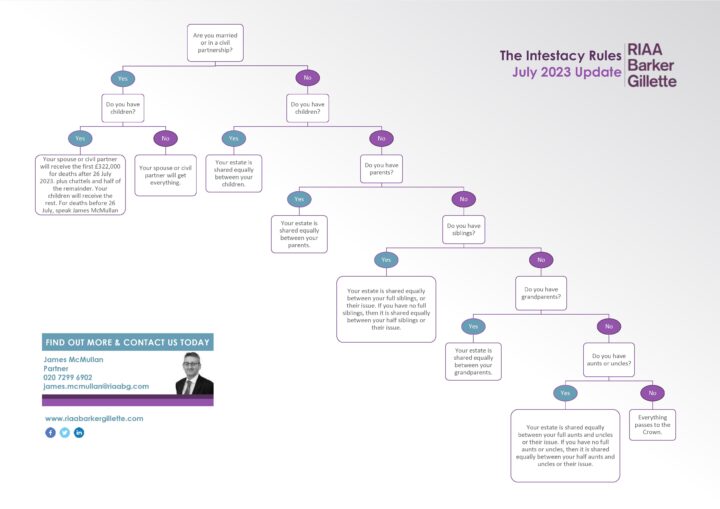
Head of Private Client, James McMullan, explains that without a valid Will, the Intestacy Rules will decide the division of assets belonging to a cohabitee. Under these rules, a cohabiting partner will not be included. Typically, the whole of their estate would go to children, or if they have none, to parents or other family members.

Infochart The Intestacy Rules 2023 Update

Although the surviving cohabitee could apply for “reasonable financial provision” under the Inheritance (Provision for Family and Dependants) Act 1975, this option would be very slow and potentially expensive. In the meantime, they may be blocked from living in the couple’s home if it is not held in shared ownership.

Inheritance Tax

Writing a Will is also a good time for couples to consider inheritance tax implications, as they will not benefit from the exemption given to gifts between spouses and civil partners. Also, unlike a married couple or civil partners, the first-to-die’s nil rate band cannot be transferred to the survivor.

Property Ownership

Regarding property ownership, our property partner reiterated that if a couple buys a property together or agrees, one has become entitled to a share. Ownership must be structured to reflect this and the intentions of each upon death. Such ownership must be formally documented and ideally recorded at the Land Registry. If the property is owned as ‘joint tenants’, there are two consequences:

  1. the couple is electing not to own separately defined shares in the property, and if anything is done to bring the joint ownership to an end, the couple will own the property in equal shares.
  2. Upon the death of one, the whole property will pass automatically to the other regardless of the intestacy rules or any Will.

If a property is owned as tenants in common, then each will own a specific share – which can be in any proportions, by any agreed calculation – and each is free to choose what will happen to their share of the property on death. This aspect should also be considered when a Will is written, as someone may wish to leave their share to children, but with the survivor having the right to continue living in the house until their death or relocation.

Cohabitation Agreements

Cohabitation Agreements are formal agreements outlining what will happen if a couple separates. Cohabitation agreements can also set out day-to-day matters, such as who is responsible for household expenditure and in what proportions. As well as helping to settle disputes when a relationship ends, by referring to the original intention, it can be useful to clarify matters before a couple moves in together by encouraging discussion and agreement over the details.

Cohabitation Agreements should be drawn as a deed, independently witnessed. For instance, both parties should demonstrate there was no duress by seeking independent legal advice. A cohabitation agreement may be set aside or varied by the courts if the circumstances change, for example, if the couple has children, so it is important to review what has been put in place regularly.

Speak to Pippa Marshall for more information on how unmarried couples can protect themselves.

Note: This is not legal advice; it provides information of general interest about current legal issues.

Intestacy Rules QR Code for online interative quiz

Employment Law Basics

Always err on the side of caution, and when in doubt, consult a qualified lawyer before taking any action. See employment solicitor Karen Cole’s list of Employment law basics:

  1. Provide written employment contracts to all employees (tailor them to levels of seniority) and ensure your policies and procedures are contained in a staff handbook. Make sure both are regularly reviewed.
  2. Have a social media policy with clear guidelines regarding what you consider acceptable behaviour regarding usage and content. Make it clear that unacceptable use of social media (whether professional or personal) could result in disciplinary action.
  3. Proactively manage sickness absence. Keep detailed absence records and conduct return-to-work interviews after any period of absence. Consider whether the employee may be disabled.
  4. Keep up to date with changes in employment law. You can regularly check the Advisory, Conciliation & Arbitration Service (ACAS) website.
  5. Never hold a meeting with an employee (for whatever reason) without taking detailed conversation notes. Keep written records of any personnel matter.
  6. Ensure employee appraisals/reviews are carried out and that they are accurate. It is easy to avoid difficult conversations about poor performance, but this only creates problems down the line. A fair performance management procedure should be implemented, and should it become necessary, it will assist with dismissal procedures further down the line.
  7. Follow the ACAS Code of Practice on Disciplinary and Grievance Procedures, again found on the ACAS website. Any compensatory award made against you by the Employment Tribunal could be increased by 25% if you do not.
  8. Understand what discrimination means and how to avoid it. Appreciate that this does not just apply to employees. Be aware of actions throughout the recruitment process and that you could be held responsible for the actions of third parties.
  9. Do not initiate a without prejudice discussion or protected conversation with any employee without taking legal advice first.
  10. Always seek legal advice if you are unsure. The right legal advice at the right time could prevent a hefty legal bill.

Call Karen Cole today to find out how the employment law basics apply to you.

Note: This is not legal advice; it provides information of general interest about current legal issues.


Brand protection and your business

At the start of a venture, small business owners tend to focus on raising finance and securing clients in order to establish and grow their business. What is often not in such sharp focus is the intellectual property which arises out of the branding of the business: the name of a restaurant or a clothing label, for example. But brand protection is paramount.

This is understandable. At the outset, a business may have limited branding, and any intellectual property is likely to be of little material value, but business owners need to be aware that there are risks to this approach, which can have severe consequences once the business develops.

Protect your brand from the start

Put simply, if you do not protect the branding of your business, you risk competitors branding their business in a similar fashion, drawing away your clients and profits.

Successful businesses require a unique, established and recognisable brand and in order to achieve this, the necessary protection needs to be put in place. If your business is unable to deliver this, it could face real problems.

Imagine this scenario: you work tirelessly on your business for five years. You establish a client base and develop a recognisable brand only to find out that one of your competitors is using aspects of your branding to appeal to your customers. Not only could it be difficult to enforce your rights without any registered protection in place, the competitor could even have the ability to stop you from marketing your business in the way you want.

Trademarks

One way to protect against this is to register a trademark, which grants the holder the statutory right to use the mark exclusively in connection with the goods or services it is registered for. Trademarks prevent others from using identical or similar marks and shield your business from competitors seeking to imitate or reproduce your goods or services.

Trademark protection is most commonly applied to trading names, slogans, and logos. For example, the brand name Tesco and its slogan “Every Little Helps” and Nike with its “Swoosh” logo. The mere mention of those marks illustrates the point that businesses become synonymous with their trademarks.

Putting protection in place

Clearance searches

Before making an application to register a trademark, it is vital to undertake clearance searches to ensure no other marks may be infringed.

The process is made slightly more complex in that registered and unregistered trademarks may exist. This means that whilst some marks may be easily found on the Intellectual Property Office’s (IPO) database, other marks will be harder to find, meaning that all searches should be wide-ranging and should be undertaken with a high degree of care and attention.

If done properly, this process can yield unintended benefits, particularly when existing marks that are identical or similar to your own are found. Whilst this may be frustrating, it allows you to tweak the branding of your business, meaning that registration and protection are possible, and an expensive rebrand is not required at a later date under the threat of a third-party claim.

The simple act of undertaking searches early on can give your business a great head start.

Application

Once clearance searches have been performed, the trade mark registration application must be made to the IPO and assigned to a certain class.

There are 45 classes in total, each accounting for a particular sector in which goods and services are provided. It is important that your mark is classified appropriately, as this process will determine the extent of the protection afforded to the mark.

An application for protection in one class costs either the basic fee of £170 (plus £50 for each additional class) as a flat fee or the right start fee of £100 (plus £25 for each additional class) as an initial payment for the application to be reviewed by an IPO examiner, plus an additional fee of £100 (plus £25 for each additional class) should the applicant decide to proceed in light of the examiner’s report.

Post application

Once the application has been made, the IPO will provide an examination report within 20 days in which they can object to the application and provide an overview of any defects which the prospective mark may have. For example, a defect could be that the mark is too generic or that the mark is too similar to an existing mark.

You should seek legal advice throughout this period to ensure money is not wasted on unsuccessful applications.

The application can progress to the next stage if the IPO has no objections.

Publication

The application must be published in the trademarks journal two months before registration, during which time it can be opposed. The mark will be registered if no objections are raised during this period. If objections are raised, the party in opposition can issue one of two responses to the application:

  1. Threatened response: In this case, the two-month period is extended by one month, and the parties negotiate on the registration of the mark. This negotiation can take many forms and could involve the opposing party asking the applicant to reduce the scope of the application. If negotiations are unsuccessful, the opposing party would need to decide whether to make a formal opposition.
  2. Formal opposition: The opposing party formally opposes the application. Both parties would make representations to the independent body presiding over the dispute. It is more than likely that both parties would incur costs, and if the applicant loses, they may well be liable for their opponent’s fees.

Registration

If no objections are raised (or any objections raised are successfully resolved), the mark can proceed to the next stage and become formally registered.

The registration of the mark lasts for ten years and can be renewed for further periods of ten years (subject to the payment of renewal fees).

From the point of registration onwards, the proprietor gains a valuable and exploitable commercial asset. The business’ branding becomes much easier to protect, and a deterrent is put in place to prevent third parties from exploiting the goodwill of the business and potentially drawing customers away.

Speak to Victoria Holland today about Brand Protection.

Note: This article is not legal advice; it provides information of general interest about current legal issues.


What is General Data Protection Regulation?

The General Data Protection Regulation will apply in the UK from 25 May 2018. This is a significant change in data protection law, and businesses will need to invest time in preparing for the changes.

Given Brexit, do you still need to prepare for compliance with the GDPR?

Yes. The government has confirmed that the UK’s decision to leave the EU will not affect the commencement of the General Data Protection Regulation.

To avoid being classified as inadequate in terms of the level of protection given to personal data, the UK must offer data protection standards that comply with EU requirements. A company outside the EU with operations in the EU must also comply.

The short answer is no.

Under the General Data Protection Regulation, consent must be given:

  • freely, i.e. not as part of the employment contract;
  • actively, i.e. not simply ‘by default’; and
  • it must be as easy to withdraw as to give.

As an employee cannot usually reject a clause in their employment contract, it is not (for GDPR purposes) considered to be ‘freely given’. Therefore, silence, pre-ticked boxes or inactivity cannot constitute consent as these do not allow the employee to say no to an aspect of the proposed processing.

However, the General Data Protection Regulation does allow employers to rely on alternative valid bases for processing personal data (other than just employee consent). For example, where an employer needs to process personal data to operate the payroll or the sick pay system. Employers can rely on the justification that such processing must happen for the employer to perform the employment contract.

How will the GDPR change the rules regarding subject access requests?

A subject access request is a written request made by or on an individual’s behalf for the information he or she is entitled to ask for under section 7 of the Data Protection Act 1998.

In standard cases, the current 40-day time limit for responding to subject access requests will be reduced to one month, and the £10 fee will be revoked.

In complex cases, the one-month timeframe can be extended by a further two months, and provision will be made for a fee to be charged if the request is clearly unfounded or excessive.

The General Data Protection Regulation will extend the right of access to personal data. Employees will be entitled to more information about how their data is handled, who has access to it, how long it is held, etc. Therefore, employers should ensure that anyone appointed to handle subject access requests has received up-to-date training.

What steps should employers take to prepare for the GDPR coming into force?

The General Data Protection Regulation affects the whole of the business, but from an HR angle, we would suggest the following steps are taken as part of the overall business preparations:

Audit HR data and data processes

Now is the time to assess what data is held by HR and how it is processed (who it is shared with and why?).

What data protection policies and procedures do you currently have, and are these working?

Are there any risk areas that need attention before the General Data Protection Regulation comes into force?

Audit your third-party processors

The General Data Protection Regulation increases employers’ obligations to ensure that their third-party data processors comply with data protection laws. The obvious ones here include external payroll providers and occupational health assessors.

You need to make sure that your contractual terms require third parties to comply with data protection laws in processing personal data about your workforce.

You should consider what steps you take to vet and check external service providers for compliance both prior to and during their appointment.

Ensure staff are trained appropriately

General data protection training is as important as ever. Those with specific data processing responsibilities should be given additional tailored training.

Move away from relying solely on employee consent to justify business-critical data processing.

Do you need to appoint a data protection officer?

The GDPR requires companies whose core activities consist of processing operations that require regular and systematic monitoring of data subjects on a large scale to appoint a data protection officer. This person must have expert knowledge of data protection law and practices, and their job will be to monitor internal compliance with the GDPR. Businesses that do not fall into this category may still wish to appoint someone to monitor data processing and keep a check on compliance.

If you’re concerned about the General Data Protection Regulation, speak to Karen Cole today.

Note: This article is not legal advice; it provides information of general interest about current legal issues.


Stay in touch

Subscribe to our newsletter

Stay in touch

By completing your details and submitting this form you confirm you are happy for us to send you marketing communications and that you agree to our Website Privacy Policy and Legal Notice and to us using Mailchimp to process your data.


Sending

News/Insight

  • Renters’ Rights Act: why process and paperwork matter more than ever for landlords
    The Renters’ Rights Act has now passed into law, marking one of the most significant shifts in the private rented sector in a generation. Most of the new measures will take effect in May 2026, with a national landlord database to follow later in th


    Read more
  • Understanding the Roles of Executors and Trustees
    When making a will, you place significant trust in those appointed to carry out your wishes. Executors and trustees are key roles, often held by the same people, but their responsibilities differ. Understanding these roles and their obligations helps


    Read more
  • Assigning or Subletting a Commercial Lease: What Tenants Need to Know
    This article explains the key differences between assignment and subletting, outlines the legal framework in England and Wales, and highlights the practical issues tenants should consider before taking action.


    Read more
  • Completion and post-completion steps in a sale: Final steps for sellers
    A guide to completion and post completion steps in a corporate sale including exchange, stamp duty, Companies House filings and key administrative requirements.


    Read more
  • How to protect your brand: A beginner’s guide
    Trademark protection for businesses explained, including how to register a trademark in England and Wales and the key steps to protect your brand.


    Read more

What they say...

  • Paul Woodman, March 2026
    Will writing “Excellent service from start to finish. Efficient and good value. Charlotte was very professional, knowledgeable and understanding.”

  • Client, March 2026
    Great Service “Contacted RIAA to update my will and other things. Charlotte and James provided an efficient, friendly service, and the process was dealt with quickly. Much appreciated.”

  • Client, March 2026
    Expert knowledge and support “Pippa was invaluable in her insight, knowledge, and support. Through what is a very difficult time, she gave me hope that there is something to be done. Very solutions-oriented!”

  • Eve, March 2026
    Professional, compassionate and seamless legal support “I would like to express my sincere gratitude to Charlotte, Solicitor at RIAA Barker Gillette (UK) LLP, for the outstanding support she provided to my father during the creation of his will

  • Laura Kelly, February 2026
    Review of legal guidance received “I recently worked with Patrick Simpson on my settlement agreement. Patrick guided me through every stage with exceptional care and diligence. He kept the process moving efficiently, always updating me promptly

Read more