
News story

August 1, 2023

The Intestacy Rules

In July 2023, the statutory legacy due to a surviving spouse or civil partner under the Intestacy Rules increased from £270,000 to £322,000.

What is a statutory legacy?

Under the Intestacy Rules, the statutory legacy is a fixed sum that the intestate’s surviving spouse or civil partner is entitled to, providing there is enough money in the estate and the intestate leaves behind no close family members such as children.

What are the Intestacy Rules?

The Intestacy Rules are the rules that govern how your estate will be distributed if you die without having made a will. However, the rules may not distribute your estate as you hope.

The rules of intestacy depend on your family tree, whether you are married or in a civil partnership, and whether you have any surviving family members at the time of your death. See our info-gram below.
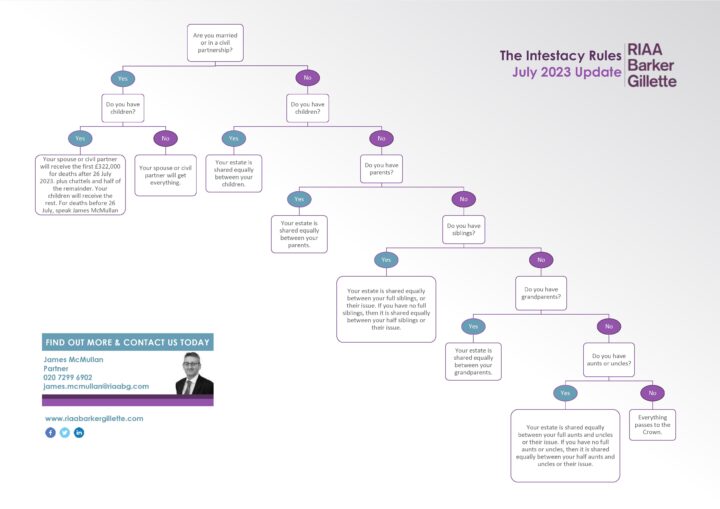
Infochart The Intestacy Rules 2023 Update

Is the text too small?

For a larger copy of the above image, please click here, or why not use our interactive online quiz instead?

What if I live with someone, but we’re not married?

Under the Intestacy Rules, unless you are married or have entered into a civil partnership, your partner will receive no part of your estate on your death; similarly, nor will your stepchildren. Instead, your unmarried partner would have to claim against your estate under the Inheritance (Provision for Family and Dependants) Act 1975, a costly and stressful process that usually leaves a trail of damaged familial relationships where no one is the winner except the lawyers.

Why make a will?

Having a will in place ensures that you make provisions for your preferred friends and family members. They also allow you to cater for unforeseen circumstances, including the possibility that a beneficiary may die before you. Read our article “The benefits of having a will” for more information.

If you’re still unsure about the Intestacy Rules or if you have a query about a death before 26 July, speak to private client partner James McMullan today.

Note: This article is not legal advice; it provides information of general interest about current legal issues.

Stay in touch

Subscribe to our newsletter

Stay in touch

By completing your details and submitting this form you confirm you are happy for us to send you marketing communications and that you agree to our Website Privacy Policy and Legal Notice and to us using Mailchimp to process your data.


Sending

News/Insight

  • Next equal pay appeal: when can market pressures justify different pay
    When can recruitment and retention pressures justify different pay? Karen Cole explores the Next equal pay appeal, explaining why equal pay risks remain and what employers should consider when reviewing pay packages and the evidence supporting their


    Read more
  • Domestic Abuse Protection Orders: where are they available and what other protection can you seek?
    Domestic Abuse Protection Orders can offer tailored protection, but availability is currently limited. Pippa Marshall explains how they work, who can apply and the other protective orders available, including non-molestation and occupation orders.


    Read more
  • Missing beneficiaries and unknown heirs: what should executors do?
    What should an executor do if someone entitled to inherit cannot be found? James McMullan explains how to trace missing beneficiaries, the limits of statutory notices and the options to consider before distributing an estate.


    Read more
  • Pay transparency in recruitment: Is your business ready to disclose salaries?
    Employers may eventually have to provide salary information much earlier in the recruitment process under proposals being considered by the Government.


    Read more
  • Pension inheritance tax changes will increase executors’ responsibilities from April 2027
    From 6 April 2027, most unused pension funds and pension death benefits will be included within the scope of Inheritance Tax. We explain what the changes mean for executors, why estate administration may become more complex and how careful planning c


    Read more

What they say...

  • Bryan E, September 2026
    Absolutely outstanding “This firm is super professional, efficient and friendly at the same time. You could not wish for a better service. I have used them for my Will and a range of other matters over many years. I’ve found all the vario

  • Jan Norris, September 2026
    Excellent Service “Charlotte Barbaroussis has prepared our wills, LPAs and a discretionary trust. She was professional, kind and patient throughout. A very fine person to have looking after us.”

  • Brian Nunan, August 2026
    “I dealt with the group for many years, and no matter which solicitor I used, the results were always the same. Excellent!”

  • Client, July 2026
    Constructive and empathetic “I contacted Pippa Marshall at RIAA Barker Gillette through a recommendation regarding a family law matter. Pippa was always clear, efficient, empathetic and helpful, offering constructive insights on my situation. I

  • Dino, July 2026
    A lucky professional meeting! “We had an excellent professional experience to recommend to all those who need legal help in the UK.”

Read more
Send this to a friend