
Suspension of rent because of a lockdown

The most common question has been, “Do I have to carry on paying my rent?” or conversely “Must my tenant still pay the rent?” Typically, the answer is yes. The rent is still payable, as nobody in the real estate world foresaw the lockdown.

Such has been its severity that lawyers will be expected to address the possibility of repetition in future lease negotiations.

For many years it has been customary in leases to stipulate that rent will be suspended and not payable if the property is damaged by fire or another insured risk. Note that a precursor to the usual relief application is physical damage or destruction of the bricks and mortar, and the virus has not caused such damage.

Tenants will likely try to negotiate the inclusion of wording which extends the suspension of rent to the period of any lockdown resulting from a future pandemic or similar event. Landlords may or may not resist successfully. The leap in mindset has already been done in respect of what lawyers commonly call ‘uninsured risks’, but this has been relatively easy to concede because of the rarity of its application. Fears regarding the virus have spilt over into fear of a second pandemic once the current one is over. It is likely to be regarded as a clear and present risk.

Landlords may look to offset the risk against insurance cover, as they do with a loss of rent insurance in case of damage by fire (mostly paid for by tenants).

Doubtless, insurers are already reflecting on new products and extensions to business interruption policies due to the pandemic. Press stories on the reliability of claims on such policies for the current virus leave one with the impression that the endeavours of the insurance industry may continue to exploit the fine line which sells policies but does not necessarily pay out on them.

Insurers have to make profits, and the hard truth may be that the effect of the pandemic is so huge that its widest effects are uninsurable. It falls to the government to be an insurer of last resort (a role that it undertook as a reaction and not by design regarding COVID-19). It may not be beyond the limits of the insurance industry to develop a loss of rent policy for the real estate world, which complements a clause for suspension of rent in case of a pandemic lockdown. Time will tell.

What will become normal practice, in respect of the sharing or bearing of risk between landlord and tenants for rent payment for properties that are not useable because of the pandemic lockdown, is uncertain. It will surely be the subject of active discussion in future lease negotiations.

Call John Gillette today if you have a question about the terms of your lease of commercial premises or any future lease.

Note: This is not legal advice; it provides information of general interest about current legal issues.

Make your will the top of your list

This global pandemic may be a major life event for everyone and something we will discuss in years to come. It may change our approach to many aspects of our lives.

The Law Society has reported that many people have used this time to create or update their wills. However, many people in the UK still do not have a will, and with most hospital visitation rights being suspended, should you fall fatally ill, a last-minute will may not be possible.

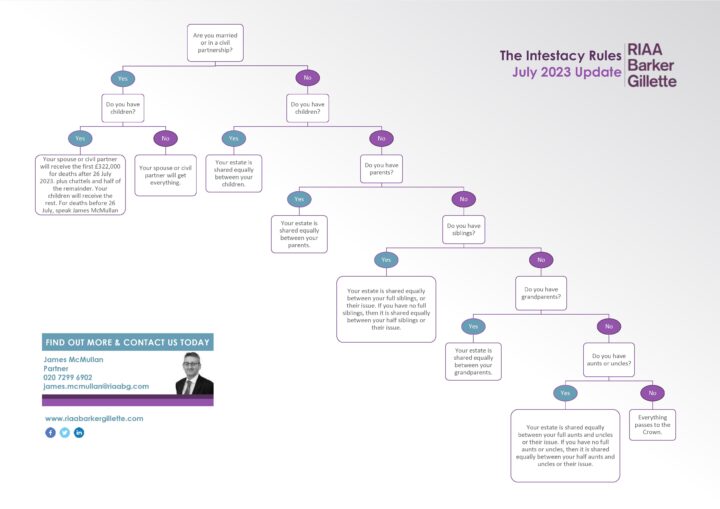
If you do not have a will, your estate (all the assets you own at the date of your death) are distributed in accordance with the Intestacy Rules. Here you can find a useful flow chart to see where your assets will go under the Intestacy Rules.

If the Intestacy Rules do not distribute your assets as you would like, you must create a will. This will give both you and your loved ones peace of mind. Losing a loved one can be difficult enough. A will helps provide your loved ones with security and assurance that they will be supported even after you are gone.

Beyond distributing your assets, you can appoint guardians for your children or even create a trust fund for minor children or a disabled member of your family to ensure they receive the support they need after you have gone – this can even include your pets! We can ensure that your will is tax-efficient, using all available reliefs and allowances from inheritance tax.

Call private client partner James McMullan today.

Note: This is not legal advice; it provides information of general interest about current legal issues.


Relying on legal advice can provide a defence

In the recent Court of Appeal case David Allen t/a David Allen Chartered Accountants v Dodd & Co Limited, Dodd & Co escaped liability for inducing a breach of contract because they had sought legal advice on their intentions before acting which provided them with a defence. They successfully demonstrated that they had honestly relied upon the legal advice they were given, even though that advice was incorrect.

Facts

Mr Pollock worked at David Allen Chartered Accountants (David Allen). His employment contract contained non-compete and non-solicitation clauses, commonly known as post-termination restrictions or restrictive covenants. Dodd & Co wished to employ Mr Pollock and were aware of his restrictive covenants. Before employing him, Dodd & Co sought legal advice on the enforceability of Mr Pollock’s restrictive covenants and were advised:

“…the restrictive covenant hasn’t got a lot going for it. You could, therefore, act and allow [Mr Pollock] to act on the basis that it isn’t enforceable and contact David Allen’s clients. This is almost certain to provoke a strong reaction. He will probably write to [Mr Pollock] setting out why he believes [Mr Pollock] is in breach…”

As a result of that advice, Dodd & Co employed Mr Pollock, as whilst not entirely without risk, it was more likely than not that the restrictive covenants were unenforceable. In fact, the court held that the covenants were enforceable, and by working for Dodd & Co, Mr Pollock was in breach. Nonetheless, the court rejected the claim against Dodd & Co, brought by David Allen, for inducing the breach by Mr Pollock on the basis that they had relied honestly on the legal advice they had obtained.

The Court of Appeal’s decision

The decision was subject to appeal, and the Court of Appeal upheld the High Court’s decision. It found that Dodd & Co were not ignorant of Mr Pollock’s contractual obligations and had gone to the trouble of obtaining legal advice before offering him employment. The fact that the legal advice turned out to be wrong was not enough for David Allen to be successful in his claim against Dodd & Co. During the appeal, David Allen argued that there should be liability whenever a defendant believes there is a risk that its conduct, in this case employing Mr Pollock, would cause a breach. The court rejected the argument:

“As everyone knows, lawyers rarely give unequivocal advice; and even if they do the client must appreciate that there is always a risk …that the advice will turn out to be wrong.”

Although this case focuses on restrictive covenants in an employment setting, it is important to remember that the tort of inducing a breach of contract applies to all manner of contracts, and it is best practice to seek legal advice early on. Where a party honestly relies on such advice, it may prove to be a defence to the tort of inducing a breach of contract.

The courts accept that a solicitor’s advice is rarely definitive and will inherently attach an element of risk. Generally, the party seeking that advice must weigh up any risks identified within the advice before acting upon it – even if, in some circumstances, it may still provide a suitable defence.

The message is clear; always consult a solicitor before acting!

Call Karen Cole today for advice and information.

Note: This is not legal advice; it provides information of general interest about current legal issues.


Lockdown your data whilst remote working

Staff are likely to be working remotely or in different circumstances, which could make customer and client details more vulnerable to data breaches, and cyber-criminals are ratcheting up their fraudulent scams. It is also worth bearing in mind that data relating to employee health will likely increase given the pandemic, and extra security measures must be given to this special category of personal data.

Businesses are implementing contingency planning, with staff working from home and using domestic internet and possibly personal devices to access cloud-based software and systems, making keeping data safe and secure more important than ever, as fines for data breaches will still apply.

Whilst it’s not quite “Stop all the clocks, cut off the telephone”, the Data Protection Act 2018 (DPA) does provide strict operating boundaries for businesses processing personally identifiable information about individuals with a statutory obligation to notify the regulator of any breach which places an individual’s personally identifiable information at risk. It also gives wide-ranging power to the UK’s data regulator, the Information Commissioner’s Office (ICO), which can impose high penalties for breaches.

Karen Cole, our Deputy Data Protection Leader and Employment Partner, explains:

“Tackling the threat of the Coronavirus is taking businesses into unchartered territory, and while data protection law doesn’t stand in the way of homeworking, or the use of personal devices, it demands even greater attention to security measures, as the ones that you use in the office will need to be tailored to suit these new circumstances.

The human element is often the reason for data breaches and without direct supervision and colleagues to consult, these may be more likely to happen. Certainly, there are reports of a steep rise in attempted cyber fraud, with many more phishing emails, malware and social engineering, where fraudsters dupe staff into revealing information or making money transfers.”

The other major threat to data security during the crisis is handling individual information about staff and visitors who have travelled to high-risk areas, symptoms, test results and when self-isolation has taken place. This is personal data protected by the DPA, but where it concerns health, it may be special category data under the DPA, which requires special security measures.

Such information should be collected and used only as absolutely necessary in managing risk and should not be retained unless essential, such as for an insurance claim.

Karen added:

“Ideally the management and sharing of information is set out in a policy so you know who to tell and what information is shared with whom. So, for example, the ICO has said that it is ok to inform other staff if someone tests positive, or is suspected of having contracted the virus, so as to protect the health and safety of all, but to avoid naming those individuals.

Organisations will be struggling to keep pace in this fast-changing environment, it’s important to make sure you don’t drop the ball when it comes to personal data. If you end up with a breach and compromised data when you come out the other end it will be a serious issue. The ICO has the power to impose fines of up to €20m or 4% of total worldwide turnover and the damage to corporate reputation can be immense.”

While the ICO say they will be pragmatic about matters such as speed of response to information requests during the crisis, there is no suggestion that they will accept reduced data security standards.

Give yourself peace of mind. Call Karen Cole today.

Note: This is not legal advice; it provides information of general interest about current legal issues.


Co-parenting during COVID-19

Our family lawyers are seeing an increase in cases where COVID-19 is used as an illegitimate excuse to defy child arrangements orders or alter previously agreed routines. Whilst additional thought must be given to ensure that both children and parents remain safe, that should not be at the expense of quality time with each parent.

We urge all separated parents to read the helpful Cafcass guidance “Co-parenting and child arrangements in a global pandemic – advice for families” and seize upon these difficult times as a positive opportunity to improve communication with your co-parent.

Home-schooling parents should use this time to understand their children’s educational development and safely harness the advantages of sharing quality family time together. Technology can also greatly assist children with their schooling needs, exercise classes and staying in touch with friends and family. Indeed, social media sites have seen an influx of families coming together to make videos and “shorts” to entertain us all.

Thankfully, in the last two weeks, our lawyers have also seen many cases where these unprecedented times, coupled with the right guidance, have persuaded parents to set aside their differences and really prioritise their children’s needs. We can only hope parents will continue with the same spirit once we’ve overcome the Coronavirus pandemic.

Pippa Marshall is a Resolution member. Resolution is a community of family justice professionals who work with families and individuals to resolve their issues in a considered and constructive way.

If you’re struggling to maintain the status quo, our family team can help and assist you with any disputes over children. Call Pippa today.

Note: This is not legal advice; it provides information of general interest about current legal issues.


Don’t put your footer in it when it comes to contracts

Although legislation to align e-signature standards across the EU was introduced by the Electronic Identification Regulation in 2016 and the Electronic Communications Act 2000, there remains confusion.

Head of Corporate and Commercial Victoria Holland explains:

“As a general rule, no contract made under English law needs to be signed, or even be in writing, unless the contract is a guarantee for payment by someone else, or it relates to land or is made by deed. People often think they must sign on the dotted line to seal a deal but in many situations all that is needed is a clear agreement and intention.

With the increased use of electronic communications in contractual negotiations, it is important for companies to understand all the different circumstances in which an exchange may form a binding contract.”

Last year, the Law Commission published a report on the electronic execution of documents to tackle this uncertainty. The Law Commission confirmed that e-signatures could be used to execute documents as an alternative to wet ink signatures in most circumstances and relied upon as evidence.

The recent case of Neocleous v Rees signals a further shift in the approach to e-signatures with implications for anyone involved in electronic, contractual negotiations.

The court ruled that including the writer’s name in the automatic email footer amounted to an electronic signature and was sufficient to conclude a binding contract for transferring an interest in land.

The judge said that the email sender knew that his name would be added as a footer and, although it was an automatic process, it represented a conscious decision, combined with the name and contact details being in the conventional style of a signature, at the end of the document.

Head of Dispute Resolution, M. Qaiser Khanzada, explains:

“This case related to a fairly rare type of property transaction but has an important message for day-to-day communications. If companies are to avoid inadvertently entering into a contract with suppliers or customers, they should incorporate a clear disclaimer designed to prevent the accidental formation of a contract and not simply rely on an automatic proviso to their e-signatures.”

It follows that, as well as email footers, other methods that could create a valid signature include:

  • secure passwords
  • tick-boxes
  • PIN numbers

Ink signatures are still required for the execution of deeds, as the signature must be witnessed, and the law does not presently allow for remote witnessing. However, live video witnessing is under discussion.

For contract enquiries, speak to Victoria Holland today. For contract disputes, call M. Qaiser Khanzada today.

Note: This is not legal advice; it provides information of general interest about current legal issues.


Trial periods in a redundancy scenario

It is advisable, in any redundancy consultation, for an employer to make a reasonable search for suitable alternative employment, which employees at risk of redundancy could perform to avoid being made redundant.

Where alternative employment is offered, both the employer and the employee benefit from a trial period to assess the suitability of that role. Under the Employment Rights Act, the trial period starts when the employee’s employment under their existing contract ends and lasts for a period of four weeks.

In the recent case of East London NHS Foundation Trust v Mr David O’Connor, Mr O’Connor worked for the NHS. In 2017 he was made aware that he was at risk of redundancy. He was told that due to a reorganisation, his current role would be “deleted” on 3 July 2017 and he began a trial for a different role on that date.

The parties subsequently disagreed about whether this role was suitable and Mr O’Connor pursued a grievance which was unsuccessful. The NHS again offered Mr O’Connor the alternative role which he declined, and he was therefore dismissed in December 2017.

In dismissing Mr O’Connor, the NHS refused to make a redundancy payment to him, as it argued that the trial period had ended on 9 August 2017.

One of the first issues the Employment Tribunal had to consider was whether Mr O’Connor had been dismissed on 3 July 2017, prior to starting the trial of his new role. They concluded that he had not and, therefore, 3 July was not the start date of his trial period.

In a scenario such as this, legislation provides that an employee shall be taken to be dismissed by his employer if, amongst other things, the employer gives notice to the employee to terminate his existing contract of employment.

Whilst the NHS had informed Mr O’Connor that he was at risk of redundancy and made him aware that his role was being “deleted”, it did not, in law, constitute a notice of dismissal.

An employer must communicate to an employee that their employment is terminating and whilst Mr O’Connor knew that his then role was being “deleted”, the Employment Tribunal held that it was ambiguous as to whether Mr O’Connor would consequently know that his employment contract was being terminated.

Employers need to have a sound working knowledge of the redundancy process and the recommended practices surrounding it, so as not to fall foul of procedure. Employers that do not carry out a full and fair redundancy process could face claims for unfair dismissal.

For advice and information on any redundancy process, Karen Cole today.

Note: This is not legal advice; it provides information of general interest about current legal issues.


Human rights, employment and social media

In the case of Herbai v Hungary, an HR manager, Mr Herbai, was dismissed following his two blog posts on HR strategy and tax rates. In his blog, Mr Herbai described himself as an HR expert in management at a large bank. When this came to his employer’s attention, he was dismissed on the grounds that his conduct had damaged the bank’s economic interests and breached its confidentiality standards.

The Hungarian Supreme Court upheld the bank’s decision to dismiss Mr Herbai on the grounds that his conduct had endangered the bank’s business interests.

Mr Herbai appealed the decision because the termination of his employment had breached his freedom of expression rights under Article 10 of the Human Rights Act.

Article 10 confirms an individual’s right to freedom of expression and information, subject to certain restrictions that are “in accordance with law” and “necessary in a democratic society”. This right includes the freedom to hold opinions and to receive and impart information and ideas.

The court considered four elements relevant to the restriction of free speech in the context of an employment relationship:

  1. The nature of the speech
    The court rejected the bank’s argument that Article 10 did not apply as the published comments were addressed to HR professionals rather than the public.
  2. The motives of the author
    The motive was simply to share knowledge with a professional readership.
  3. The damage caused by the speech to the employer
    The bank made no attempt to demonstrate how the speech could have adversely affected its interests.
  4. The severity of the sanction imposed.
    Clearly, Mr Herbai had suffered a severe penalty, as he had been dismissed without any lesser sanction being considered.

The European Court of Human Rights found that the Hungarian courts had failed to balance an individual’s right to freedom of expression and an employer’s right to protect its legitimate business interests. They, therefore, did not discharge their positive obligations under Article 10.

Employers need to be vigilant so as not to violate employees’ rights in relation to freedom of expression. It is always advisable to take legal advice before dismissing an employee.

If you have a query about the dismissal of an employee or any other employment enquiries, call Karen Cole today.

Note: This is not legal advice; it provides information of general interest about current legal issues.


Gifts and entertainment or bribery and corruption?

Corporate gifts – what is bribery, and what are the offences under the Bribery Act 2010?

Bribery is giving or offering a person a financial or other advantage to induce them to act improperly. It is also a crime to ask for or to receive an inducement in return for acting improperly.

The four offences under the Bribery Act are:

  • Paying bribes: to give or offer someone an incentive with a view to inducing them to act improperly.
    Receiving bribes: to receive an incentive to act improperly as a result.
    Bribery of foreign officials: to give a foreign public official an incentive to influence the official and obtain business as a result.
    Failure to prevent bribery: a commercial organisation will be guilty of an offence if a person connected with that organisation (including employees, subsidiaries, and agents) commits one of the individual bribery offences above unless the organisation can show it was unaware and adequate procedures were in place.

What are the consequences?

Since introducing the Bribery Act, the Serious Fraud Office (SFO) has shown an increasingly tough attitude towards tackling corruption. In one recent high-profile case, a division of multinational transport company Alstom was hit with a massive £15m fine for corrupt business activities after a €2.4 million bribe was paid to secure a €79.9 million contract to supply tram services to Tunisia.

While the issue of bribery may seem the domain of big business, even the smallest companies can feel the force of the Bribery Act if they do not have the right checks in place.

What do to?

Our white-collar crime partner, Vinay Verma, explains:

“Whatever their size, every company must demonstrate they take corruption seriously and have appropriate and up to date policies in place. While the legislation details the offences that may be committed by individuals, it also sets out how a company may be criminally liable if it fails to prevent bribery. Even if the company did not know the bribery was taking place, it could still be liable if there was a lack of adequate procedures.

Good practice would include routine risk assessments, continual training and reminding staff regularly of the value and items it is okay to give or receive, with permission required for anything outside this. Guidance should be provided to all staff in a company’s code of ethics or equivalent document.

It’s also a good idea to require everyone to record anything and everything related to corporate gifts and hospitality, whatever their value, to help keep policies and thresholds in people’s minds.”

As well as the value of any corporate gift or entertainment, other key factors to consider are intention and timing. While the timing is not likely to be problematic when gifted during the Christmas period, alarm bells could ring if there were a procurement process underway at the same time.

Similarly, suppose the intention is to build or reinforce relationships with a customer. In that case, having a clear business development opportunity for the company will make a corporate gift or event more likely to pass the test.

Vinay added:

“If the corporate gift or hospitality involves a way to promote the company it is more likely to be considered as reasonable business development. So, a company-branded gift or a corporate get-together where staff can chat with customers is going to be more appropriate than handing over hard-to-get tickets for a sporting event for the customer to attend with friends or family or sending cases of expensive wine.”

Particularly if it is unconnected to a legitimate business activity, lavish hospitality and expenditure are more likely to be interpreted as undue influence intended to encourage or reward improper performance.

The case involving Alstom Network UK Ltd, which followed a ten-year investigation by the SFO across a number of Alstom group companies in 30 countries, was just one of the instances identified where bribery had taken place. Charges brought against the companies and individuals across three linked cases were conspiracy to corrupt, contrary to section 1 of the Criminal Law Act 1977 and section 1 of the Prevention of Corruption Act 1906, as the actions pre-dated the introduction of the Bribery Act 2010. Charges under the earlier legislation relied on the ‘identification’ principle to obtain a corporate conviction for bribery, which the Bribery Act was designed to overcome. The identification doctrine holds that for a company to be guilty of a criminal offence, it must be established that someone who can be described as its ‘directing mind and will’ was involved in committing the offence.

Contact Vinay Verma today if your policies and procedures need refreshing or putting in place.

Note: This is not legal advice; it provides information of general interest about current legal issues.


Debunking myths about dying without a will (intestate)

Photo of a Last Will and Testament

Photo by Melinda Gimpel on Unsplash

If you don’t make a will and die intestate, the government will make one for you by way of the Intestacy Rules. So, to encourage these 5.4 million adults to make a will, we’ve debunked some of the myths about what happens when you die intestate.

Everything I have will pass to my husband/wife/civil partner (spouse)

Not necessarily. If you are married or in a civil partnership and do not have children, only then will everything pass to the surviving spouse.

Having children changes the rules. If you have children, your spouse will only be entitled to:

  • the first £250,000 of your estate
  • your personal possessions
  • half of the rest of your estate

The remaining half will be placed into a statutory trust for your children until they reach the age of 18 (or when they marry if earlier).

Everything will pass to my common-law partner

Wrong! The concept of a common-law partner itself is a myth. These relationships are not recognised by English law.

The fact is if you are not married or in a civil partnership, your partner will not inherit anything unless you have created a will. This is also true if you have children with your partner. While your child will be able to inherit, your partner will be left with nothing.

Infochart The Intestacy Rules 2023 Update

It’s cheaper to die without a will

This depends on the assets in your estate. Some assets, e.g., property held in the deceased’s sole name or as tenants in common can only be transferred if there is a Grant of Probate. Sometimes, banks also require sight of a Grant of Probate before they close bank accounts.

The process of applying for a Grant of Probate can be time-consuming and expensive. The Intestacy Rules dictate who will be entitled to make an application for a Grant. You may not think that this person would be the best one because of their age, health or even their physical location. It may also be necessary to have a genealogical report to research and identify any lost or unknown relatives. These reports can cost thousands of pounds. An intestate estate is generally more complex and therefore more expensive to administer.

As mentioned above, your long-term partner will not be entitled to anything if you are not married or in a civil partnership. Your partner, or anyone else who was dependent on you, risk having to make an application to the court for reasonable financial provision. Again, costing time and money.

I’m still young and I have time to make a will

There’s no guarantee. While everyone hopes that they will live a long and healthy life, no one knows what’s around the corner. You must make your wishes clear so that everybody knows how you want your assets distributed. This is even more important with business assets, as the people who will inherit if you die intestate (under the Intestacy Rules) may not be the best ones to run your business and help it flourish.

Why should I make a Will?

A will can make it easier for your family to manage an already traumatic experience.

If your circumstances change, you can easily update your will to reflect your new wishes. It’s a good idea to review your will whenever there’s a major life-changing event such as a birth, a death, a marriage or a divorce.

A will is not limited to disposing of your assets:

  • If you have children, you can nominate guardians.
  • If you are supporting someone vulnerable or with a disability, you can ensure they continue to receive assistance when you have gone.
  • If you have a pet, you can leave funds for someone to look after your pet.

A solicitor, so far as possible, can ensure your will is drafted in the most tax-efficient way for your family.

If you’d like to talk to someone about making a will contact James McMullan in our Private Client team today.

For a larger copy of the above image, please click here, or why not use our interactive online quiz instead?

Note: This article is not legal advice; it provides information of general interest about current legal issues.

*Last accessed 30 October 2019

Stay in touch

Subscribe to our newsletter

Stay in touch

By completing your details and submitting this form you confirm you are happy for us to send you marketing communications and that you agree to our Website Privacy Policy and Legal Notice and to us using Mailchimp to process your data.


Sending

News/Insight

  • Renters’ Rights Act: why process and paperwork matter more than ever for landlords
    The Renters’ Rights Act has now passed into law, marking one of the most significant shifts in the private rented sector in a generation. Most of the new measures will take effect in May 2026, with a national landlord database to follow later in th


    Read more
  • Understanding the Roles of Executors and Trustees
    When making a will, you place significant trust in those appointed to carry out your wishes. Executors and trustees are key roles, often held by the same people, but their responsibilities differ. Understanding these roles and their obligations helps


    Read more
  • Assigning or Subletting a Commercial Lease: What Tenants Need to Know
    This article explains the key differences between assignment and subletting, outlines the legal framework in England and Wales, and highlights the practical issues tenants should consider before taking action.


    Read more
  • Completion and post-completion steps in a sale: Final steps for sellers
    A guide to completion and post completion steps in a corporate sale including exchange, stamp duty, Companies House filings and key administrative requirements.


    Read more
  • How to protect your brand: A beginner’s guide
    Trademark protection for businesses explained, including how to register a trademark in England and Wales and the key steps to protect your brand.


    Read more

What they say...

  • Paul Woodman, March 2026
    Will writing “Excellent service from start to finish. Efficient and good value. Charlotte was very professional, knowledgeable and understanding.”

  • Client, March 2026
    Great Service “Contacted RIAA to update my will and other things. Charlotte and James provided an efficient, friendly service, and the process was dealt with quickly. Much appreciated.”

  • Client, March 2026
    Expert knowledge and support “Pippa was invaluable in her insight, knowledge, and support. Through what is a very difficult time, she gave me hope that there is something to be done. Very solutions-oriented!”

  • Eve, March 2026
    Professional, compassionate and seamless legal support “I would like to express my sincere gratitude to Charlotte, Solicitor at RIAA Barker Gillette (UK) LLP, for the outstanding support she provided to my father during the creation of his will

  • Laura Kelly, February 2026
    Review of legal guidance received “I recently worked with Patrick Simpson on my settlement agreement. Patrick guided me through every stage with exceptional care and diligence. He kept the process moving efficiently, always updating me promptly

Read more