
UK approach to AI regulation

AI Regulation - the UK's approach - picture to go with article. Picture of a man at a computer with overlaid images.

In March 2023, the government produced its white paper “A pro-innovation approach to AI regulation“. The white paper follows the government’s AI regulation paper published in 2022.

Through its white paper, the government hopes to promote responsible innovation and uphold public confidence in this ground-breaking technology. It covers issues we face as AI advances, provides recommendations to overcome specific problems and sets out a regulatory framework.

The proposed regulatory framework

Unlike the EU, the UK government does not plan to adopt new legislation to regulate AI. Nor will it create a new regulator. It will rely on existing regulators to apply essential safety, transparency, and accountability principles to emerging AI. It says, “By rushing to legislate too early, we would risk placing undue burdens on businesses.” Plus, it would be difficult for legislation to keep up with this advancing technology.

The government believes its regulatory approach is flexible and adaptable and will promote innovation that can move with the times.

The paper also acknowledges the importance of international cooperation in regulating AI. It highlights the need for global standards and collaboration between nations.

The good and the bad

AI’s potential for good is vast:

  • Bias-Busting Potential: Quantum computing coupled with AI chatbots, as suggested by physicist Kaku Michio, could help eliminate bias and discrimination from AI outcomes, ensuring fairness for all.
  • Medical Marvels: AI’s application in healthcare can lead to faster and more accurate diagnoses, personalised treatment plans, and drug discoveries, revolutionising medical practices and saving lives.
  • Efficiency Boost: AI can automate tasks, increasing productivity and freeing humans from mundane work, ultimately driving economic growth.
  • Advanced Accountability: The combination of AI and quantum computing might pave the way for more transparent and accountable AI systems, making tracking and rectifying potential issues easier.

However, as with much innovation, AI also brings with it potential dangers:

  • Potential Biased Outcomes: AI’s reliance on biased training data can perpetuate unfair outcomes, deepening societal biases and causing discriminatory effects on individuals and groups.
  • Opaque Complexity: Understanding and evaluating AI systems is complex, making assigning responsibility and accountability for any adverse consequences challenging.
  • Job Disruption: The automation potential of AI poses a significant threat to jobs across industries, leading to potential unemployment and economic instability.
  • Data Dangers: Gathering extensive data for AI applications raises privacy and data protection concerns, as AI could uncover personal information without consent.
  • Safety and Security Risks:
  • AI’s susceptibility to cyberattacks and its use in critical sectors such as healthcare and transportation raises safety and security apprehensions.

The UK’s five AI regulatory framework principles

The UK government has adopted five fundamental principles to underpin the framework to guide and inform the responsible use and development of AI:

  1. Safety, security and robustness
  2. Appropriate transparency and explanation
  3. Fairness
  4. Accountability and governance
  5. Contestability and redress

The proposed regulatory framework and the legal sector

AI regulation is set to reshape the legal arena dramatically. It’s about fairness, ethics, and accountability.

Think AI-driven legal decisions that are not just swift but are inherently just —a massive change to an industry built on precedent. Envision AI pouring over case law, laying out its reasoning transparently, open for ethical scrutiny.

But it doesn’t stop there. Privacy takes the spotlight. Imagine AI that can predict case outcomes by diving into historical data without compromising privacy. AI that can draft airtight contracts, optimising terms with historical data while fiercely guarding client secrets.

AI in law isn’t just about efficiency; it’s about upholding trust in a system as old as civilisation.

The bottom line is that AI’s role in the law is imminent, where decisions are just, privacy is paramount, and trust is non-negotiable. Get ready for an innovative and unshakably principled legal landscape powered by AI.

Conclusion

Although the UK government has taken a light touch approach to regulation, the UK’s policy may go some way to allaying concerns raised by high-profile individuals, such as Geoffrey Hinton ‘the godfather of AI’ and Elon Musk, that it is not mindlessly going, in the words of Star Trek, “Where no man has gone before”, and that its approach is both considered and flexible to keep up with this fast-paced tech.

The proposed AI regulatory framework provides necessary protection to steady the pace of the rapidly evolving AI technology and all its implications, with significant benefits for individuals and society, provided that it is carefully implemented and monitored to ensure that it achieves its intended goals.

Contact corporate partner Victoria Holland today.

Note: This article is not legal advice; it provides information of general interest about current legal issues.
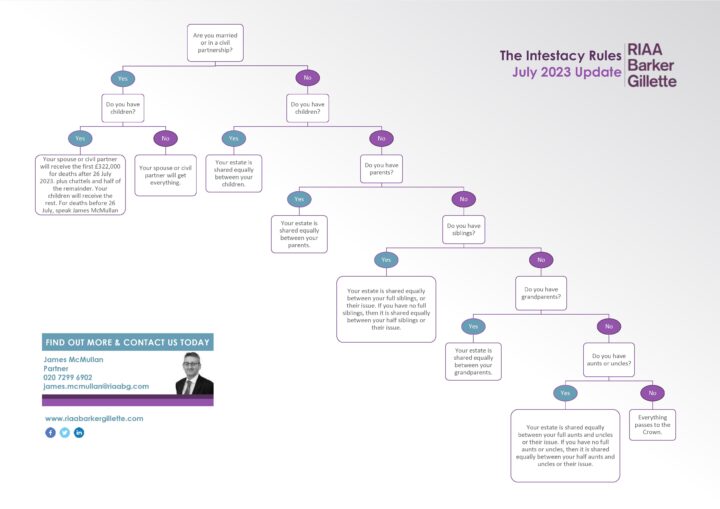


Death of a shareholder

When a shareholder dies, their shares are dealt with by the executors of their estate (if there is a will) or by the administrators under the Intestacy Rules (if there is no valid will). Both the executors and administrators are known as ‘personal representatives’ (PRs).

Infochart The Intestacy Rules 2023 Update

For a larger copy of the above image, please click here, or why not use our interactive online quiz instead?

What happens next with the shares depends on the terms of any shareholders’ agreement relating to the company in which the shares are held, the company’s articles of association and the ages of the beneficiaries of the shares.

Shareholders’ agreement

If a shareholders’ agreement exists, it is the first reference point in determining the next steps, as it may include rules about what happens to those shares in the event of a shareholder’s death.

Shareholders may have included provisions to prevent family members from becoming shareholders in a business they know nothing about. Or to stop the sale of a deceased shareholder’s shares to third parties.

The shareholders’ agreement may include rights (so-called ‘pre-emption rights’) that entitle the remaining shareholders (or some of them) to purchase the deceased shareholder’s shares before anyone else. Or there may be an option agreement triggered on death, which allows the beneficiaries to buy out the remaining shareholders.

Articles of association

PRs must next review the company’s articles of association for additional or supplemental provisions.

Under the default rules of the Model Articles, PRs can enter themselves into the company’s statutory registers as the holders of the deceased’s shares or, as appropriate, transfer the shares to particular persons.

Many companies have bespoke articles of association, which often include restrictions on the transfer of shares and may allow the directors to refuse to register new members. Any such share transfer restrictions will generally apply to transfers of shares on death.

If the shareholders’ agreement conflicts with the articles of association regarding any matters, the shareholders’ agreement will prevail. If the shareholders’ agreement is silent on any issues, the articles of association would determine the position.

Ages of beneficiaries

You must consider the ages of the beneficiaries to whom the shares pass.

If any beneficiaries are under 18 years old, then, depending on the will (if there is one), there are two options: either the PRs must form a trust to look after those children’s shares, or the children’s guardians receive their shares in the expectation that they will use them for the benefit of the children.

If the PRs form a trust, the trustees (who may be PRs or others) will administer the trust for the beneficiaries. The trust will own the shares, but the trustees will vote on company issues.

How we can help

Exit is one of the critical issues shareholders consider when setting up or becoming involved in any business. These plans must include providing for what happens if a shareholder dies.

If you need to put a shareholders’ agreement or bespoke articles of association in place, RIAA Barker Gillette’s experienced corporate and commercial team can prepare them.

We can also advise you on the terms of an existing shareholders’ agreement or articles of association and help ensure you incorporate appropriate provisions to death and other matters you may need to consider.

Call corporate solicitor Evangelos Kyveris today or speak to the head of our private client department, James McMullan.

Note: This article is not legal advice; it provides information of general interest about current legal issues.

Intestacy Rules QR Code for online interative quiz

Estate planning for blended families

Blended families picture of a family of various ages walking along the beach.

Blended families have become increasingly common in today’s society. As relationships evolve and individuals remarry or enter into new partnerships, estate planning becomes crucial. It ensures the fair and smooth transfer of assets to loved ones. In the context of blended families, where there may be children from previous relationships, navigating wills and inheritance requires careful thought and legal expertise. This article aims to provide valuable insights and guidance for UK residents.

Understanding the unique challenges

Blended families face unique estate planning challenges due to the complex dynamics involved. Considerations such as protecting the interests of biological children from previous relationships, providing for a new spouse or partner, and addressing potential conflicts among family members require thoughtful planning.

Updating your will

One of the most critical steps in estate planning for blended families is updating your will. A well-drafted will ensures that you clearly outline your wishes regarding asset distribution. Failing to update your will after entering a new relationship may lead to unintended consequences, with assets potentially passing to the wrong beneficiaries or even causing legal disputes, which can be hugely expensive and damaging to family relationships. When updating your will, it is essential to consider the following points:

  • Spousal/civil partner inheritance rights: In the UK, a spouse or civil partner has certain automatic inheritance rights, regardless of what a will states. Understanding these rights and ensuring that your wishes align with them is essential. Consulting with a knowledgeable solicitor will help you understand and navigate these legal requirements effectively.
  • Provision for biological children: Suppose you have children from a previous relationship. In that case, you may wish to ensure that you provide for them adequately in your estate plan. You can achieve this through specific provisions in your will, such as leaving assets or establishing trusts to benefit your children.
  • Providing for a new spouse or partner: Most people want to provide for their new spouse or partner while ensuring their children receive their fair share. Various strategies, such as life interest or discretionary trusts, can be implemented to balance these competing interests. Seeking legal advice will help you determine the most suitable approach based on your circumstances.
  • Guardianship of minor children: If you have minor children, it is vital to address guardianship arrangements in your will. Designating who will assume guardianship responsibilities ensures that your children will be cared for according to your wishes.

Communication and managing expectations

Open and honest communication is essential when navigating estate planning matters within blended families. Discussing your wishes and intentions with all relevant parties can help manage expectations and minimise potential conflicts. Consider involving family members, especially those directly affected by your estate plan, in the discussion process. While conversations about inheritance can sometimes be uncomfortable, proactively addressing these matters can help avoid misunderstandings and resentment later on.

Seek professional guidance

Given the complexities involved in estate planning for blended families, seeking professional guidance from a reputable law firm specialising in estate planning and family law is strongly recommended. An experienced solicitor can provide tailored advice, help you understand the legal implications, and ensure your estate plan is comprehensive and legally sound.

Regular review of your estate plan

Lastly, periodically reviewing and updating your will and estate plan is crucial to reflect any changes in your family dynamics, financial situation, or legislation. Life events such as births, deaths, divorces, or significant financial changes may necessitate adjustments to your Will or other estate planning documents. By conducting regular reviews, you can ensure that your estate plan remains up-to-date and aligned with your current wishes.

Navigating your will

Estate planning for blended families requires careful consideration and professional expertise. Updating your will, effectively communicating with your loved ones, and seeking the guidance of an experienced solicitor will help you navigate the complexities and ensure the distribution of your estate accords with your wishes. You can achieve peace of mind by undertaking these essential steps and know that your estate will be distributed according to your intentions, ultimately providing for your new family and any children from previous relationships.

Contact James McMullan today for estate planning advice for blended families.

Note: This article is not legal advice; it provides information of general interest about current legal issues.


Unfair contract terms

Unfair contract terms man reading a contract

In this article, corporate partner Victoria Holland highlights examples of the Unfair Contract Terms Act (UCTA)’s reasonableness test by looking at two examples of case law.

St Albans City and District Council v International Computers Ltd

Case background

The St Albans council bought a computer system from International Computers Limited (ICL) to collect a new local tax. St Albans overestimated the number of taxpayers because of a fault in the software and set the rate too low. It sued ICL for over £1 million in damages for breach of contract. ICL relied on a clause in its standard terms of business limiting its liability to £100,000.

Decision time

Both the High Court and the Court of Appeal held that the limit of £100,000 was unreasonable under UCTA. The main reasons for finding the limit unreasonable were:

  • ICL was a large company with substantial assets and well insured. Therefore, it was better positioned to bear losses than the St Albans local authority. The local authority would have to meet losses from increased local taxes, reduced services or both.
  • It was reasonable for the person making the profit to carry the risk.
  • ICL was in a strong bargaining position. St Albans had no realistic alternative to accepting ICL’s terms. St Albans had objected to the limitation clause in negotiations. However, ICL said St Albans had to refer any changes back to its legal department. The resulting delay would have made it impossible to launch the new tax on time.
  • St Albans had not been offered any inducement, such as a reduction in price, to accept the limitation.
  • St Albans had no opportunity of getting better terms elsewhere because other sellers were offering similar terms (with the same cap on liability).
  • The limitation of £100,000 bore no relation to ICL’s insurance cover of £50 million, and ICL had not attempted to justify the difference.

As an aside, the Court of Appeal reduced the award of damages on unrelated grounds.

Phoenix Interior Design Ltd v Henley Homes plc and another

Case background

Interior design services were provided to the defendants by Phoenix Interior Design for the refurbishment and fitting out of the 5-star Dunalastair Hotel in the Scottish Highlands. Phoenix sought payment of outstanding invoiced sums, representing 50% of the total contract value. The defendants argued that the contract had not been completed based on various allegations that the goods and services supplied had been defective and counterclaimed for damages for breaches of warranty.

The case was tried over two weeks in the Queen’s Bench Division. The judgment considered the law on the incorporation of standard terms and conditions, UCTA’s reasonableness of exclusion clauses, acceptance, and contractual completion. The defence for the counterclaim related to the following clauses:

“8 Warranties and Liability

8.1 Subject to the conditions set out below, the Seller warrants that the Goods will correspond with their specification at the time of delivery (subject to the Seller’s right under clause 3.3 to alter and amend any specification) and will be free from defects in material and workmanship for a period of 3 months from delivery.

8.2 The above warranty is given by the Seller subject to the following conditions: ……

8.2.3  the Seller shall be under no liability under the above warranty (or any other warranty, condition or guarantee) if the total price of the Goods has not been paid by the due date for payment. “

Application of the reasonableness test

UCTA’s reasonableness test applies here where the terms seek to exclude liability. The court held that the exclusion was ineffective because it was an unusual clause hidden in the terms and conditions and hadn’t been properly highlighted to the customer. It was also unclear and exorbitant, which would bar all rights of redress against the supplier for even a slight delay or deduction. The following points were raised and should be taken into account when drafting and dealing with limitation clauses in standard terms:

Visibility and Signposting: Ensure that harsh and unusual exclusions and limitations are clearly visible and not hidden in small print. This helps to avoid disputes and challenges regarding their incorporation and enforceability.

Incorporation of Standard Terms: Make it easy for the counterparty to find the standard terms. Clearly state how the terms are incorporated into the contract. Even if the terms are not provided “overleaf” as stated in pre-contract proposal documents, they can still be considered incorporated if they are supplied separately to the customer, both in hard copy and by email.

Reasonableness Test: The same factors that affect the incorporation of standard terms are relevant to the reasonableness test under the Unfair Contract Terms Act (UCTA). If the exclusion or limitation clauses are clearly visible, the supplier will likely have a stronger case on reasonableness.

These practical points should help ensure that limitation clauses are effectively drafted and incorporated into contracts, reducing the risk of disputes and challenges.

Key takeaways

Applying the reasonableness test can be complex and highly fact-specific. When negotiating your commercial contracts, it is advisable to consult legal professionals well-versed in contract law and who can help navigate UCTA and other relevant statutory and case law.

Speak to corporate partner Victoria Holland for more detailed and accurate guidance on applying the reasonableness test under the Unfair Contract Terms Act. Call him today.

Note: This article is not legal advice; it provides information of general interest about current legal issues


Can a UK employee work abroad remotely?

working abroad

Photo by Euan Cameron on Unsplash

Employer approval and communication

Before employees embark on working abroad remotely, they must obtain express approval from their employer. Employers should understand an employee’s intentions and clarify any concerns or expectations to ensure that the arrangement aligns with company policies, procedures and management.

Open and transparent communication is critical to maintaining a positive working relationship.

Whilst some cases may turn on their facts, any approach to remote working should be consistent and employees treated fairly.

Immigration and work permits

When working abroad remotely, it is vital to comply with that country’s immigration and work permit requirements. Accordingly, travelling to another country as a tourist and working remotely without the necessary permits may be illegal and have serious consequences.

Employers should research and take advice on the immigration regulations of the country the employee wishes to work from. Determine if the employee is eligible to work abroad remotely.

Tax implications

Working abroad, whether remote or not, may have tax implications in the UK and the country the employee plans to work from.

Tax residency rules and double taxation treaties come into play. An employer must understand its obligations regarding collecting and reporting tax if employees work abroad remotely.

These countries will have their own PAYE equivalent systems, and the employer will likely be responsible for correctly administering the employee’s tax payments and complying with any reporting obligations.

Failure to comply with tax regulations can result in penalties and legal issues. It is advisable to seek professional advice to understand the tax obligations in both jurisdictions.

Employment rights and benefits

While working abroad remotely, UK employees still retain their rights and benefits under UK employment law. For instance, such rights include rights relating to working hours, rest breaks, annual leave, and protection against discrimination.

It is crucial to ensure that remote working arrangements do not compromise these rights.

Employment contract and terms

Reviewing the employment contract and any relevant policies or agreements already in place is essential. Some employment contracts may contain specific clauses addressing remote working or working abroad. It is vital to understand the terms and conditions surrounding remote work, whether any geographical restrictions apply, and discuss these with the employee making the request.

Some employers reading this may take a proactive approach and review their employment contracts and policies in anticipation of requests from their employees.

Data security and privacy

Remote work requires careful consideration of data security and privacy. Ensure you have the necessary cybersecurity measures to protect sensitive company information and personal data. Employers should familiarise themselves with the data protection laws of the country the employee plans to work from and the UK to ensure compliance.

Each country has its cultural norms, legal system, and employment practices. Therefore, employers must invest time in familiarising themselves with the local customs, work culture and legal framework of the country where the employee will work.

Suppose an employee works abroad remotely for an extended period. In that case, they may acquire local employment rights even if the employer is UK-based. This situation might result in the employee having greater employment rights than colleagues working for the same employer. Such an imbalance could cause administrative difficulties and lead to employee inequality.

Conclusion

Employers must seek local legal advice on employees’ statutory rights, especially when terminating the employment relationship. In contrast, while working abroad remotely may seem enticing to employees, navigating the legal landscape and considering the necessary precautions are essential.

Understanding an employee’s immigration requirements, tax implications, and other legal considerations will help you make informed decisions and avoid potential legal pitfalls.

Open communication with the employee and professional advice from legal and tax experts is invaluable in ensuring a smooth and compliant transition to working, or not working, abroad.

Call Karen Cole today if you need advice on navigating overseas remote working or would like to review and update your employment contracts and associated policies.

Note: This article is not legal advice; it provides information of general interest about current legal issues.


Greenwashing attracts the wrong attention

Greenwashing image of painting - green acrylic

Photo by Nick Collins on Unsplash

The Advertising Standards Authority (ASA) has found Shell guilty of ‘greenwashing’ with an advertising campaign themed ‘ready for cleaner’ that breached advertising guidelines.

The ASA ruled the petrochemical giant’s campaign was misleading as it left out information on Shell’s more polluting work with fossil fuels. The ASA banned the adverts from appearing in the future.

It’s the latest such breach confirmed by the ASA. This follows Tesco’s ban for a plant-based burger ad, a Persil advert, and two HSBC adverts. The ASA found all to be misleading in their claims of environmental benefits.

The ASA is the UK’s independent advertising regulator responsible for ensuring that ads across UK media stick to the advertising codes.

“Action like this to tackle inflated environmental sustainability claims is only likely to increase, as we see rising consumer and investor demands for products and services that fulfil sustainable objectives.

For example, companies who may have selectively highlighted some actions over others, or perhaps slapped a green label and a recycling logo on a product need to be aware that their customers are going to look below the surface to be sure that brands aren’t offering them empty promises.”

Victoria Holland, Partner and Head of Corporate and Commercial at RIAA Barker Gillette

The press has spotlighted corporate greenwashing in the financial services sector too. But, the Financial Conduct Authority has anti-greenwashing rules on its schedule for later this year. It intends to include them in its Sustainability Disclosure Requirements.

“Certainly, larger organisations need to focus on Environmental, Social, and Governance (ESG) ratings, as this increasingly drives investment decisions in financial markets. It is inevitable that this type of attention will filter down to smaller enterprises regarding consumer demands.”

Victoria Holland

The term ‘greenwashing’ was first coined by an environmentalist in the USA during the 1980s. However, it has only recently entered everyday use. Some of the examples highlighted as corporate greenwashing tactics include:

  • Companies claiming that they have implemented positive ESG processes while the results or progress are yet to be seen
  • Cherry-picking product attributes or data and ignoring others which would be negative in environmental terms
  • Misuse of labelling schemes

The ASA and its sister organisation CAP (Committee of Advertising Practice) have published guidance. The guidance aims to help businesses comply with the ASA and CAP’s codes for broadcast and non-broadcast advertising, sales promotions and direct marketing communications. They also include postings on social media.

Contact Victoria Holland today.

Note: This article is not legal advice; it provides information of general interest about current legal issues.


Checking your employment status

In this article, Karen Cole focuses on the employment status categories (including checking your employment status), the legal aspects of employment, and the differences between PAYE and invoicing.

How many employment status categories are there?

There are three primary employment status categories:

  1. employed
  2. self-employed
  3. workers

What do the employment status categories mean?

Employed

An employed person works under an employment contract and receives a regular salary or wage. The employer deducts income tax and national insurance contributions from their salary. Some core legal protections only apply to employees, such as paid sick pay and rights on termination of employment granted under the Employment Rights Act 1996, including the right not to be unfairly dismissed and the right to receive a statutory redundancy payment.

Self-employed

A self-employed person works for themselves and is responsible for paying their income tax and national insurance contributions. They are not entitled to the same employment rights as employed individuals, such as sick pay and paid holiday leave, and they can choose which jobs they take on and when and how they work.

Workers

A worker is somewhere between employed and self-employed. They work under a contract, but not necessarily a permanent one. Workers receive some employment rights, such as the right to the minimum wage, paid holiday and protection from discrimination, but only some of the rights that employees enjoy. Unlike employees, workers don’t benefit from protection against unfair dismissal, a statutory minimum notice period or a statutory redundancy payment. A defining feature of a worker is that they must turn up for work even if they do not want to, whereas a self-employed person can decide when they work.

Checking your employment status

Control

You’re more likely to be employed if someone tells you what to do and how to do it. If you have control over how you carry out your work, you’re more likely to be self-employed.

Substitution

You’re more likely to be employed if you’re required to do the work personally. If you can send someone else to do the work, you’re more likely to be self-employed.

Mutuality of obligation

If you’re offered work and are obliged to accept it, and the employer is obliged to provide it, you’re more likely to be employed. You’re more likely to be self-employed if you can turn down work.

Equipment

If you’re provided with equipment to do your work, you’re more likely to be employed. If you provide your equipment, you’re more likely to be self-employed.

Financial risk

You’re most likely to be employed if you’re not responsible for any financial risk, such as equipment, materials or expenses. If you bear the cost of any financial risk, you’re most likely to be self-employed.

Casual/freelance workers

Businesses may engage casual workers in various ways and on several types of contracts, including zero-hours, short-hour, or guaranteed minimum-hour contracts.

Employers often recruit casual workers using self-employed contracts, such as freelance agreements, contractor or sub-contractor agreements, or supply of services agreements.

Crucially, the labels applied by the parties and the contractual documentation will not be the key to determining employment status; what happens in practice will be essential, and tribunals may disregard express contractual provisions when determining an individual’s status.

The employment status of a casual worker can change over time, for example, if their working arrangements develop a regular pattern. Someone can start work as a self-employed contractor but develop worker status as the relationship with the employer progresses. A steady stream of cases in the employment tribunal (and sometimes higher) suggests that many gig economy workers hired as self-employed contractors are actually workers under employment law.

Note: This article is not legal advice; it provides information of general interest about current legal issues.


What is the reasonableness test?

A crucial part of UCTA is the so-called “reasonableness test”, which assesses the fairness and enforceability of specific contract terms.

Which terms does the reasonableness test apply to?

The reasonableness test primarily applies to exclusion and limitation clauses which seek to limit or exclude liability for breach of contract, negligence or other claims. 

The courts may deem such clauses unfair or unenforceable if they fail the reasonableness test. The test considers such factors as the following when evaluating a contractual term:

  1. The relative bargaining power of the parties
    The test considers any power imbalance between the parties to determine whether one party can impose unfair terms on the other.
  2. Knowledge and awareness of the term
    It assesses whether the party affected by the term had sufficient opportunity to understand and appreciate its implications.
  3. Inducements or representations made
    The test considers any inducements, representations, or special circumstances that influenced the inclusion of the term in the contract.
  4. The subject matter of the contract
    The court can assess the term’s reasonableness in light of the nature and purpose of the contract, including the risks and liabilities typically associated with such agreements.
  5. Availability of alternatives
    The test examines whether the party imposing the term offered alternatives, allowed negotiation or if they presented the contract as a “take it or leave it” proposition.
  6. Public interest
    The reasonableness test may consider the public interest or any social or economic implications of the specific term.

The test seeks to balance safeguarding the interests of parties with less bargaining power while still acknowledging the legitimate business interests of all parties involved.

If the courts deem a contractual term unreasonable under UCTA, they may modify the term or declare it unenforceable. this can result in the affected party not being bound by that particular term. They may be entitled to seek remedies or adjustments to the term to align it with reasonableness standards.

Conclusion

In conclusion, the reasonableness test allows parties to challenge unfair or oppressive contractual provisions and promotes fairness in commercial transactions.

Victoria Holland can review your commercial agreements and provide tailored advice based on the specific circumstances of a contract. He can help you navigate the complexities of UCTA. Victoria can ensure you thoroughly understand the reasonableness test and its implications in any given situation. Call him today.

Note: This article is not legal advice; it provides information of general interest about current legal issues.


Step-families and succession planning

step image to represent step families

Photo by Liane Metzler on Unsplash

Any fans of the mega-hit TV series Succession, which follows the fortunes of the Roy siblings, will know how fraught inheritance issues can be when no clear inheritance plan is in place, especially when multiple spouses and step-families are involved. But it’s a story that’s not restricted to the super-rich like the Roys, as rising re-marriage numbers are creating more blended families and leading to inheritance disputes. 

In one recent case to reach the High Court, three siblings were cut out of their inheritance when their step-mother changed her will in favour of their step-brother after their father died. 

In 2017, the McLean couple made ‘mirror wills’, where each reflects the other, so the outcome should be the same no matter who dies first. Those wills shared the couple’s estate equally between four children, three from Mr McLean’s first marriage and the younger son born during their marriage. When the older siblings found themselves cut out of the later will, they went to court, claiming that their father had trusted his second wife “implicitly” over the terms of the inheritance.

The court has to decide whether the doctrine of mutual wills applied to their step-mother’s original 2017 will, which would mean there was an agreement between the couple to make wills with substantially the same terms and conferring reciprocal benefits and not to revoke them without the consent of the other.

“For the doctrine of mutual wills to apply, there needs to be a contract between the two testators that both wills will be irrevocable and remain unaltered, and this agreement should be incorporated into the will, or through some other form of evidence. It is not enough to make mirror wills or reciprocal wills and to show some general intention.

Without an explicit agreement not to revoke the will, any surviving partner may make a new will, with very different outcomes, and that’s why it’s important to be clear from the outset.”

Head of Private Client James McMullan

While the McLeans must wait to hear the outcome of their case, the courts have upheld another inheritance challenge in similar circumstances.

After divorcing, the Colicci’s signed a deed that covenanted that any shares they still held in their jointly-owned company would pass to their two children when they died. Both promised to make wills to support that. But the husband had remarried and later made a new will leaving his shares to his second wife, not telling his ex-wife or children what he had done. When he died unexpectedly, his later will was challenged successfully, as the court ruled that the original deed was a binding obligation which prevented either of the parents from making other arrangements to dispose of their shares on death.

According to the latest Office for National Statistics figures, almost 30% of marriages are now second or subsequent marriages. Behind the figure is a growing complexity in family structure, with step-mothers, step-fathers, step-children and step-siblings. 

“Proper planning can help satisfy everyone, and decisions will depend on individual circumstances; this could be through mutual wills containing a clear declaration that neither side can revoke or change the agreed terms without the consent of the other. 

Another option is to create a trust within a will. This can be a simple and effective way to make sure that the surviving partner has all they need while alive, but at the same time making sure that children from an earlier relationship do not miss out. It does require specialist help to get things right, but it means you can be sure things will play out as you intend.”

Head of Private Client James McMullan

A trust can allow each partner to leave their estate, or the bulk of it, in trust for the survivor and then to their children following the survivor’s death. Trusts can allow for the use of any assets – such as a house or investment income – to support the survivor for the rest of their life, but with the assets held in trust – whether for children from an earlier marriage or a charity or anyone else – when the survivor dies. 

Plan for your succession today; call private client partner James McMullan today.

Note: This article is not legal advice; it provides information of general interest about current legal issues.


How could your corporate commercial lawyer make or break your business?

corporate commercial lawyer

Photo by CHUTTERSNAP on Unsplash

Leaning on the experience of your corporate commercial lawyer is a critical ingredient in the success of your business, especially if it is in its infancy. But does your lawyer have the right experience and know how to recognise your specific needs, those of your business and its industry’s risks?

Corporate commercial lawyers are generally competent in advising businesses on a wide range of matters, such as:

  • Identification of risks
  • Incorporation and corporate structure
  • Board minutes and resolutions
  • Contract drafting and review
  • Financing arrangements
  • Negotiations
  • Intellectual property rights
  • Non-disclosure agreements
  • Licenses and distribution agreements
  • Regulatory compliance

You can expect competent advice when instructing any qualified, SRA-regulated lawyer who should be adept at foreseeing legal pitfalls and providing sound advice to shield your business against them.

However, like electric cars, corporate commercial lawyers are not all made equal. Many adopt a tactic of risk eradication and an unwillingness to compromise, which can jeopardise your commercial deal or transaction.

From time to time, the balancing act of risk versus reward tips the scales in favour of pressing ahead despite that risk.

I am not advocating throwing caution to the wind here. On the contrary, an excellent corporate commercial lawyer will identify risks but, rather than be fearful of them, help you to manage them in a way that does not impede your business’ growth, using pragmatism and commerciality drawn from their experience of working with other companies like yours, your competitors and within your sector, and advise you accordingly.

Speak to Evangelos Kyveris today for pragmatic, insightful corporate advice and to weigh up your risk/benefit analysis.


Stay in touch

Subscribe to our newsletter

Stay in touch

By completing your details and submitting this form you confirm you are happy for us to send you marketing communications and that you agree to our Website Privacy Policy and Legal Notice and to us using Mailchimp to process your data.


Sending

News/Insight

  • Renters’ Rights Act: why process and paperwork matter more than ever for landlords
    The Renters’ Rights Act has now passed into law, marking one of the most significant shifts in the private rented sector in a generation. Most of the new measures will take effect in May 2026, with a national landlord database to follow later in th


    Read more
  • Understanding the Roles of Executors and Trustees
    When making a will, you place significant trust in those appointed to carry out your wishes. Executors and trustees are key roles, often held by the same people, but their responsibilities differ. Understanding these roles and their obligations helps


    Read more
  • Assigning or Subletting a Commercial Lease: What Tenants Need to Know
    This article explains the key differences between assignment and subletting, outlines the legal framework in England and Wales, and highlights the practical issues tenants should consider before taking action.


    Read more
  • Completion and post-completion steps in a sale: Final steps for sellers
    A guide to completion and post completion steps in a corporate sale including exchange, stamp duty, Companies House filings and key administrative requirements.


    Read more
  • How to protect your brand: A beginner’s guide
    Trademark protection for businesses explained, including how to register a trademark in England and Wales and the key steps to protect your brand.


    Read more

What they say...

  • Paul Woodman, March 2026
    Will writing “Excellent service from start to finish. Efficient and good value. Charlotte was very professional, knowledgeable and understanding.”

  • Client, March 2026
    Great Service “Contacted RIAA to update my will and other things. Charlotte and James provided an efficient, friendly service, and the process was dealt with quickly. Much appreciated.”

  • Client, March 2026
    Expert knowledge and support “Pippa was invaluable in her insight, knowledge, and support. Through what is a very difficult time, she gave me hope that there is something to be done. Very solutions-oriented!”

  • Eve, March 2026
    Professional, compassionate and seamless legal support “I would like to express my sincere gratitude to Charlotte, Solicitor at RIAA Barker Gillette (UK) LLP, for the outstanding support she provided to my father during the creation of his will

  • Laura Kelly, February 2026
    Review of legal guidance received “I recently worked with Patrick Simpson on my settlement agreement. Patrick guided me through every stage with exceptional care and diligence. He kept the process moving efficiently, always updating me promptly

Read more