
Risks of varying an employment contract

An employment contract can only be amended in accordance with its terms or by mutual consent. You cannot change an employment contract unilaterally; simply changing an employment contract without consent could result in either a breach of contract and/or a repudiatory breach.

Damaged relations and bad publicity are also potential outcomes, and if a loss of pay occurs, the employee may bring an ‘unlawful deduction from wages’ claim.

Not all changes require an employment contract to be amended. Some changes may occur in practice as opposed to the physical amendment of the contract. In other cases, the contract will already allow for the proposed change.

Contractual right to vary?

If the proposed change affects the existing terms of the contract, you will not need to amend the contract if:

  • the existing terms are sufficiently broad to accommodate your proposals;
  • there is a specific right for you to vary the contract in this way; or
  • the contract gives you the general power to vary its terms.

THE RISKS: Any ambiguity in the terms of the contract will be construed against you. Any specific flexibility clauses will be given a restrictive interpretation by the courts and may be limited by an implied term, for example, an obligation to exercise the clause reasonably.

THE REALITY: By and large, general flexibility clauses can only be used to make reasonable or minor administrative amendments that are not detrimental to an employee.

THE ALTERNATIVES: If your proposals involve altering the existing contract, but you have no contractual right to do so, you could:

  1. get express agreement to the new terms (either from the employee or through a binding collective agreement);
  2. terminate the existing contract and offer continued employment on the new terms; or
  3. unilaterally impose the change and use the employee’s conduct to establish their implied agreement to the new terms.

The risks of unilaterally imposing a change

If you impose a contractual change without the employee’s express or implied consent, you will be in breach of contract, and the original terms of the contract will remain in place. The employee can respond to the breach in one of the following ways:

  • work under the new terms in protest whilst bringing a claim for breach of contract or unlawful wage deductions (known as ‘standing and suing’);
  • in respect of a fundamental breach (i.e. that it goes to the root of the contract), employees can resign and bring a claim for constructive dismissal;
  • where possible, i.e. when there has been a change in duties or working hours, employees can refuse to work under the new terms; or
  • do none of the above and accept the change.

If you provide a new contract to an employee, and they do not sign and return it, the question arises as to whether the employee is bound by the new contract. The burden will be on you to show an “unequivocal act implying acceptance”. The test of whether the employee has impliedly accepted is objective and depends on the employee’s conduct rather than his intentions.

C for consideration

Any agreement that varies the terms of an existing employment contract must be supported by consideration (see below) and/or executed as a deed.

Consideration is where the variation can either benefit or prejudice a party. For instance, if you are varying an employment contract, consideration could constitute a pay rise, bonus payment, promotion or continuous employment (except in the case of economic duress or fraud). The performance of an existing duty may provide consideration if it offers a practical commercial benefit, such as saving time or inconvenience.

The issue of consideration becomes more problematic when the proposed change will not take effect until sometime in the future. Changes of this type often relate to termination, for example, notice periods and restrictive covenants. In these cases, it may be more difficult to rely on the concept of continued employment as a consideration for the change.

ADOPT A CAUTIOUS APPROACH: allot some form of consideration to any change, for example, expressly tying the change into an annual pay rise.

IN PRACTICE: many employers document their permitted variations by deed or by referring to the payment of a small sum (a ‘peppercorn’) by way of consideration. These methods attempt to alleviate the risk of disputes over whether valid consideration was, or had to be, given for the variation.

Practical considerations

In reality, you are undertaking a selling exercise and should always look for ways to ‘sell’ the proposed change to your employees, even if it is to their detriment. You should bear in mind the following points when communicating a proposed change:

Is the change necessary?

Often, the answer will be a resounding yes due to the company’s financial position. If the alternative to the suggestion is a more formal restructuring (resulting in job losses), you should make your employees aware of this. That way, they are more likely to view the change as the lesser of two evils.

Can staff be offered any incentive to help them accept the change?

Offering an additional benefit in return for a detrimental change is often an effective way of securing agreement. This does not have to be financial. You should consider other innovative benefits to induce staff to agree to the proposed change.

Does all of the change have to be implemented at once?

It is possible to make some changes over time or put in place transitional arrangements. This may make the ultimate change easier, particularly as employees often find the timing of a change more disconcerting than the change itself.

The timing of a proposed change

You should consider linking the introduction of a change to something beneficial which will happen to employees at a certain time. For example, it may be easier to introduce a change to a contractual commission structure at the same time as annual salary reviews. The salary increase could be presented as a trade-off for a less favourable change in the commission structure.

Contact Alex Deal today for more information on varying an employment contract.

Note: This article is not legal advice; it provides information of general interest about current legal issues.


Sudden death – What to do

When someone close to you dies unexpectedly, you are often left in a state of shock and bewilderment.

We aim to set out some of the immediate steps to be taken when sudden death occurs and highlight a few topics you should consider discussing with a solicitor, depending on your unique circumstances.

Immediate steps

If you are with the deceased when they die, you will need to phone the emergency services, who depending on the circumstances of the death, may organise a post-mortem to find out its cause.

Shortly thereafter, you must contact a local funeral director to make arrangements. Note the body can only be released to them once the authorities are satisfied with the post-mortem results and a death certificate has been provided.

The hospital will provide the next of kin with the necessary papers to take to the Registry Office for Births, Marriages & Deaths. The death must be registered within five days unless there are exceptional circumstances. Note, if the death is reported to the coroner, the death cannot be registered until the coroner gives permission (although, in some cases, an “interim certificate” may be provided pending the final decision of the coroner.

The Registrar will issue the death certificate and provide you with as many copies as you wish (for a nominal fee). Once the funeral directors have a copy of the certificate, they can collect the body from the hospital.

The family must then consider various questions. Who has the right to decide how the body is disposed of? Burial or cremation? The answer to these questions can raise sensitive issues. It is best to try and resolve these matters amicably rather than risk a breakdown in family relations and incur legal costs arguing over this.

Strictly speaking, the legal position is that there is no property in a corpse, so the estate’s beneficiaries cannot “claim” any rights over the body. The personal representatives (the PRs) of the estate are responsible for disposing of the body.

If the deceased made a will, the executors are the PRs. If they died intestate (without a valid will), the PRs are the administrators of the estate (persons chosen in accordance with the Intestacy Rules).

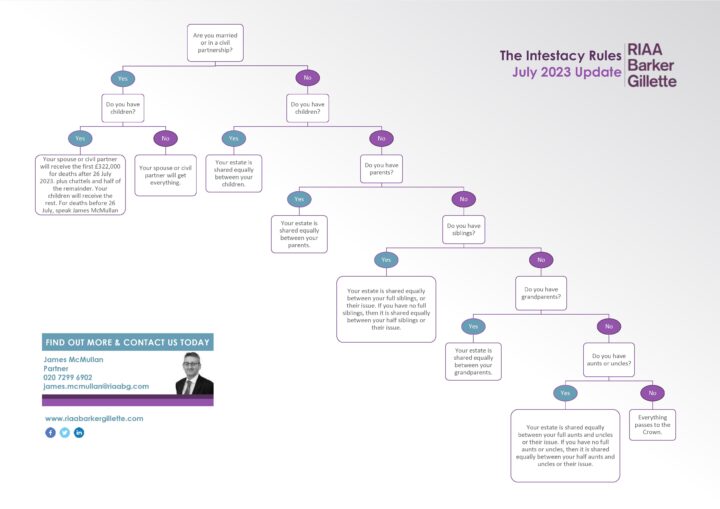
Infochart The Intestacy Rules 2023 Update

The deceased’s true wishes are often expressed in their will or a side letter which may be kept with it.

Is there a will?

It is important to check for a will by going through the deceased’s personal papers, making enquiries with their bank, building society, or family solicitor and/or carrying out a search of the National Wills Register to see if there is a valid will. We can, of course, do this for you.

If there is a valid will, it will confirm the executors’ details and how the estate should be distributed and may confirm any funeral directions. If no will can be found, the deceased’s estate will be distributed in accordance with the Intestacy Rules, which are not always as straightforward as one would think.

The estate

Once the PRs have been identified and have agreed to act, they will need to uncover all of the details of the estate (all of the deceased’s assets and debts). This will involve gathering up their papers and providing the details of any assets (bank account statements, pension fund details, savings and investments, life insurance etc.) and any debts (mortgages, loans, HP agreements, etc.). The PRs must notify the deceased’s bank and any other financial institutions of the death.

  • Bank accounts: If a bank account is in the deceased’s sole name, the account will be frozen. If a joint account, the deceased’s name will be removed from the account, and the survivor will usually be entitled to the funds in that account.
  • Funeral expenses: The PRs will usually incur the costs of making the funeral arrangements. Such expenses, provided they are reasonable in relation to the deceased status in life and the size of his estate, will be deducted from the estate before other unsecured debts. Although the deceased’s bank accounts may be frozen, this is one instance where the banks are permitted to release funds to pay the funeral directors directly.
  • Administration of the estate: Once the funeral has taken place, the PRs should progress the administration of the estate and implement the wishes of the will (or process the estate in accordance with the Intestacy Rules).
  • Now, the difficult bit… Inheritance Tax: If Inheritance Tax is payable on the estate (any estate worth over £325,000 (but subject to other exemptions and reliefs that may be available), a complete and accurate Inheritance Tax account should be prepared and lodged with HM Revenue & Customs as soon as possible. This is usually the most difficult part of the process. The Inheritance Tax account must be completely accurate. HM Revenue & Customs are now levying penalties against PRs where care has not been taken to provide an accurate Inheritance Tax account. Interest starts to run on the Inheritance Tax liability six months after the end of the month of death, so the clock is ticking.

Rest assured, we draft, advise on and assist with Inheritance Tax accounts as part of our service.

James McMullan, Head of Private Client, RIAA Barker Gillette (UK) LLP

All told, the probate process contains many traps and pitfalls. In all but the most straightforward of cases, you should consider taking advice from a solicitor.

For more information, contact James McMullan today.

Note: This article is not legal advice; it provides information of general interest about current legal issues.

Intestacy Rules QR Code for online interative quiz

The Future of Digital Identity

Digital Identity

AML in the Regulated Sector: A Quick Guide

Regulated businesses and nominated compliance and reporting officers employed therein are regarded by politicians and law enforcement agents as gatekeepers. We are required and expected to know the statutory and regulatory regime governing our obligations and what is required of us.

For those of us working in the regulated sectors, our Anti Money Laundering (and Terrorist Financing) obligations can be ascertained from the following legislation and regulations, namely:

  • the Terrorism Act 2000;
  • Part 7 of The Proceeds of Crime Act 2002 (POCA);
  • the Money Laundering Regulations 2007; and
  • various obligations arising out of international treaties and conventions, not the least of which are EU AML Directives. We are currently working with the third European Directive. The fourth has been enacted, more of which later.

All of the above have been amended to varying degrees by subsequent legislation and it is easy to find online up-to-date legislation and regulations incorporating the current source material with amendments. See for example www.legislation.gov.uk.

Although this presentation deals with AML, I mention the Terrorism Act as a reminder that preventing criminal proceeds from going to fund terrorist activity grows ever more significant.

Our primary obligations

Our obligations are essentially three-fold:

  1. to take appropriate measures to avoid our businesses being used for money laundering (and terrorist financing);
  2. to report it where we suspect it is occurring (SARs); and
  3. to keep adequate records so that suspicious activity can be properly investigated and prosecuted.

KYC: Know your customer/client also known as CDD: client/customer due diligence

Knowing our client/customer and performing client due diligence is at the heart of measures we must adopt in order to be compliant and our obligations are set out fairly comprehensively in Regulations 5-15 of the 2007 Money Laundering Regulations.

What is required?

Regulation 5 explains what is required for ordinary customer due diligence, namely: identifying the customer/client and verifying that identity through a reliable and independent source; and where there is a beneficial owner who is not the customer/client, identifying that owner and taking adequate measures to verify that identity on a risk-sensitive basis.

We are also required to obtain information on the purposes and intended nature of the business relationship.

When is it required?

Regulation 7 provides three triggers for requiring CDD measures to be undertaken:

  • when (actually before) we establish the business relationship or carry out a transaction;
  • when we suspect money laundering or terrorist financing; and/or
  • where we doubt the veracity or adequacy of the documents, data or information previously obtained for identification and verification purposes.

Regulation 8 deals with ongoing monitoring (see below), but Regulation 7 also requires us to apply customer due diligence measures to existing customers at other appropriate times.

How do we conduct CDD?

The regulations say what we should do and when, but other than emphasising that we must do so on a risk-sensitive basis, they do not prescribe how we should do this.

Each industry sector and the regulatory bodies in those sectors publish guidance notes on best practices whilst seeking not to detract from the all-important theme that we must adopt a risk-sensitive approach. What is appropriate for one risk factor may not be for another. I still advocate a face-to-face meeting with the client and the production of ID documents where possible and proportionate, but it is difficult in the modern world to think of a better system than that such as is offered by CallCredit where, for a few pounds, you can search the enormous databases available to obtain reliable and independent verification of a client’s identity and, where necessary, beneficial owners. Such searches can also help you in assessing risk depending on the search criteria adopted.

To Emphasise: CDD means not just knowing our client or customer but also their business relationship with us, assessing the risk of exposure to money laundering from that client or relationship and adopting appropriate measures to meet that risk. We are then obliged to monitor it during the relationship.

Ongoing monitoring

We have already seen that Regulation 7 requires customer due diligence measures to be applied to existing customers at other appropriate times. Regulation 8 enforces this obligation and describes ongoing monitoring as meaning the scrutiny of transactions undertaken throughout the course of the relationship so as to ensure that the transaction is consistent with the relevant person’s knowledge of the customer, his business and risk profile and keeping the documents, data and information obtained for the purpose of client/customer due diligence measures up-to-date.

Given that Regulation 20 obliges us to establish and maintain appropriate and risk-sensitive policies and procedures in relation to our obligations, it is essential that you undertake regular documented reviews of your client/customer business relationship if you are not already doing so.

Suspicious activity reports (SAR)

We should all now be familiar with these. Our obligations arise out of part 7 of POCA, particularly sections 330, 331 and 332. SARs are now made to the National Crime Agency (NCA), and according to its first published annual report on SARs, there were over 381,000 in the year 2014/15, over 83% of which came from banks. Other financial institutions accounted for a further 12%, leaving all other sectors responsible for just 5%.

The regime provides that businesses in the regulated sector must appoint a nominated officer, and staff working in that business are provided with a defence from prosecution if they report their suspicions to the nominated officer, who in turn must then decide whether to disclose those suspicions to the NCA by way of a SAR.

Nominated officers (aka Money Laundering Reporting Officers – MLROs) must make a disclosure to the NCA where they know or suspect money laundering or terrorist financing (a subjective test) or where there are reasonable grounds for suspecting suspicious activity (an objective test).

It is worth remembering also that anyone can make a disclosure pursuant to section 338 of POCA where they suspect money laundering, and section 338 of POCA provides them with a defence if they go on to otherwise commit one of the substantive money laundering offences described in sections 327 to 329 of POCA.

Note also that there are defences for delaying or not making a disclosure, but I advise non-lawyers to seek legal advice before making such a decision, given the penalties for failing to do so. Those of you who are lawyers will know that one of the reasonable excuses for not making a SAR is that the information came to you in a situation covered by Legal Professional Privilege, a defence not open to other professionals.

Studying the report, it is pleasing to note that the confidentiality of SARs promised by the regime is working well and that only two breaches of the confidentiality of reports are recorded.

From my own experience, the consent to proceed is working reasonably well, and the seven-day target promised is being met by the NCA, who say that their average response is 3½ days.

Finally, once a disclosure has been made, don’t forget the anti-tipping off requirements of section 333 POCA, which always cause difficulties for professional advisors, putting us in conflict with our duties to keep our clients informed.

Record keeping

Regulation 8 requires us to keep our AML records up to date. Regulation 19 states that we must keep those records for the specified period, which is five years from the end of the business relationship or when the occasional transaction is completed. The records specified are the CDD documents and records supporting the nature of the business relationship. Keeping business records is second nature to most, if not all of us, in the regulated sector and given the e-storage facilities available to us, it will be no easy task to defend an allegation of failing to keep adequate records.

Keeping compliant

There has been relatively little substantive change to the legal framework outlined above for some years now, and the legislation has grown into its existing state since the establishment of the Financial Action Task Force (FATF) in 1989 and the First EU Directive in 1991. There is a wide-ranging network of advice and guidance issued by government and law enforcement agencies and our professional and regulatory bodies out there. It is essential that you obtain the AML guidance notes specific to your sector and that you subscribe to relevant bulletins in relation to anti-money laundering and terrorist financing. I also recommend attending relevant courses and seminars and (of course!) consulting relevant, experienced professionals such as myself should you need more detailed or tailored help in keeping compliant.

There simply is no excuse for not keeping up-to-date, given the enormous amount of material and training available.

And don’t forget the need to train all staff in ML and TF awareness (regulation 21).

The Fourth EU Directive

It was enacted in June 2015 and requires full implementation by June 2017. The current thinking is that it should not be too difficult to assimilate the changes into our current framework, as the emphasis is very much on expanding the concept of ultimate beneficial ownership and the need for enhanced customer due diligence in that area. One significant change is the need to establish central registers of corporate ownership details.

It also expands the definition of Politically Exposed Persons to those operating within the boundaries of the United Kingdom and for those involved in the gambling sector; it takes the regulations beyond just casinos.

Summary

I will finish where I started. Those of us who work in the regulated sector and those of us who are compliance or reporting officers in that sector are no longer regarded as businessmen; we are gatekeepers. We are required and expected to take risk-based measures to avoid our businesses being targeted by criminals to launder the proceeds of criminal conduct or to fund terrorism. If, despite such measures, we are unlucky enough to fall foul of the activities of terrorist funders or money launderers, we need to be able to show that we have adopted all the measures required of us, that if there were reasonable grounds for suspecting ML, we reported it and that we have kept full, proper and adequate records of the measures taken by us and our appropriately trained staff.

If we can’t do all of this, then we may well face civil, regulatory and even criminal sanctions, as well as loss of business reputation and goodwill.

Note and disclaimer. This is the text of a short oral presentation and must not be taken as a definitive guide on any part of the law concerning money laundering and terrorist financing. There are many exceptions to the general principles outlined above. Please seek professional help on a retained basis should you need to do so.

Speak to COLP Susan Humble for more information on digital identity today. 

Note: This article is not legal advice; it provides information of general interest about current legal issues.


Workplace investigations

Organisational preparation

The ACAS Code of Practice on Disciplinary and Grievance Procedures emphasises the importance of carrying out necessary workplace investigations of potential disciplinary matters without unreasonable delay in order to establish the facts of the case. This is an important step employers often either overlook entirely or do not handle properly. This ACAS guidance is, therefore, welcome and worthy of careful consideration.

It is possible to settle most problems quickly and without undue process. An employer should therefore consider whether a quiet word or informal action might be all that is required to resolve a matter.

If an informal chat is not practical or possible, the employer should consider a number of factors before commencing an investigation:

  • Will a preliminary investigation help?
  • Does the matter warrant further action?
  • Do any internal policies or procedures require an investigation?
  • Should the employer suspend the subject(s) of the investigation pending its outcome?

An employer should act promptly if an investigation is necessary. Upon instigating an investigation, an employer should decide the precise purpose and scope of the investigation, how long it will take, who should oversee the matter within the organisation and who should be the investigator.

Keep an investigation confidential. You may put temporary measures in place while you conduct the investigation, such as suspension or employee transfer.

Unless there is a contractual right to suspend an employee without pay (which would be unusual), the suspension should always be on full pay and confirmed in writing, with a clarification that the suspension does not connote guilt or any indication of the likely outcome of the investigation.

Investigator’s preparation

Once you have decided to conduct an investigation, it may be beneficial to create an investigation plan to follow, providing a structured approach. Preparation may include:

  • Checking internal policies and procedures.
  • Identifying sources of evidence.
  • Identifying the parties relevant to the investigation.
  • Deciding in what order to collect evidence.
  • Arranging where meetings should take place.
  • Contacting the relevant parties and their managers.
  • Keeping managers informed of the process.

Handling a workplace investigation meeting

While investigation meetings are often needed, some workplace investigations only require collecting written and physical evidence. An investigation meeting is an opportunity for an investigator to interview the individual involved or someone with information relating to the matter under investigation.

Although there is no statutory right for an employee to be accompanied at an investigation meeting (as it is not a disciplinary meeting), not being accompanied could leave the individual at an unfair disadvantage and may be provided for in a workplace policy. Therefore, it is often safer to offer the employee the option of having a fellow employee accompany him or her at an investigatory meeting, particularly if the facts under investigation are serious in nature.

Gathering evidence

Any investigator appointed should, insofar as possible, be unconnected with matters under investigation. The investigator should remember their role is to establish the facts of the matter. They should consider evidence that supports the allegations and that undermines them. Once collected, an investigator should analyse each piece of evidence objectively and consider:

  • What does the evidence reveal?
  • Are there any doubts over the credibility and reliability of the evidence?
  • Is the evidence supported or contradicted by any other evidence?
  • Do the results suggest further evidence needs collecting?
  • Should they prepare written witness statements?

Evidence to consider collating includes witness statements, written records and documentation (e.g. attendance sheets and paper copies of electronic material), physical evidence (e.g. CCTV, computer and phone records) and searches of personal possessions.

If the investigator needs to prepare and rely on witness statements, it may take further investigation to verify or undermine the information given. The investigator may also need to make omissions to avoid the identification of the witnesses.

Writing a workplace investigation report

It may be helpful if the investigating officer prepares a report summarising the steps taken in the workplace investigation, the investigations, and the evidence available regarding them. Such a report might assist with the conduct of the disciplinary hearing. Any investigation report should cover all the facts that were and were not established and whether there were any mitigating circumstances to consider. To exclude any information may leave an investigation open to accusations of bias and filtering evidence to suit one’s findings.

The report should reflect the investigator’s own conclusions. While an investigator may seek advice from a third party, such as HR, the conclusions should be theirs.

An investigator will often be asked to make a recommendation. Any recommendation should be restricted to suggesting whether any further action may be necessary or beneficial. In most circumstances, an investigator should recommend:

FORMAL ACTION

  • To initiate a disciplinary hearing.
  • Changes to an organisation’s policy or procedure.
  • Further investigation into matters uncovered.

INFORMAL ACTION

  • Training or coaching for parties involved.
  • Counselling for the parties involved.
  • Mediation for the parties involved.
  • Notification that further similar action may result in disciplinary action.

NO FURTHER ACTION

  • Counselling, mediation or another form of support may be beneficial to the parties involved and the organisation.

It is important to note that it should be the decision maker, not the investigator, who decides whether or not a disciplinary hearing will be held.

After a workplace investigation completes

Once an investigator completes their investigation and hands in their report, they will not usually be involved in further action other than the following possible matters:

  • Discussing the report in person with the individual/panel they report to.
  • Attending the disciplinary hearing.
  • Advising on any amendments or updates to the organisation’s policies and procedures.

There will usually be a need to retain investigation reports for a period. The report should be securely disposed of once it becomes irrelevant or outdated.

Contact Karen Cole if you require any help with a workplace investigation.

Note: This article is not legal advice; it provides information of general interest about current legal issues.


Fulfilling your lease formalities

The Court of Appeal decision in the case of Lankester & Son Ltd v Robert David Rennie and Anne Rennie reaffirms that tenants must ensure they follow all the appropriate legal lease formalities when assigning a lease. This ensures the effective assignment of the lease and releases the outgoing tenant from its obligations under the lease.

In this case, the signed but undated transfer regarding the lease assignment was not delivered in the legal sense. On the case’s particular facts, there was no estoppel or implied surrender of the lease. Therefore, the lease remained vested in the tenant, who remained liable under the lease covenants. In this case, the original tenant vacated the premises and allowed the new tenant into occupation without a formal assignment. The new tenant paid rent to the landlord for some time and then sought to vacate. The landlord asserted on the one hand, that the new tenant was liable for the rent but, on the other hand, argued that the lease had not been properly assigned and the original tenant was liable for the rent.

The Court of Appeal held that there had been no transfer of legal title, as registration had not been effected and that the original tenant remained the tenant under the lease.

This case affirms the warning to outgoing tenants to ensure the completion of all legal lease formalities before allowing the assignee into an occupation. Following this course will avoid nasty shocks in the future. Landlords also need to be careful not to inadvertently find themselves estopped from denying an assignment has occurred.

Contact John Gillette if you have any queries on whether you’ve fulfilled your lease formalities.

Note: This article is not legal advice; it provides information of general interest about current legal issues.


Squatters: What to do when they return

Landlords have been plagued by removing one set of squatters only to find that another set, or indeed the same ones, have returned shortly thereafter. This is particularly more so since the criminalisation of squatting in residential premises in 2012.

To remove squatters, a landlord must obtain an order for possession in the local county court to the premises against “persons unknown” and the county court can enforce bailiffs. Transfer to the High Court can speed up a possession order.

What then happens if they return, as you can only enforce a writ of possession once?

A landlord does not need to go through the process again. He can apply for a writ of restitution, which is effectively a writ in aid of another writ.

The Court must give leave for the issue of the writ of restitution, even where the re-occupation is not by the same persons. Potentially, as long as there is a sufficient link between the two events, the Court should after a period grant the writ.

If you’ve got squatters and need assistance, speak to property litigator Laura St-Gallay today.

Note: This article is not legal advice; it provides information of general interest about current legal issues.


Commercial leases: What to do when a tenant breaches

Forfeiture

One option possibly open to a landlord is the right to forfeit a commercial lease or re-enter where the tenant is in breach of the commercial lease or on the occurrence of certain events set out in the commercial lease, such as the tenant’s insolvency.

Before taking any steps, the landlord should consider whether it is commercially in its interest to take the property back. It might want to do this if granting a new tenancy on superior or similar terms. However, suppose the market no longer supports the current letting terms, or there will likely be a void period. In that case, it may be in the landlord’s best interests to keep the existing tenancy in place and pursue alternative remedies.

Statute and common law govern the right to forfeit, and therefore the landlord needs to be very careful in its dealings with the tenant and ensure nothing is done to waive that right, such as treating the commercial lease as continuing. It is advisable to cease communications and put a rent stop in place. Still, the specific breach can be considered directly with one of our team who can advise how best to communicate, if at all, with the tenant to avoid such problems.

If the tenant forfeits the commercial lease, the risk is the ousted tenant may still make an application for relief from forfeiture.

Before entering into a new commercial lease, it is advisable to consider the position further and put the former tenant on written notice that they must make an application promptly if they intend to do so.

Do not get caught out by not serving the appropriate notice. For all breaches of covenant (except for the non-payment of rent), the landlord must serve a section 146 notice under the Law of Property Act 1925 requiring the breach(es) to be remedied if they can be remedied.

Again for advice on what would be considered a reasonable period of notice, this will depend on the individual circumstances of the case, and we can advise further. Further statutory obligations arise in relation to breaches of a repair covenant in the lease if the Leasehold Property (Repairs) Act 1938 applies and it is advisable to attach a schedule of dilapidations in some cases to the notice.

Tactically it can be advisable in some cases for a landlord to serve a section 146 notice where a landlord does not actually intend to forfeit the commercial lease, but it can prompt a tenant to remedy the breaches. Further considerations apply to premises let under a long commercial lease.

Self-Help for breach of repair covenants

There are limits to the amount of damages that a landlord can recover for the breach of the tenant’s repair covenants during the term of a commercial lease. So, in some cases, a landlord may enter the property and carry out the works itself if the lease provides for this (known as a “Jervis v Harris” clause).

An advantage of this type of clause in your lease means that the sums expended can be recovered from the tenant as a debt. However, landlords need to be very careful to ensure that the works do not go beyond the specific disrepair. Otherwise they could be liable for trespass if they have no right of re-entry for such additional works. Advice from a surveyor is prudent in such circumstances in conjunction with legal advice.

If you have a tenant in breach of a commercial lease, speak to property litigator, Laura St-Gallay.

Note: This article is not legal advice; it provides information of general interest about current legal issues.


What happens when you only receive part of an enforcement debt?

Receiving part of an enforcement debt can occur in situations where the sale proceeds did not achieve the full amount, an offer for settlement was made and accepted by the creditor, or there is a payment by instalment arrangement agreed upon.

The Taking Control of Goods Regulations 2013 have clarified the situation to work out how the part payment is allocated towards the principal sum and fees.

Where goods have been sold at auction, the funds are allocated as follows:

  • The auctioneer’s fee.
  • The compliance fee (currently £75 plus VAT) to the enforcement officer.
  • Allowable disbursements such as locksmiths, storage fees etc.
  • Balance split pro rata between the judgment debt itself and the enforcement fees.
  • When the debtor and the creditor agree on a settlement sum, the balance is split pro rata between the creditor and the enforcement fees after payment of the compliance fee.

The same applies as above when there is an instalment plan agreed upon. After the compliance fee is paid, split the sum pro rata.

In instances of co-ownership of goods, the co-owner must first receive their share of the proceeds proportionate to their ownership and split the balance as per the rules bulleted above.

If you’ve only received part of an enforcement debt and have a query, contact Laura St-Gallay today.

Note: This article is not legal advice; it provides information of general interest about current legal issues.


Consumer protection

Amendments made to the Consumer Protection from Unfair Trading Regulations 2008 mean that from 1 October 2014, consumers who are victims of misleading or aggressive practices can use these regulations for redress.

The redress rights only apply to a contract or payment for the sale or supply of a product made after 1 October 2014.

The definition includes a tenancy or service contract between a trader and a consumer, and there must have been a “prohibited practice”.

The definition of “trader” is broad and covers someone acting for the purposes of their business, trade or profession. Therefore, the definition can cover buy-to-let landlords. However, the redress rights do not apply to sales or purchases of real estate, social housing or lettings falling outside of Part 1 of the Housing Act 1988.

So what is a “prohibited practice”?

The regulations define a “prohibited practice” as an act, omission, course of conduct, or representation that is either “misleading” or “aggressive”. Misleading can include situations where the information is factually correct, but the overall presentation would mislead the average consumer.

This prohibited practice must be a significant factor in the consumer’s decision to enter into the contract. This will differ on the individual circumstances of each case.

How do the consumer protection changes affect landlords?

The rights of redress could increase void periods if tenants seek to determine tenancy agreements under these powers. They could also bring potential negligence claims against agents. Therefore, ensuring not only the tenancy agreement itself is properly explained to the tenant and information given, but that any agent acting on the landlord’s behalf to market and tenant the property are acting in the same way.

Businesses already operating in the private rented sector should know their consumer protection duties. They should

  • have appropriate compliance procedures in place
  • verify the accuracy of any statements made in marketing material
  • keep accurate records
  • train staff appropriately.

They must also ensure that all charges and fees are transparent and that they are made aware of them at the outset. For instance, you should discuss and document:

  • information about deposit requirements
  • guarantors
  • the terms of the agreement
  • what happens at the end of the tenancy, and
  • how it can be brought to an end.

We recommend noting down any questions asked, the responses given and getting the tenants to sign the same confirming the accuracy of the information provided and their understanding of it.

How do the consumer protection changes affect tenants?

Amongst other provisions, assured shorthold tenants can now:

  • bring civil proceedings to unwind their tenancies
  • get a full refund
  • get a discount on their rent, and
  • claim damages for additional losses or any harm they have suffered.

The new rights also cover holiday accommodation leases and contracts for agency services. However, actions available to tenants will depend on their timing.

Timings for tenants

If a tenant acts in the first month of the assured shorthold tenancy, they can indicate to the landlord that they want to terminate the assured shorthold tenancy and recover the full rent and deposit back. They can do this either by agreement or by court proceedings, and no deduction will be made for the time they have been in occupation. Alternatively, the tenant can seek a rent discount and damages. In either case, they must demonstrate an actual loss.

If the tenant seeks to take action after the first month but before 90 days from the start of the assured shorthold tenancy, the tenant can still seek to terminate the assured shorthold tenancy, but will not get a full refund of rent or deposit.

After 90 days have expired, the tenant loses the right to unwind the assured shorthold tenancy. However, they may still claim discounted rent and/or damages.

Conclusion

These powerful new rules potentially can have quite a negative impact on landlords and give tenants an upper hand, so getting it right beforehand will become all the more important.

Speak to property litigator Laura St-Gallay today.

Note: This article is not legal advice; it provides information of general interest about current legal issues.


Business lease applications

In Lie v Mohile, the Court of Appeal held that an application for a new business tenancy made by one of two business partners was not valid.

This upholds the established case law of Jacobs v Chaudhuri in that all joint tenants must join in an application under the Landlord and Tenant Act 1954 unless the tenants can take advantage of one of the statutory exceptions.

Section 41A provides an exception for partnerships where not all of the joint tenants continue to use the demised premises for the purposes of the partnership business, namely:

  • The lease must be vested in at least two joint tenants;
  • The demise must include property occupied for the purposes of the business;
  • The business must, at some time during the tenancy, have been carried on in partnership by all of the joint tenants;
  • at least one of the joint tenants must currently carry out the business, either alone or in partnership with others and occupy no part of the property, under the tenancy, for the purposes of the business carried on by the other joint tenants or tenants;
  • It is very important, not only when a protected lease is ending but at the start of a business, that the legal structure is considered in view of any application. Doctors and dentists, in particular, often practice from shared premises, and there may be circumstances where vesting property interests in a special purpose vehicle (SPV), such as a limited company or limited liability partnership, may help avoid disputes in the future. It is sensible to take legal advice on a corporate and property level and to consider any tax implications.

Speak to property litigator Laura St-Gallay today about your business lease application.

Note: This article is not legal advice; it provides information of general interest about current legal issues.


Stay in touch

Subscribe to our newsletter

Stay in touch

By completing your details and submitting this form you confirm you are happy for us to send you marketing communications and that you agree to our Website Privacy Policy and Legal Notice and to us using Mailchimp to process your data.


Sending

News/Insight

  • Deal or no deal? Keeping negotiations on track
    How to keep commercial deals on track with Heads of Terms, NDAs and exclusivity, improving efficiency, reducing risk and avoiding delays.


    Read more
  • Rights and wrongs: How AI is reshaping Employment Tribunal claims
    AI may be a familiar presence in the workplace, but it’s now starting to appear somewhere less expected: the Employment Tribunal (ET). Grayson Stuckey explores this trend – and what it means for employers.


    Read more
  • Renters’ Rights Act: why process and paperwork matter more than ever for landlords
    The Renters’ Rights Act has now passed into law, marking one of the most significant shifts in the private rented sector in a generation. Most of the new measures will take effect in May 2026, with a national landlord database to follow later in th


    Read more
  • Understanding the Roles of Executors and Trustees
    When making a will, you place significant trust in those appointed to carry out your wishes. Executors and trustees are key roles, often held by the same people, but their responsibilities differ. Understanding these roles and their obligations helps


    Read more
  • Assigning or Subletting a Commercial Lease: What Tenants Need to Know
    This article explains the key differences between assignment and subletting, outlines the legal framework in England and Wales, and highlights the practical issues tenants should consider before taking action.


    Read more

What they say...

  • Paul Woodman, March 2026
    Will writing “Excellent service from start to finish. Efficient and good value. Charlotte was very professional, knowledgeable and understanding.”

  • Client, March 2026
    Great Service “Contacted RIAA to update my will and other things. Charlotte and James provided an efficient, friendly service, and the process was dealt with quickly. Much appreciated.”

  • Client, March 2026
    Expert knowledge and support “Pippa was invaluable in her insight, knowledge, and support. Through what is a very difficult time, she gave me hope that there is something to be done. Very solutions-oriented!”

  • Eve, March 2026
    Professional, compassionate and seamless legal support “I would like to express my sincere gratitude to Charlotte, Solicitor at RIAA Barker Gillette (UK) LLP, for the outstanding support she provided to my father during the creation of his will

  • Laura Kelly, February 2026
    Review of legal guidance received “I recently worked with Patrick Simpson on my settlement agreement. Patrick guided me through every stage with exceptional care and diligence. He kept the process moving efficiently, always updating me promptly

Read more