
Caste discrimination at work

The term caste denotes a hereditary, endogamous (marrying within the group) community associated with a traditional occupation and ranked accordingly on a perceived scale of ritual purity.

For those unaware of the workings of the caste system, the terms can be baffling, with different names used to identify the lowest castes and different groups having different statuses depending on the caste system to which they belong.

In July 2018, the government published the outcome of a consultation on whether legislation was needed to protect against caste discrimination. The government decided that it would not legislate in this area but would rely on emerging case law. This means an arguably more laissez-faire approach of allowing case law to develop, in which it is argued that caste is covered by the current definitions of race or religious belief.

There is clearly an overlap between religious belief and race discrimination with caste discrimination, but the larger question will be whether some forms of caste discrimination will fall outside of the scope of either of these two forms of discrimination. Some castes are based on occupation or profession; therefore, individuals suffering the effects of this type of discrimination may not be protected.

The Equality and Human Rights Commission’s response to the government’s decision was:

“The government has missed a crucial opportunity to improve legal clarity and has taken a step back by looking to repeal the duty to include caste as an aspect of race in the Equality Act 2010. This is inconsistent with the UK’s international obligations to provide for separate and distinct protection for caste in our legislation.”

As things stand, those who claim to be victims of caste discrimination are now reliant on ‘caste discrimination’ being captured under race and/or ethnic origins within section 9 of the Equality Act 2010.

Where a claimant has been treated less favourably because they are believed to be a member of, or descended from, a separate race or ethnic group, the existing provisions of section 9 should come into play. However, whether this is an improvement on a statutory definition is questionable.

Call employment solicitor Karen Cole today if you have been affected by any of the issues raised in this article.

Note: This article is not legal advice; it provides information of general interest about current legal issues.
When the end of summer spells the end of a marriage

When Angelina Jolie filed for divorce from Brad Pitt in 2016, it followed a family disagreement on board a private jet taking the couple and their six children back to the United States from the South of France. Despite Jolie submitting the petition immediately, the couple separated. According to news reports, two years down the line, it has yet to be heard in court, with financial submissions taking a back seat while the couple continues to battle over custody.

In the UK, no-fault divorce has come a step closer with the news that the Government is planning to overhaul the law, but even in situations where everyone agrees, reaching a final outcome can take much longer than couples ever imagine, so the advice is to focus on the practicalities, which can be far-reaching.

“Thinking clearly, setting aside high running emotions and avoiding point-scoring can make the difference if the worst happens. You also need to look at the bigger picture and consider how the relationship impacts on every aspect of your life.

Something often overlooked is getting an up to date will in place. If you have an existing will that leaves everything to your spouse, it will remain valid until the decree absolute is confirmed, even if you have separated or received your decree nisi.

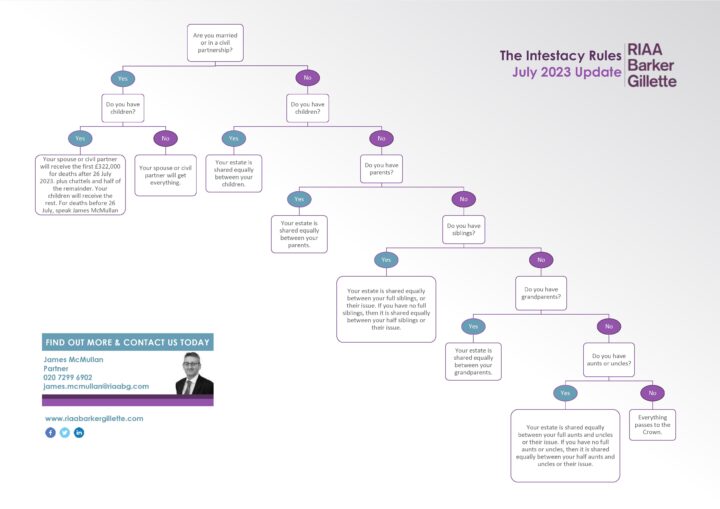
Equally, if you do not have a will and something were to happen to you before the divorce is completed then the intestacy rules would apply. These govern what happens when someone dies without a will, and, again, the spouse you are divorcing would benefit.

Updating or making a will ensures that your estate reflects the outcome that you want, which is important if you have children or if you have moved into a new relationship.”

Infochart The Intestacy Rules 2023 Update

For a larger copy of the above picture, please click here.

Recently, a new partner had to make a legal challenge to secure provisions for her infant children when their father died before the divorce to his former wife was complete. Bianca Corrado had a long-term affair with Malkiat Singh Ubbi, but his will had not provided for the children, aged three and six months, meaning the only route open to Corrado was to bring a claim on their behalf under the Inheritance Act for provision as dependents. In Ubbi v Ubbi, the High Court awarded almost £400,000 to the children from the £3.5m estate, and the case is likely to be used as future guidance for similar Inheritance Act claims on behalf of infant children in the future.

“In this case the court had to make a reasoned decision, but it may well be that the children’s father would have been more generous if he had made provision in his will. This was a positive outcome for the children but taking a case to the High Court is not an option for many people. Many people don’t like to deal with making a will, for all sorts of reasons, but the fallout for those left behind is worth keeping in mind.”

RIAA Barker Gillette’s private client team has a lot of experience drafting wills and advising on estate planning. Call Pippa Marshall today.

* The research was carried out by a team from the University of Washington and involved divorce petitions in Washington, DC, over a 14-year period.

Note: This article is not legal advice; it provides information of general interest about current legal issues.


Too poor for retirement?

On attending a very informative presentation given recently by Rathbones, one of the UK’s leading providers of investment management services, our Head of Private Client, James McMullan, was struck by the disconnect between what the government tells us about the state of the country’s finances and the reality of the situation.

Rathbones have produced an article and a detailed report referring to various official sources, all pointing to the fact that our children, the so-called “Millennials”, will be the first generation to be poorer than their parent’s generation. However, the situation is much worse than this, and the report is worth reading in full.

It is clear that the State is gradually withdrawing its responsibility for, and reducing its contribution to, the welfare of its citizens as they enter their retirement years. This makes it more important than ever that we get good and timely advice about our finances and arrange our affairs in the most tax-efficient manner possible. This starts with a well-considered tax-efficient will and structuring lifetime estate planning provisions to maximise the allowances and reliefs available under the Inheritance Tax legislation.

It is vitally important to review your financial plans and arrangements regularly (we would suggest once a year) to ensure that these are on course. Keeping in close contact with your solicitor, accountant, or financial advisor is an important part of this process. Given the challenges facing our children’s generation, families cannot afford to ignore long-term financial planning. When apathy prevails, the taxman is happy! Don’t let the Revenue take 40% of your family’s wealth when timely planning can save thousands of pounds and make our children’s lives a little bit easier.

If you have concerns over your retirement and how to put estate planning measures in place, contact James McMullan today.

Note: This article does not constitute legal advice; it provides information of general interest about current legal issues.


Landlords must check they hit the spot with deposits

According to figures from insurers, the number of claims relating to deposits peaked at 25% of all professional indemnity claims made by estate and letting agents in the first quarter of this year, up from just 3% last year. The claims most often relate to a landlord lodging a deposit late or failing to provide the correct information to the tenant about the terms and the deposit scheme used.

Under the Housing Act 2004, any deposit must be held by the landlord pursuant to an Assured Shorthold Tenancy Agreement (AST) in a registered deposit protection scheme and within 30 days, the tenant must be given specific details of the deposit protection scheme used and details about how the scheme works.

If a court rules that a landlord has failed in their duty, it can impose fines of up to three times the value of the deposit and the return of the deposit in addition to a fine, which must be paid within 14 days of the court order.

Property litigation expert Laura St-Gallay explains:

“It’s the landlord who will find themselves subject to the county court order. They may be able to bring a claim against the letting agent, if there is one involved, who in turn will claim on their professional indemnity insurance. It’s a costly business and bad in reputational terms for all concerned.”

She added:

“The legislation has been in place for a long time, but we see both agents and landlords getting it wrong still. Where landlords have a big property portfolio, they are more likely to have the right processes in place. For small-scale landlords or the accidental ones who may have ended up renting out their home while working elsewhere, it’s worth adopting some of the practices of the big boys as it’s no defence to say you didn’t know or had left it to your agent.

That includes taking some time to understand the law as it affects you as a landlord and having checklists for each stage of the tenancy. Then you need to ensure they are used each time, whether you are doing it yourself or checking that your agency has acted properly on your behalf. In the worst-case scenario, if you haven’t used a deposit scheme when you should have, the court can rule that a tenant does not have to leave the property when the tenancy ends.”

In addition to ensuring that the deposit is properly protected within the relevant time scales and that the Prescribed Information is provided to the tenant, landlords must now ensure that tenants are provided with a copy of the current “How to Rent” Guide, the current Energy Performance Certificate (EPC) and, before the tenancy commences, a Gas Safety Certificate.

This becomes even more important given that non-compliance can hinder the service and use of the Section 21 possession notice procedure. This can result in delays in recovering possession of the property and returning the deposit, putting landlords in an unprotected and weak position.

If you wish to discuss the steps to be taken before entering into any AST, call Laura St-Gallay, who can advise and ensure you enter into a fully compliant AST, or alternatively, if you need advice on how to recover possession of your property, Laura can also assist.

Note: This article is not legal advice; it provides information of general interest about current legal issues.


The hidden disability: when mental health affects employee wellbeing

The taboo of talking about mental health has started to shift following several high-profile campaigns. Still, many employers are keeping quiet and avoiding conversations with staff, even though they have legal responsibilities, and it’s been shown to improve the bottom line.

According to the Health & Safety Executive, over 11 million working days are lost each year because of stress in the workplace. Research among workers by MIND, the mental health charity, found that a continuing culture of fear and silence around the topic was adding up to a big cost to employers, with over 20% reporting they had called in sick to avoid workplace stress, and 30% saying they did not feel they would be able to speak openly with their line manager about the issue.

Such figures highlight the need for companies to have strategies focused on mental health as part of employee wellbeing, tackle stress-related absences, and avoid potential complaints or even litigation from staff.

Employers have a legal duty to protect employees from stress at work by undertaking a risk assessment and acting on it. Where an employee suffers from a mental health condition that has a long-term effect on day-to-day activity, this may be classed as a disability, requiring the employer to take positive action under the Equality Act 2010. The Equality Act makes it unlawful for an employer to treat a disabled person less favourably because of their disability without a justifiable reason.

Employment lawyer Karen Cole:

“Best practice is for employers to have clearly stated policies that are reflected in the company’s culture, so that a manager who notices a change in personality, evidence of low mood or periods of increased absence, will feel equipped to enquire if any workplace support is needed. It needs to happen in a supportive environment where the employee feels comfortable in opening up and asking for help, if needed.

It’s important to avoid an atmosphere where an employee feels that raising the issue of mental health may affect their future prospects, or that they will feel stigmatised by asking for help. Unwillingness to talk can make for a difficult position for employers.”

Such difficulties have been highlighted in disability discrimination claims which have reached the Court of Appeal. One case involved a former employee of Newport City Council, who had been off work on three separate occasions for stress-related illness and depression. Finally, the Council asked an occupational health advisor for an opinion on whether the employee was fit for work. The opinion given was that he was not a candidate for ill-health retirement and that he was not disabled for discrimination purposes. When he was subsequently dismissed following allegations of bullying, he brought a claim of disability discrimination. The Council said that it relied upon the opinion of an occupational health expert. Still, the Court of Appeal said that an employer must make a factual judgement and cannot “simply rubber stamp the adviser’s opinion”.

This need to look more carefully was reflected in another case involving an employee who had been resistant to discussing her health issues and would not allow contact with her GP. Here the Court of Appeal found in favour of her employer, Liberata UK Ltd, because the company did all it could “reasonably be expected to have done” – it did not rely solely upon occupational health advice but reviewed it in the light of its own experience and impressions of the employee and undertook its own further investigations.

Karen added:

“In creating and maintaining a culture of wellbeing, an employer should start from a perspective of how best to provide everyone with responsible support and protection from unfair or discriminatory treatment and should reflect that in processes and practice. If anyone has issues that impact on how they may perform a particular function – whether related to physical or mental health – then it’s important to look at how to introduce reasonable adjustments to enable them to fulfil the role.”

If you have any queries regarding mental health in the workplace, call Karen Cole today!

Note: This article is not legal advice; it provides information of general interest about current legal issues.


ACAS guidance on employment references

Does an employer need to provide an employment reference?

An employer can provide an employment reference and decide on the amount of information they provide within the reference. Special circumstances may mean an employer is obliged to provide a reference. For example, when an agreed reference forms part of the terms of a settlement agreement or employers that are regulated by the Financial Conduct Authority or the Prudential Regulation Authority.

What must a reference include?

The reference can include basic facts such as job descriptions, answers to questions that the potential employer has asked, and any details about the applicant’s skills and abilities or strengths and weaknesses concerning the suitability of an applicant for the new role they have applied for.

Can a bad reference be given?

The reference must be ‘accurate’ and ‘fair’ and must not contain any ‘misleading’ or ‘inaccurate’ information.

What issues can arise with giving references?

Applicants can request a copy of the reference sent to the new employer if they wish.

It is usually best practice and safest for employers to have a policy about what references will cover. That way, employees know what to expect. It is generally safest to limit references to factual issues, such as the job applicant’s employment dates and job description. If an employer provides a reference for some individuals but not others, it could face allegations of discrimination, victimisation, or breach of trust and confidence. Employers also need to be mindful that there is no obligation within a contract with the employee to provide a reference.

Employers should record on an individual’s file whether or not the employee wishes the employer to provide a reference.

Suppose there is ever any doubt over whether or not an individual has given consent for an employer to give a reference. In that case, the employer should contact them to check whether they should provide the reference.

If a reference included information about an individual’s health, the employer would need the individual’s consent before disclosing that information.

For further advice on references or any other employment issue, speak to solicitor Karen Cole today.

Note: This article is not legal advice; it provides information of general interest about current legal issues.


Employee data subject access requests

Under the Act, a “data subject” can make a data subject access request (a DSAR), and a “data controller” has a duty to comply, subject to some exceptions.

Although responding to a DSAR can be time-consuming and expensive, the obligations of transparency under the Act mean that you must be willing to explain how you are handling the request and to confirm this to the employee within the required time limit. If you do not, the employee may feel aggrieved and believe that you have failed to comply with the Act’s requirements, leaving you vulnerable to a potential complaint being made to the ICO or a court order to comply with the DSAR.

It is, therefore, important to respond to a DSAR in an appropriate manner.

What to do if you receive data subject access requests from employees

You should make an initial assessment to consider:

  1. whether or not you store or process data concerning the employee;
  2. whether you intend to respond;
  3. the scope of the request; and
  4. the proposed approach to finding the data and dealing with the response.

In general, regardless of any suspicions about the employee’s motivation, you should approach compliance in a positive and helpful way:

  1. you must facilitate the exercise of the DSAR;
  2. the request must be handled fairly and transparently;
  3. information must be provided in a concise, transparent, intelligible and easily accessible form, using clear and plain language.

In the employment forum, DSARs are frequently made in the context of an ongoing dispute or a tribunal or court claim. An employee may be genuinely motivated by a wish to find out what data is being processed and to ensure that it is accurate. However, the employee may also see the trouble and expense to which you may be put by dealing with a DSAR as offering useful leverage in a dispute and in achieving a settlement.

Your response

Your response should be in writing or, if appropriate, by electronic means. If the request was made originally by electronic means, information should be provided “in a commonly used” electronic form unless otherwise requested by the employee. At the employee’s request, the information may be provided orally as long as you are certain of the identity of the individual making the request. However, oral requests are rare.

Except in perhaps very straightforward cases, it would be sensible to take legal advice before either substantively responding to a DSAR or indicating a refusal to deal with such a request.

Are there any exceptions to the DSAR?

Under the Act, there is no obligation to comply with a DSAR in relation to the following:

Personal data in respect of which a claim of legal professional privilege could be maintained in legal proceedings. This applies only to documents which carry legal professional privilege for the purposes of English law.

Reference

A reference given (or to be given) in confidence for employment, training or educational purposes. The exemption covers the personal data within the reference, whether processed by the reference giver or the recipient.

Management

Personal data is processed for the purposes of management forecasting or management planning in relation to a business or other activity to the extent that complying with a DSAR would prejudice the conduct of the business or activity. For example, it is likely to prejudice the conduct of a business if information on a staff redundancy programme is disclosed before it is announced to the rest of the workforce.

Records of Intent

Personal data consisting of records of intentions in relation to negotiations between the employer and employee to the extent that compliance with the DSAR would be likely to prejudice the negotiations.

Other

Other exceptions relate to regulatory functions, judicial appointments and proceedings, the honours system, criminal investigations, tax collections and various corporate finance services.

What happens if you do not respond to a DSAR?

Other than in exceptional cases, you will be under a duty to take action on a request by responding. There are, however, some circumstances in which you may decide not to take action. Examples might be where:

  • the person to whom the DSAR was addressed is not the data controller (perhaps because it is acting as a data processor or someone else is the controller);
  • the request is unfounded or excessive; and/or
  • you can demonstrate that the request infringes the EU doctrine of abuse of rights.

If so, you must tell the employee without delay and, at the latest, within one month of receipt of the request. You must give reasons for not taking action. You must tell the employee of the possibility of complaining to the supervisory authority and taking legal proceedings.

Except in clear circumstances and in which you are confident you can justify a decision not to take action on a request (as might be the case if you are not the controller), you should engage with the employee and seek to limit the request.

For more information on data subject access requests, speak to employment lawyer Karen Cole today.

Note: This article is not legal advice; it provides information of general interest about current legal issues.


Islamic Wills in England and Wales

The European Convention on Human Rights gives everyone in the UK a right to freedom of thought, conscience and religion. This includes the freedom for an individual to live and die following their faith. This, coupled with English law’s principle of testamentary freedom, allows everyone over the age of 18, with mental capacity, to create a will.

Accordingly, a Muslim over 18 years old with full mental capacity has the right to dispose of his or her assets in accordance with Sharia law, subject to compliance with English law.

How to create an Islamic will

The legal requirements set out in section 9 of the Wills Act 1837 must be complied with for a will to be valid. In brief, a will must be:

  • in writing;
  • signed with the intention to give effect to the will; and
  • signed in the presence of two or more witnesses.

As with any will, care should be taken in selecting any executor(s). Sharia law recommends choosing Muslim men who have knowledge of Sharia law as their knowledge will assist them in making decisions during the estate administration. For example, investing monies in a trust fund in accordance with Islamic finance rules. Further, the will should declare the testator’s intention to follow Sharia law. This will be useful should the will be challenged.

Documenting any funeral wishes within your will, including any preferred burial site, is also useful. Many Islamic wills directly object to having an autopsy, although that will likely be a matter for English law and the relevant authorities.

Sharia law sets out strict rules determining how an individual’s assets are administered upon death. These have been prescribed in the Quran and are vastly different to English law.

Failing to create a will, Islamic or otherwise, will result in the deceased’s personal assets being distributed in accordance with the Intestacy Rules.

For a simple guide to the Intestacy Rules, see our flowchart below(a larger copy of which can be found here):

Infochart The Intestacy Rules 2023 Update

For a larger copy of the above image, click here.

These distribution rules are vastly different from those set out in the Quran. Beneficiaries under the Intestacy Rules may elect to distribute the estate in accordance with Sharia law. However, it may not be in their interest to do so, and the lack of a will can lead to family disputes.

Sharia law and estate planning

In England and Wales, estates over £325,000 are subject to a 40% Inheritance Tax, subject to any other available reliefs and exemptions. Sharia law is not the most tax-efficient way to distribute an estate as it does not fully utilise reliefs and exemptions available such as the residential nil rate band (also known as the “additional threshold”) or a spouse’s exemption.

Lifetime estate planning can assist in reducing the Inheritance Tax payable under Sharia law distribution.

Before creating an Islamic will speak to our wills, tax and trusts specialist, James McMullan, to ensure you create a valid will, attempt to minimise your Inheritance Tax liability and avoid potential claims against your estate under the Inheritance Act.

You should review your will every 18 to 24 months and whenever a life-changing event occurs, such as a birth, death, marriage*, divorce or an increase in wealth.

* It is important to note that a marriage revokes a will in its entirety, but a divorce does not, although a gift in a will to a spouse who is later divorced by the testator will be treated as if the spouse had pre-deceased.

Note: This is not legal advice; it provides information of general interest about current legal issues.


Tracking your digital worth for the next generation

In research undertaken by accountants PWC, the value of our digital assets was estimated at £25bn, yet in a YouGov poll over half of those surveyed admitted nobody would be able to access such assets after their deaths, as they had not made any arrangements to deal with what would happen.

As a result, finding out how to protect confidential information and pass on digital assets is becoming increasingly important – whether when making a will and appointing executors, or considering attorneys to act during a period of ill health or other incapacity.

Digital assets include all content, accounts and files created and stored in a digital form, whether online, in the cloud, or on a computer or smartphone. These assets may have great financial or sentimental value.

Obvious examples of assets with a tangible financial value would be bank, building society or other types of investment accounts, but could also include gambling accounts, cryptocurrency accounts and internet payment accounts like PayPal.

Social media accounts, personal photographs and other personal records and correspondence may only have sentimental value, but in between, there may be some that have a potential value, such as domain names, blogs, or affiliate accounts that generate advertising revenue.

As the Yougov research highlighted a common problem associated with digital assets is that it is not always clear who owns digital content after death. Often the reason for this is that users found the detailed terms & conditions too difficult to understand or so long-winded that they did not read them. Some digital assets may be only a licence to use services, such as online music and media supplied through Apple’s iTunes. This sort of licence is personal to the individual and cannot be transferred to another person.

“Protecting digital assets by making sure your executors know exactly what you own is becoming increasingly important, so you need to make sure it’s on the list when it comes to making or updating your will.” private client solicitor James McMullan explains.

“Physical assets are relatively easy to identify, but if you don’t provide any record of assets held online, it’s quite possible they would be overlooked. The other problem is where access is blocked, which may be because executors don’t have the log on information or because they don’t have authority to access the account.”

Some accounts will not allow access by a third party, even if they are authorised to do so by the account holder, and in this case, it would be unlawful if executors access the account using the account holder’s log-in information.

This restriction may also be a problem for attorneys acting under a power of attorney, whether for a specific purpose or, more generally, under a Lasting Power of Attorney (LPA) for financial affairs. An LPA, which allows an individual to appoint one or more people to act as their ‘attorneys’ to help in the management of their affairs, is common among older people or those suffering from long-term illness. However, they are increasingly put in place by younger people who may need to enable partners or others to act on their behalf while they are away, for example, when travelling for business.

Protecting your digital assets

  • Make a full listing of all digital assets, including where they are stored; keep the listing updated regularly and store it securely. This can be alongside your will.
  • Make a record of all usernames and passwords, together with the email address associated with the account, in case it is needed to reset a password, and store this separately and securely from the full listing. There are also software options for secure storage of account details and passwords.
  • Never include any personal log-on information or account information within the will itself, as it becomes a public document once the Courts issue a Grant of Probate to executors. Similarly, no such information should be included in a Lasting Power of Attorney as the document must be shared with institutions and companies when attorneys request authority.
  • Assets that have only sentimental value, such as photographs, can be gifted within your will as personal chattels, to ensure they do not get overlooked.
  • For all online assets, check the small print and find out what happens to the account on death and then leave guidance to your executors, including whether you wish any particular accounts to be deleted or held as memorials.
  • Give specific authority to your executors to access and manage all your digital assets. This should be in writing and can be included within your will or made in a separate document that is signed and witnessed.

Speak to James McMullan today to track your digital worth for the next generation.

Note: This is not legal advice; it is intended to provide information of general interest about current legal issues.


Cohabitant agreements: giving unmarried couples rights

Even if you have spent years jointly contributing to the running of a house, splitting the mortgage between you, having children together or living with each other for decades, losing a partner could change everything.

If the relationship ends through separation or bereavement, unmarried cohabiting couples do not have the same or similar rights as married couples. Nor do they have the same rights as those living in civil partnerships. Both heterosexual and same-sex couples are vulnerable if they don’t have that piece of paper saying that the state recognises their relationship in law.

So how can an unmarried couple protect themselves if they don’t want to get married or are ineligible for a civil partnership? The best way is to draw up a cohabitant agreement.

What is a cohabitant agreement?

A cohabitant agreement is very similar to a pre-nuptial agreement. It is a document that lays down precisely who owns what, property rights and arrangements, the care of any children and how debts are dealt with if one of the couple either passes on or leaves the relationship. It is usually signed by both partners and notarised by a solicitor.

This doesn’t, however, make it a legally binding document. Like pre-nuptial agreements, cohabitant agreements are exactly what they say they are – agreements. It lays out the expressed wishes of the couple should the relationship break down or a partner dies, but if the next of kin does not agree with the terms of the agreement, then it can be easily challenged in court.

In most cases, as long as the welfare of any children is not impacted, the courts will recognise a cohabitant agreement and are unlikely to interfere, especially if most of the document deals with financial or property arrangements. The courts can rule to enforce a cohabitant agreement, but the document itself is not technically legally binding. We would also recommend that you make wills to provide for each other.

Surely the fact I’m a common-law spouse is enough?

The term ‘common law’ is a misnomer when used about relationships. It is certainly a well-known phrase, but it is not recognised in law, and as far as the courts are concerned, there’s no formal or recognised ‘common law’ relationship, even if you’ve been together for years.

What happens if you don’t have an agreement?

If you’re unmarried but in a long-term relationship with someone and don’t have a cohabitant agreement, then the death of a partner can be particularly traumatic. Without an agreement, there is no provision in law for the remaining partner to inherit any of their deceased partner’s estate. A surviving partner is not exempt from Inheritance Tax, either something a married or civil partnership couple have.

To receive anything from the deceased person’s estate, the surviving partner must go to court to prove that they co-owned assets – everything from the car, the house, or even the TV. In short, without some form of legal protection, surviving co-habitant partners could be left with nothing.

What should go into a cohabitant agreement?

Just like any formal agreement, they should be as detailed as possible. If unsure, you should talk to a family law solicitor, like Pippa Marshall, who will help you draw up a cohabitant agreement that could protect you both.

Your agreement should include:

  • a statement of intent – explaining exactly the nature of the agreement;
  • personal details and full disclosure of your financial assets, including inheritance and wills;
  • how any possessions/financial assets or property should be dealt with;
  • income and expenses – whether finances are covered in a joint agreement or kept separate, and whether one partner will support the other should they stop working or be unable to work;
  • clear arrangements concerning children, including their educational needs; and
  • mortgage payments on any joint-owned property, and who pays what if the couple separates.

Other clauses can be included, as there is no formal template for a cohabitant agreement. Therefore, getting good legal advice before drawing up any agreement that could be challenged in a court of law is important.

Speak to Pippa Marshall today.

Note: This is not legal advice; it provides information of general interest about current legal issues.


Stay in touch

Subscribe to our newsletter

Stay in touch

By completing your details and submitting this form you confirm you are happy for us to send you marketing communications and that you agree to our Website Privacy Policy and Legal Notice and to us using Mailchimp to process your data.


Sending

News/Insight

  • Understanding Court of Protection applications in England and Wales
    When someone can no longer make decisions for themselves and has not put a Lasting Power of Attorney in place, the Court of Protection can step in. This article explains what the Court of Protection does, when an application may be needed, and what t


    Read more
  • Warranties and indemnities: Key protections in share and asset sales
    An overview of warranties and indemnities in share and asset sales, explaining key differences, common protections, liability limits and risk allocation.


    Read more
  • The Employment Rights Act is a call to action for employers 
    A new year, a new employment framework: what employers need to know about the Employment Rights Act passed by parliament in December 2025.


    Read more
  • Dilapidations explained: What commercial tenants and landlords need to know
    Dilapidations are a common source of dispute at the end of a commercial lease. They can involve significant sums of money and often come as an unwelcome surprise to tenants who believed they had left a property in reasonable condition. Understanding


    Read more
  • The role of due diligence in corporate transactions
    In corporate transactions, due diligence is a key stage that usually follows agreement of Heads of Terms, allowing the Buyer to investigate the target company or its assets before committing to the deal.


    Read more

What they say...

  • Sharla Munian, February 2026
    Outstanding Legal Support and a Brilliant Result “I cannot recommend RIAA Barker Gillette highly enough. My solicitor supported me throughout a very challenging property litigation matter, and thanks to her expertise, dedication, and strategic

  • Client, February 2026
    Very good service in disagreement with architect “RIAA assisted me in a conflict I had with my architect, who wanted to overcharge me. The end result was satisfactory, with invoices reasonable despite being slightly higher than expected!”

  • Sharla Munian, February 2026
    Outstanding Solicitor Who Delivered the Outcome I Hoped For “After a number of years navigating a complex financial settlement following my separation, my solicitor has been incredible from start to finish. Their professionalism, patience, and

  • Peter, February 2026
    Advice on potential claims by an employee & settlement negotiation “Clear, efficient advice and timely execution. I would highly recommend Patrick and RIAA Barker Gillette.”

  • Amish Bristol, January 2026
    Absolutely brilliant, fast, professional, clear and delivered a robust service “Recent mortgage oversight from Ben Marks and Anne was superbly dealt with, and I intend on moving all my business to them. For a big firm, they really do pay attent

Read more