
ACAS guidance on employment references

Does an employer need to provide an employment reference?

An employer can provide an employment reference and decide on the amount of information they provide within the reference. Special circumstances may mean an employer is obliged to provide a reference. For example, when an agreed reference forms part of the terms of a settlement agreement or employers that are regulated by the Financial Conduct Authority or the Prudential Regulation Authority.

What must a reference include?

The reference can include basic facts such as job descriptions, answers to questions that the potential employer has asked, and any details about the applicant’s skills and abilities or strengths and weaknesses concerning the suitability of an applicant for the new role they have applied for.

Can a bad reference be given?

The reference must be ‘accurate’ and ‘fair’ and must not contain any ‘misleading’ or ‘inaccurate’ information.

What issues can arise with giving references?

Applicants can request a copy of the reference sent to the new employer if they wish.

It is usually best practice and safest for employers to have a policy about what references will cover. That way, employees know what to expect. It is generally safest to limit references to factual issues, such as the job applicant’s employment dates and job description. If an employer provides a reference for some individuals but not others, it could face allegations of discrimination, victimisation, or breach of trust and confidence. Employers also need to be mindful that there is no obligation within a contract with the employee to provide a reference.

Employers should record on an individual’s file whether or not the employee wishes the employer to provide a reference.

Suppose there is ever any doubt over whether or not an individual has given consent for an employer to give a reference. In that case, the employer should contact them to check whether they should provide the reference.

If a reference included information about an individual’s health, the employer would need the individual’s consent before disclosing that information.

For further advice on references or any other employment issue, speak to solicitor Karen Cole today.

Note: This article is not legal advice; it provides information of general interest about current legal issues.

Employee data subject access requests

Under the Act, a “data subject” can make a data subject access request (a DSAR), and a “data controller” has a duty to comply, subject to some exceptions.

Although responding to a DSAR can be time-consuming and expensive, the obligations of transparency under the Act mean that you must be willing to explain how you are handling the request and to confirm this to the employee within the required time limit. If you do not, the employee may feel aggrieved and believe that you have failed to comply with the Act’s requirements, leaving you vulnerable to a potential complaint being made to the ICO or a court order to comply with the DSAR.

It is, therefore, important to respond to a DSAR in an appropriate manner.

What to do if you receive data subject access requests from employees

You should make an initial assessment to consider:

  1. whether or not you store or process data concerning the employee;
  2. whether you intend to respond;
  3. the scope of the request; and
  4. the proposed approach to finding the data and dealing with the response.

In general, regardless of any suspicions about the employee’s motivation, you should approach compliance in a positive and helpful way:

  1. you must facilitate the exercise of the DSAR;
  2. the request must be handled fairly and transparently;
  3. information must be provided in a concise, transparent, intelligible and easily accessible form, using clear and plain language.

In the employment forum, DSARs are frequently made in the context of an ongoing dispute or a tribunal or court claim. An employee may be genuinely motivated by a wish to find out what data is being processed and to ensure that it is accurate. However, the employee may also see the trouble and expense to which you may be put by dealing with a DSAR as offering useful leverage in a dispute and in achieving a settlement.

Your response

Your response should be in writing or, if appropriate, by electronic means. If the request was made originally by electronic means, information should be provided “in a commonly used” electronic form unless otherwise requested by the employee. At the employee’s request, the information may be provided orally as long as you are certain of the identity of the individual making the request. However, oral requests are rare.

Except in perhaps very straightforward cases, it would be sensible to take legal advice before either substantively responding to a DSAR or indicating a refusal to deal with such a request.

Are there any exceptions to the DSAR?

Under the Act, there is no obligation to comply with a DSAR in relation to the following:

Personal data in respect of which a claim of legal professional privilege could be maintained in legal proceedings. This applies only to documents which carry legal professional privilege for the purposes of English law.

Reference

A reference given (or to be given) in confidence for employment, training or educational purposes. The exemption covers the personal data within the reference, whether processed by the reference giver or the recipient.

Management

Personal data is processed for the purposes of management forecasting or management planning in relation to a business or other activity to the extent that complying with a DSAR would prejudice the conduct of the business or activity. For example, it is likely to prejudice the conduct of a business if information on a staff redundancy programme is disclosed before it is announced to the rest of the workforce.

Records of Intent

Personal data consisting of records of intentions in relation to negotiations between the employer and employee to the extent that compliance with the DSAR would be likely to prejudice the negotiations.

Other

Other exceptions relate to regulatory functions, judicial appointments and proceedings, the honours system, criminal investigations, tax collections and various corporate finance services.

What happens if you do not respond to a DSAR?

Other than in exceptional cases, you will be under a duty to take action on a request by responding. There are, however, some circumstances in which you may decide not to take action. Examples might be where:

  • the person to whom the DSAR was addressed is not the data controller (perhaps because it is acting as a data processor or someone else is the controller);
  • the request is unfounded or excessive; and/or
  • you can demonstrate that the request infringes the EU doctrine of abuse of rights.

If so, you must tell the employee without delay and, at the latest, within one month of receipt of the request. You must give reasons for not taking action. You must tell the employee of the possibility of complaining to the supervisory authority and taking legal proceedings.

Except in clear circumstances and in which you are confident you can justify a decision not to take action on a request (as might be the case if you are not the controller), you should engage with the employee and seek to limit the request.

For more information on data subject access requests, speak to employment lawyer Karen Cole today.

Note: This article is not legal advice; it provides information of general interest about current legal issues.


Islamic Wills in England and Wales

The European Convention on Human Rights gives everyone in the UK a right to freedom of thought, conscience and religion. This includes the freedom for an individual to live and die following their faith. This, coupled with English law’s principle of testamentary freedom, allows everyone over the age of 18, with mental capacity, to create a will.

Accordingly, a Muslim over 18 years old with full mental capacity has the right to dispose of his or her assets in accordance with Sharia law, subject to compliance with English law.

How to create an Islamic will

The legal requirements set out in section 9 of the Wills Act 1837 must be complied with for a will to be valid. In brief, a will must be:

  • in writing;
  • signed with the intention to give effect to the will; and
  • signed in the presence of two or more witnesses.

As with any will, care should be taken in selecting any executor(s). Sharia law recommends choosing Muslim men who have knowledge of Sharia law as their knowledge will assist them in making decisions during the estate administration. For example, investing monies in a trust fund in accordance with Islamic finance rules. Further, the will should declare the testator’s intention to follow Sharia law. This will be useful should the will be challenged.

Documenting any funeral wishes within your will, including any preferred burial site, is also useful. Many Islamic wills directly object to having an autopsy, although that will likely be a matter for English law and the relevant authorities.

Sharia law sets out strict rules determining how an individual’s assets are administered upon death. These have been prescribed in the Quran and are vastly different to English law.

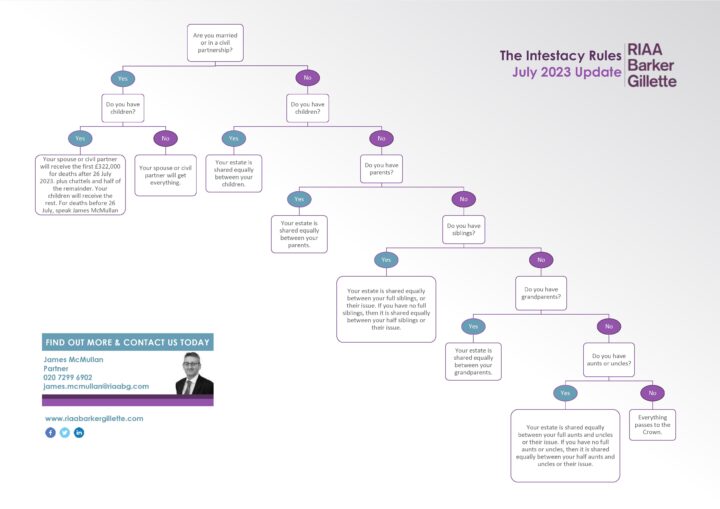
Failing to create a will, Islamic or otherwise, will result in the deceased’s personal assets being distributed in accordance with the Intestacy Rules.

For a simple guide to the Intestacy Rules, see our flowchart below(a larger copy of which can be found here):

Infochart The Intestacy Rules 2023 Update

For a larger copy of the above image, click here.

These distribution rules are vastly different from those set out in the Quran. Beneficiaries under the Intestacy Rules may elect to distribute the estate in accordance with Sharia law. However, it may not be in their interest to do so, and the lack of a will can lead to family disputes.

Sharia law and estate planning

In England and Wales, estates over £325,000 are subject to a 40% Inheritance Tax, subject to any other available reliefs and exemptions. Sharia law is not the most tax-efficient way to distribute an estate as it does not fully utilise reliefs and exemptions available such as the residential nil rate band (also known as the “additional threshold”) or a spouse’s exemption.

Lifetime estate planning can assist in reducing the Inheritance Tax payable under Sharia law distribution.

Before creating an Islamic will speak to our wills, tax and trusts specialist, James McMullan, to ensure you create a valid will, attempt to minimise your Inheritance Tax liability and avoid potential claims against your estate under the Inheritance Act.

You should review your will every 18 to 24 months and whenever a life-changing event occurs, such as a birth, death, marriage*, divorce or an increase in wealth.

* It is important to note that a marriage revokes a will in its entirety, but a divorce does not, although a gift in a will to a spouse who is later divorced by the testator will be treated as if the spouse had pre-deceased.

Note: This is not legal advice; it provides information of general interest about current legal issues.


Tracking your digital worth for the next generation

In research undertaken by accountants PWC, the value of our digital assets was estimated at £25bn, yet in a YouGov poll over half of those surveyed admitted nobody would be able to access such assets after their deaths, as they had not made any arrangements to deal with what would happen.

As a result, finding out how to protect confidential information and pass on digital assets is becoming increasingly important – whether when making a will and appointing executors, or considering attorneys to act during a period of ill health or other incapacity.

Digital assets include all content, accounts and files created and stored in a digital form, whether online, in the cloud, or on a computer or smartphone. These assets may have great financial or sentimental value.

Obvious examples of assets with a tangible financial value would be bank, building society or other types of investment accounts, but could also include gambling accounts, cryptocurrency accounts and internet payment accounts like PayPal.

Social media accounts, personal photographs and other personal records and correspondence may only have sentimental value, but in between, there may be some that have a potential value, such as domain names, blogs, or affiliate accounts that generate advertising revenue.

As the Yougov research highlighted a common problem associated with digital assets is that it is not always clear who owns digital content after death. Often the reason for this is that users found the detailed terms & conditions too difficult to understand or so long-winded that they did not read them. Some digital assets may be only a licence to use services, such as online music and media supplied through Apple’s iTunes. This sort of licence is personal to the individual and cannot be transferred to another person.

“Protecting digital assets by making sure your executors know exactly what you own is becoming increasingly important, so you need to make sure it’s on the list when it comes to making or updating your will.” private client solicitor James McMullan explains.

“Physical assets are relatively easy to identify, but if you don’t provide any record of assets held online, it’s quite possible they would be overlooked. The other problem is where access is blocked, which may be because executors don’t have the log on information or because they don’t have authority to access the account.”

Some accounts will not allow access by a third party, even if they are authorised to do so by the account holder, and in this case, it would be unlawful if executors access the account using the account holder’s log-in information.

This restriction may also be a problem for attorneys acting under a power of attorney, whether for a specific purpose or, more generally, under a Lasting Power of Attorney (LPA) for financial affairs. An LPA, which allows an individual to appoint one or more people to act as their ‘attorneys’ to help in the management of their affairs, is common among older people or those suffering from long-term illness. However, they are increasingly put in place by younger people who may need to enable partners or others to act on their behalf while they are away, for example, when travelling for business.

Protecting your digital assets

  • Make a full listing of all digital assets, including where they are stored; keep the listing updated regularly and store it securely. This can be alongside your will.
  • Make a record of all usernames and passwords, together with the email address associated with the account, in case it is needed to reset a password, and store this separately and securely from the full listing. There are also software options for secure storage of account details and passwords.
  • Never include any personal log-on information or account information within the will itself, as it becomes a public document once the Courts issue a Grant of Probate to executors. Similarly, no such information should be included in a Lasting Power of Attorney as the document must be shared with institutions and companies when attorneys request authority.
  • Assets that have only sentimental value, such as photographs, can be gifted within your will as personal chattels, to ensure they do not get overlooked.
  • For all online assets, check the small print and find out what happens to the account on death and then leave guidance to your executors, including whether you wish any particular accounts to be deleted or held as memorials.
  • Give specific authority to your executors to access and manage all your digital assets. This should be in writing and can be included within your will or made in a separate document that is signed and witnessed.

Speak to James McMullan today to track your digital worth for the next generation.

Note: This is not legal advice; it is intended to provide information of general interest about current legal issues.


Cohabitant agreements: giving unmarried couples rights

Even if you have spent years jointly contributing to the running of a house, splitting the mortgage between you, having children together or living with each other for decades, losing a partner could change everything.

If the relationship ends through separation or bereavement, unmarried cohabiting couples do not have the same or similar rights as married couples. Nor do they have the same rights as those living in civil partnerships. Both heterosexual and same-sex couples are vulnerable if they don’t have that piece of paper saying that the state recognises their relationship in law.

So how can an unmarried couple protect themselves if they don’t want to get married or are ineligible for a civil partnership? The best way is to draw up a cohabitant agreement.

What is a cohabitant agreement?

A cohabitant agreement is very similar to a pre-nuptial agreement. It is a document that lays down precisely who owns what, property rights and arrangements, the care of any children and how debts are dealt with if one of the couple either passes on or leaves the relationship. It is usually signed by both partners and notarised by a solicitor.

This doesn’t, however, make it a legally binding document. Like pre-nuptial agreements, cohabitant agreements are exactly what they say they are – agreements. It lays out the expressed wishes of the couple should the relationship break down or a partner dies, but if the next of kin does not agree with the terms of the agreement, then it can be easily challenged in court.

In most cases, as long as the welfare of any children is not impacted, the courts will recognise a cohabitant agreement and are unlikely to interfere, especially if most of the document deals with financial or property arrangements. The courts can rule to enforce a cohabitant agreement, but the document itself is not technically legally binding. We would also recommend that you make wills to provide for each other.

Surely the fact I’m a common-law spouse is enough?

The term ‘common law’ is a misnomer when used about relationships. It is certainly a well-known phrase, but it is not recognised in law, and as far as the courts are concerned, there’s no formal or recognised ‘common law’ relationship, even if you’ve been together for years.

What happens if you don’t have an agreement?

If you’re unmarried but in a long-term relationship with someone and don’t have a cohabitant agreement, then the death of a partner can be particularly traumatic. Without an agreement, there is no provision in law for the remaining partner to inherit any of their deceased partner’s estate. A surviving partner is not exempt from Inheritance Tax, either something a married or civil partnership couple have.

To receive anything from the deceased person’s estate, the surviving partner must go to court to prove that they co-owned assets – everything from the car, the house, or even the TV. In short, without some form of legal protection, surviving co-habitant partners could be left with nothing.

What should go into a cohabitant agreement?

Just like any formal agreement, they should be as detailed as possible. If unsure, you should talk to a family law solicitor, like Pippa Marshall, who will help you draw up a cohabitant agreement that could protect you both.

Your agreement should include:

  • a statement of intent – explaining exactly the nature of the agreement;
  • personal details and full disclosure of your financial assets, including inheritance and wills;
  • how any possessions/financial assets or property should be dealt with;
  • income and expenses – whether finances are covered in a joint agreement or kept separate, and whether one partner will support the other should they stop working or be unable to work;
  • clear arrangements concerning children, including their educational needs; and
  • mortgage payments on any joint-owned property, and who pays what if the couple separates.

Other clauses can be included, as there is no formal template for a cohabitant agreement. Therefore, getting good legal advice before drawing up any agreement that could be challenged in a court of law is important.

Speak to Pippa Marshall today.

Note: This is not legal advice; it provides information of general interest about current legal issues.


Understanding leasehold property

The Government has announced plans to tackle unfair leaseholder arrangements on newbuild properties, but in the meantime, as the housing market gets into full swing, it’s worth understanding the difference between freehold and leasehold property.

Increasing property prices and high population densities have seen a big increase in the number of leasehold properties across the country, as houses are split into flats and new apartment blocks are built, so there are now 1.4 million leasehold houses across England.

While leasehold arrangements are generally seen as a simple route to managing multiple occupancy buildings, over the past twenty years, there has been a big increase in the number of houses being sold by developers on a leasehold basis. These sales have seen ground rents being set at much higher levels than the ‘peppercorn’ arrangements that were typical previously and with scheduled increases. In the worst examples, leases include terms to allow the ground rent to double every ten years.

The new measures announced by the Government will target such practices, including a ban on leaseholds for almost all newbuild houses, and changes will also be made so that ground rents on new long leases – for both houses and flats – are set to zero. The Government says that it will also make it cheaper and easier for existing leaseholders to buy out their freehold, and there will be redress routes for those facing the most onerous terms.

We must wait for the details and timetable for the introduction of these changes, which are anticipated to happen during 2018, but in the meantime, whether buyer or seller, it is worth being prepared by understanding the basis on which a property is being sold. For prospective buyers, knowing the right questions to ask could save a lot of wasted time and resources. For sellers, it can ease a sale if you pre-empt any concerns and know the answers to the questions you may be asked.

What form of ownership?

It’s important to check exactly what form the ownership takes and then ask the right questions.

Freeholds

You will own the property and the land it sits on, but there may be other responsibilities that are not so obvious, such as contributing towards the maintenance of a private shared access road.

Shared freeholds

You will own your personal space in the property and generally a share of the land and the shared spaces. Any maintenance is likely to be subject to agreement between all the freeholders and the cost shared between everyone.

Leaseholds

You will be buying the right to live in the property for the remaining duration of the lease, with the land, the structure of the building and shared spaces owned by the freeholder, who may be an individual landlord or a property management company. They will hold the building insurance and consult with leaseholders about any required works, collecting service charges from each leaseholder to pay for all maintenance and managing such work. The owner of a leasehold property is effectively a tenant in a very long-term rental, having to pay an annual ground rent and ask for consent to make any changes to the property.

It’s a lease, so how long does it have to run?

Leases of between 99 and 999 years are commonly granted, and generally, the value of a property will reduce as the lease gets closer to the end but don’t expect to snap up a bargain if you’re looking for a mortgage as lenders are unlikely to make a loan on a property with anything less than 25 years left to run. If a property has only a short time left on the lease, you can ask the seller to seek an extension and transfer to you the benefit (in a Contract) of a notice served on the landlord seeking a lease extension but expect to pay a premium (to the Landlord) for the benefit following the purchase of the Property pursuant to the relevant statutory procedure.

How much is the ground rent?

Normally ground rent will apply only if it’s a leasehold property. Ground rent can be a fixed charge or one that will change over time, so check out how much is being paid currently, but look through the small print as well to be sure there are no big increases on the way. If any escalation is written in, it should not allow for a rise above the retail price index. Again, if you are seeking a mortgage, a lender will be looking to see affordability not just in the headline purchase price but also in the ongoing costs of ground rent and service charges.

How much are the service charges?

Service charges can strike fear in the hearts of leaseholders, even when they have very deep pockets, as all work is likely to be relative to the size and standing of the overall building. Be quick to ask for evidence of the service charge budget and the accounts for the past three years, and don’t be afraid to ask around about the freeholder. The agent may assure you it’s a big property management company with the right infrastructure, but if research shows they have a poor reputation in getting work done or in the amounts being charged, you’ll be glad you checked.

Are repairs and maintenance up to date?

Look at how well things are maintained as you view the property, and then check it against those service charge accounts you’ve asked for. If everywhere is looking a bit run down, there’s no evidence of regular work being done in the accounts, and there’s very little being held in the pot for future works, you can expect a big bill or an increasingly rundown environment. A survey is just as important when buying a flat as when buying a house. And, importantly, be clear about the proportion you must contribute.

And finally, for the seller, it’s always a good idea to get your ‘house in order’ by tackling paperwork before the sale board goes up. There are forms requiring detailed information about the property itself and one covering all the fixtures and fittings. If it’s a leasehold property, you will have to complete one covering details around the lease, such as the rent, service charges, insurance and future work. By working with your lawyer in advance to prepare all the forms that will be required, you’ll be well prepared to answer all the questions your potential buyer may have for you.

For more information on leasehold properties, speak to John Gillette.

Note: This article is not legal advice; it provides information of general interest about current legal issues.


Voluntary workers

A volunteer is anyone who carries out unpaid work for a charity, fundraising body or voluntary organisation. If you hire voluntary workers for your organisation, there are certain things you need to be aware of. If you happen to be a volunteer, it pays to know your rights, too. We’ve outlined some of the legalities to help you both stay on the right side of the law.

Do voluntary workers have a contract?

Although voluntary workers don’t have a contract of employment, most voluntary organisations provide volunteers with a ‘Volunteer Agreement’, which is similar to a job description. Organisations will want to avoid creating legally binding relations with volunteers that could give them worker or employee status. As such, volunteer agreements are generally short and informal in style, often phrased in terms of hopes and expectations rather than obligations. It should set out details of the organisation’s insurance cover, and any health and safety issues.

It should also outline any training you will receive as a volunteer, any expenses that will be covered, the level of support and supervision volunteers can expect to receive in their role, and how any disputes will be resolved. A volunteer agreement is not compulsory, however.

What expenses can volunteers be paid?

Volunteers are excluded from the National Minimum Wage requirements, but they can still be paid expenses such as the cost of travel, meals at work, etc. They may also be offered training, but it’s important to note that offering paid training that is not relevant to their volunteering role could mean they are classed as a worker or employee. Offering other expenses, for example, subsidised or free childcare at times when they are not volunteering, could also mean they will be classed as an employee or worker, rather than as a volunteer.

Expenses should normally be supported by receipts or a reasonable estimate. If volunteers receive any other payment, benefit or reward, they may be classed as a worker or employee and entitled to the national minimum wage. This could also apply if the organisation has promised them paid work in future. Volunteers are still eligible to claim benefits in most cases if they are only being paid expenses such as travel expenses.

What age should you be to volunteer?

There is no upper age limit in place to be a volunteer, but children under the age of 14 cannot work on a paid or voluntary basis for a profit-making organisation without special dispensation. In some cases, insurance companies may have age limits in place which may mean voluntary workers under the age of 16 or over the age of 80 are not covered.

What are your responsibilities as an employer?

There are certain legal responsibilities that you should be aware of if you are a charity or voluntary organisation employing volunteers. Firstly, you have an obligation not to discriminate when determining who to offer paid employment to. This means that you should not take into account volunteer performance when deciding whether or not to offer a voluntary worker a paid job.

Volunteer workers are covered by government health and safety legislation and you have a responsibility to resolve any health and safety issues. Employers must also protect personal data and ensure that consideration has been given to both the personal data of the volunteer and what access (and why) the volunteer may have to personal data held by the organisation generally.

Insurance cover

All organisations employing volunteers must have professional indemnity cover in place. This will cover you if a volunteer becomes injured and makes a claim or if a claim is brought against you because of the actions of a voluntary worker. You should have a specific procedure in place to deal with volunteer grievances or disciplinary issues that may arise.

Bear in mind that even if you only use volunteer workers, you will still need to have compulsory Employer’s Liability Cover by law.

Finally, if your volunteers work with children or vulnerable adults, you may also need to carry out a CRB check to ensure that they are fit to do so.

If you hire voluntary workers, or you are a volunteer talk to employment lawyer Karen Cole today.

Note: This is not legal advice; it provides information of general interest about current legal issues.


Dealing with employee theft

According to a poll commissioned by office furniture supplier Kit Out My Office, more than two-thirds of UK office workers have admitted to stealing from their employers and colleagues at some time during their careers. With the cost of stolen items averaging at £12.50 and an estimated 15 million workers having confessed to employee theft, the cost to UK employers adds up to £190 million each year. For employers, dealing with employee theft can be a difficult process. What should you do if you suspect one of your workers is stealing from your business?

Suspicion vs facts

Theft of any sort is a serious accusation to make. If, as an employer, you suspect an employee of theft, then obtaining evidence is a crucial part of the procedure. Evidence may prove your suspicions to be wrong, or they may prove them to be right. However, making an accusation of employee theft without substantial proof can leave you open to litigation. Suspicion is one thing. Solid facts are another.

Conducting an investigation

Many employers are unaware that they have a legal right to launch an investigation should they suspect an employee of stealing. The investigation must be seen to be fair and based on evidence alone. It is crucial that any investigation is also reasonable. Should the case reach an Employment Tribunal or result in the employee’s dismissal, the presiding judge will need to see a demonstration of fairness and impartiality.

The first step is to appoint an investigator. This can be someone within the office or, if it is appropriate, an external party. Your company likely has specific policies on tackling issues of this sort. However, if not, the chosen investigator should be briefed on certain aspects of the inquiry, including:

  • a timeframe in which to conduct the research;
  • guidelines on their responsibility as an investigator;
  • how their evidence will be presented;
  • minimising the investigation’s impact on employees’ morale; and
  • minimising the investigation’s impact on the day-to-day running of the business.

It is worth remembering that, ultimately, the employer bears full responsibility for the investigation’s manner, fairness and impartiality. CCTV can be an important tool in uncovering the truth of the matter, as can computer records. The chosen investigator should be given access to both.

Following up on the results of the investigation

If the evidence proves the employer’s suspicions to be groundless, then the situation should finish there. Should the employee become aware that they are or have been investigated, the best procedure is complete transparency. If appropriate, you might need to present them with the evidence that presented the grounds for suspicion.

If the investigation provides firm evidence of employee theft, you must decide what to do next. Most companies have protocols and procedures to follow. As a rule of thumb, the next step is to report the findings and present the proof to the company’s legal advisor. Smaller companies, who may not have representatives of this sort, are advised to seek the services of an employment lawyer. It is crucial to take advice at an early stage to ensure the disciplinary procedure is handled properly.

Interviewing the accused

Reporting employment theft to the police is at the employer’s discretion. This can result in criminal proceedings and either a financial fine or, in some cases, a prison sentence. However, most cases of employee theft are dealt with internally, either resulting in disciplinary action or dismissal.

Prior to any action being taken, it is strongly advised that the accused is interviewed. This gives them the opportunity to give their side of the story and is part of the process of fairness and impartiality. The interview should be conducted calmly and reasonably, and evidence supporting the accusations should be presented. Should the theft be proven, the employer should consult a legal advisor once again.

While it might seem a long road to take, riddled with procedure and red tape, ensuring that your investigations follow the appropriate guidelines and advice is as much a protective measure as it is the path to bringing a thief to justice.

Speak to employment lawyer Karen Cole today if you have concerns over theft at work.

Note: This article is not legal advice; it provides information of general interest about current legal issues.


Sign of the times

It all depends on how large the sign is and whether it is illuminated or a simple temporary banner. Illuminated signs may need permission, no matter how small they are. If you want to display an advertisement on the front of your property larger than 0.3sq metres, then you might need to apply for advertisement consent.

What if it is only temporary?

If you are putting on a local event such as a fair or street party, you can put up temporary signage up to 0.6sq metres without needing permission. Selling your house? Then ensure your estate agent’s board is no bigger than 0.5sq metres. Temporary signage should only be up for a short time. If they are up for a prolonged period, then you might find yourself on the wrong end of a fine.

Complying with advertisement permission

If you plan to erect signage outside your business, you must ensure it meets certain criteria. There are five ‘standard conditions’ that all professional advertising boards and business signs must meet:

  1. It must be kept clean. If your sign starts to look dirty and tatty, you may be asked to take it down or replace it.
  2. It must be in a safe condition – damaged signs pose a risk to the public, especially if they are large and heavy. Check regularly that your sign is safe and secure, or you could end up with a visit from the Health and Safety Executive or a council representative.
  3. It must have permission from the landowner to be there – this includes the Highways Agency if signage is being displayed at the side of the road on Highways Agency land.
  4. It must not block or hinder the interpretation of other signs, such as road, rail, waterway or aircraft signs, or make it hazardous to use these forms of transport within the vicinity of the sign.
  5. It must be removed if the planning authority withdraws permission for the sign.

Advertising that does not need permission

Not all advertising needs permission. Many signs can be erected without the need for consent, including:

  • advertisements on enclosed land;
  • advertisements on moving vehicles;
  • advertisements which are an integral part of the building’s fabric;
  • advertisements displayed on items such as petrol pumps or vending machines; and
  • advertisements displayed inside a building.

Certain conditions still apply to these types of advertisements and signs, including the size of the lettering, what goods or services they advertise, and whether the signage is illuminated.

You will probably need permission for adverts on the gable ends of buildings, some fascia signs and those that project out (where the top edge is more than 4.6m above ground level).

It is usually advisable to check before you put up an advertising board, sign or even a temporary poster.

Speak to commercial real estate partner John Gillette for more information.

Note: This is not legal advice; it is intended to provide information of general interest about current legal issues.


Contract formation

Under English law, contracts can be made orally, which frequently happens in a dynamic business environment. However, whether a binding agreement has been made depends upon the core principles of a contract being satisfied. Generally speaking, for a contract to be valid and binding, there must be:

  1. an offer from one party and acceptance of that offer by the other;
  2. a mutual intention between the parties to create legal relations;
  3. some form of “consideration” passing one way and the other (e.g. money or services); and
  4. certainty as to the terms of the contract.

Provided that these principles are complied with, a binding contract can be made at any time, in any place and in almost any manner.

These core principles of English contract law were explored in the case of MacInnes v Gross. The case concerned an investment banker (MacInnes) and the ultimate majority stakeholder in the RunningBall Group (Gross), a real-time sports data provider.

“The case sheds light on the pitfalls of relying on oral or otherwise informal arrangements made in casual settings.”

MacInnes sued Gross for €13.5m, alleging that Gross breached an oral agreement between the two whilst having dinner in Mayfair in March 2011.

MacInnes alleged that he and Gross had struck a legally binding contract at dinner, where MacInnes would assist Gross in the sale of his stake in the RunningBall Group in exchange for 15% of the difference between the actual sale price of the business and the lower of either 100m Swiss Francs or eight times the business’ 2011 earnings before interest and tax. Gross denied that such an agreement existed and said that all that had taken place was an informal meeting over dinner, at which some headline commercial terms had been discussed.

Gross accepted that when the pair met in Mayfair, there was a discussion about the future of the RunningBall Group and the possibility of MacInnes supporting the business. Gross also accepted that there was a discussion about the possibility of MacInnes participating in the benefit of a sale of the RunningBall Group. However, Gross said that all such discussions were predicated on the basis that MacInnes would invest in the RunningBall Group by buying shares at a preferential rate based on an agreed formula. Clearly, the claims being put forward by the parties, whilst broadly similar in terms of context, were significantly different in terms of substance.

Interestingly, MacInnes emailed Gross following the meeting in March 2011, setting out certain observations concerning the RunningBall Group and the options that were open to Gross regarding a possible sale. Crucially, that email contained two paragraphs concerning MacInnes’ potential role. That email was the only contemporaneous record of the discussions that had taken place over dinner and set out that MacInnes was delighted that he and Gross were “agreed on headline terms”. Contrast this to the recent case of Blue v Ashley involving Sports Direct’s CEO Mike Ashley, where no paper or electronic trace could be found evidencing the alleged contract.

Around nine months later, it became clear that a sale of the RunningBall Group was beginning to crystallise. At that point, MacInnes emailed Gross, forwarding his previous email and stating that he was conscious that their agreement had worked in his favour. MacInnes went on to say that the two of them should be “completely aligned” going forwards, and Gross replied that they needed to make a “proper contract”. MacInnes never responded to that statement, notwithstanding his obvious contention that a “proper contract” had already been made.

As time passed, MacInnes’ role in the sale of the RunningBall Group became increasingly limited; by its sale, he was almost entirely peripheral. Broadly, the terms agreed upon for the sale were:

  • €20m cash;
  • €50m worth of shares in the buying entity; and
  • deferred consideration depending on the company’s subsequent performance (initially subject to a hold-back).

On that basis, MacInnes demanded payment for €13.5m as the “objective market value of his services”, referencing the formula agreed by the parties under the alleged contract made in March 2011.

The Court was, therefore, required to determine whether a legally binding contract had indeed been made when MacInnes met with Gross in March 2011.

Unfortunately for MacInnes, the Court favoured Gross without much hesitation. Indeed, the judge was “firmly of the view that no binding contract was made [and that] there was no intention to create legal relations.”

Interestingly, the judge affirmed that “the mere fact that the discussion took place over dinner in a smart restaurant does not, of itself, preclude the coming into existence of a binding contract. A contract can be made anywhere, in any circumstances. But I consider that the fact that this alleged agreement was made in a highly informal and relaxed setting means that the court should closely scrutinise the contention that, despite the setting, there was an intention to create legal relations.”

“The key takeaway from this case is that relying on informal arrangements is simply not worth the risk. Unfortunately, Mr MacInnes learned the hard way that legal agreements should be documented in writing with the benefit of clear and considered legal advice.”

For more information on contract formation, speak to corporate lawyer Veronica Hartley today.

Note: This is not legal advice; it is intended to provide information of general interest about current legal issues.


Stay in touch

Subscribe to our newsletter

Stay in touch

By completing your details and submitting this form you confirm you are happy for us to send you marketing communications and that you agree to our Website Privacy Policy and Legal Notice and to us using Mailchimp to process your data.


Sending

News/Insight

  • Renters’ Rights Act: why process and paperwork matter more than ever for landlords
    The Renters’ Rights Act has now passed into law, marking one of the most significant shifts in the private rented sector in a generation. Most of the new measures will take effect in May 2026, with a national landlord database to follow later in th


    Read more
  • Understanding the Roles of Executors and Trustees
    When making a will, you place significant trust in those appointed to carry out your wishes. Executors and trustees are key roles, often held by the same people, but their responsibilities differ. Understanding these roles and their obligations helps


    Read more
  • Assigning or Subletting a Commercial Lease: What Tenants Need to Know
    This article explains the key differences between assignment and subletting, outlines the legal framework in England and Wales, and highlights the practical issues tenants should consider before taking action.


    Read more
  • Completion and post-completion steps in a sale: Final steps for sellers
    A guide to completion and post completion steps in a corporate sale including exchange, stamp duty, Companies House filings and key administrative requirements.


    Read more
  • How to protect your brand: A beginner’s guide
    Trademark protection for businesses explained, including how to register a trademark in England and Wales and the key steps to protect your brand.


    Read more

What they say...

  • Paul Woodman, March 2026
    Will writing “Excellent service from start to finish. Efficient and good value. Charlotte was very professional, knowledgeable and understanding.”

  • Client, March 2026
    Great Service “Contacted RIAA to update my will and other things. Charlotte and James provided an efficient, friendly service, and the process was dealt with quickly. Much appreciated.”

  • Client, March 2026
    Expert knowledge and support “Pippa was invaluable in her insight, knowledge, and support. Through what is a very difficult time, she gave me hope that there is something to be done. Very solutions-oriented!”

  • Eve, March 2026
    Professional, compassionate and seamless legal support “I would like to express my sincere gratitude to Charlotte, Solicitor at RIAA Barker Gillette (UK) LLP, for the outstanding support she provided to my father during the creation of his will

  • Laura Kelly, February 2026
    Review of legal guidance received “I recently worked with Patrick Simpson on my settlement agreement. Patrick guided me through every stage with exceptional care and diligence. He kept the process moving efficiently, always updating me promptly

Read more