
News story

October 31, 2019

Holiday pay ruling hit schools and colleges

A case heard by the Court of Appeal earlier this year will affect many in the education sector; holiday pay for workers, who only work part of the year and have no contractually set hours, should not be calculated on a pro-rata basis.

In the case of The Harper Trust v Brazel, the Court of Appeal has ruled that part-year workers on a permanent contract but with no set hours are entitled to have their statutory holiday pay calculated on the basis of their average earnings over the previous 12-week period before taking leave.

Many employers use a pro-rata calculation of annual pay to work out holiday pay for part-year workers without normal working hours. This ruling likely means that higher holiday pay payments are due to part-year workers with no set hours, and employers risk claims for unlawful deductions where pro-rata calculations have previously been made.

The case was brought by music teacher Lesley Brazel, who worked on a permanent employment contract during term time at a school but was paid only for the hours she worked. These varied from term to term, depending on how many children were taking music lessons. Under the terms of her contract, she was entitled to holiday leave of 5.6 weeks (in line with the statutory entitlement) and was required to take that holiday out of term time.

Under the Working Time Regulations 1998 (WTRs), annual leave should be calculated at the rate of a week’s pay for each week of leave.

For Ms Bezel, holiday pay was calculated by multiplying her pay for the hours she worked each term by 12.07 per cent, a commonly used set percentage to calculate holiday entitlement for those with irregular working hours and as set out in the ACAS guide to holidays and pay.
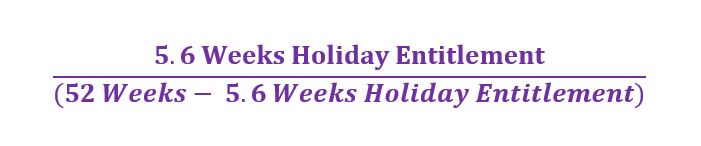
The Court of Appeal has said there is no reason to pro-rata entitlement in this way, as the WTRs state that holiday pay should be calculated in accordance with the “week’s pay provisions” of the Employment Rights Act 1996 (ERA).

Under the ERA’s provisions, where a worker does not have normal working hours, holiday pay should be taken to be the worker’s average weekly pay in the 12 weeks before leave starts (excluding any weeks in which no remuneration was payable).

Employment partner, Karen Cole, said:

“Holiday pay can be a real minefield for employers, but this ruling is clear on the treatment of part-year permanent contracts. Employers who engage workers on a permanent basis for part of the year, which may include zero-hour arrangements, should check their approach to holiday pay calculations to ensure they get it right going forwards.

Employers should also be aware that workers may bring a claim to recover underpayments for the previous two-year period presented as an unlawful deduction from wages claim. It is, therefore, vital they check records retrospectively.”

Contact Karen Cole today for information on holiday pay or other employment matters.

Note: This article is not legal advice; it provides information of general interest about current legal issues.

Stay in touch

Subscribe to our newsletter

Stay in touch

By completing your details and submitting this form you confirm you are happy for us to send you marketing communications and that you agree to our Website Privacy Policy and Legal Notice and to us using Mailchimp to process your data.


Sending

News/Insight

  • The Employment Rights Act is a call to action for employers 
    A new year, a new employment framework: what employers need to know about the Employment Rights Act passed by parliament in December 2025.


    Read more
  • Dilapidations explained: What commercial tenants and landlords need to know
    Dilapidations are a common source of dispute at the end of a commercial lease. They can involve significant sums of money and often come as an unwelcome surprise to tenants who believed they had left a property in reasonable condition. Understanding


    Read more
  • The role of due diligence in corporate transactions
    In corporate transactions, due diligence is a key stage that usually follows agreement of Heads of Terms, allowing the Buyer to investigate the target company or its assets before committing to the deal.


    Read more
  • Love in later life and the inheritance tax trap
    Increasingly, lawyers are seeing couples who have chosen to live together rather than marry, sometimes for many years, without fully appreciating how differently the law treats them, particularly when it comes to inheritance tax and financial protect


    Read more
  • Understanding Heads of Terms in corporate transactions
    Heads of terms are a crucial first step in corporate transactions. Learn what they include, why they matter, and how they shape successful deals.


    Read more

What they say...

  • Amish Bristol, January 2026
    Absolutely brilliant, fast, professional, clear and delivered a robust service “Recent mortgage oversight from Ben Marks and Anne was superbly dealt with, and I intend on moving all my business to them. For a big firm, they really do pay attent

  • Client, January 2026
    Excellent experience “The process of my work was quick and effective.”

  • Vicky, January 2026
    Clear, friendly, helpful “Very efficient and helpful with arrangements for my will.”

  • R Cook, December 2025
    Settlement Sorted “Grayson Stuckey was great. Efficient and friendly with all aspects of the support provided. We worked well together and achieved a positive outcome. Recommended.”

  • Ivan Naisbitt, December 2025
    More than just a service “Michael Davies has been representing me for about 35 years, and I cannot recommend him or RIAA Barker Gillette (UK) highly enough. Aside from the normal conveyancing, he is always on hand to advise and guide you throug

Read more
Send this to a friend