
Force Majeure and the Gulf Conflict: What Pakistani Businesses Need to Know

Force Majeure and the Gulf Conflict: What Pakistani Businesses Need to Know

On 28 February 2026, the United States and Israel launched strikes on Iran. Iran retaliated across the Gulf, targeting energy infrastructure and effectively closing the Strait of HormuzQatarEnergy, Kuwait Petroleum Corporation and Bahrain’s Bapco Energies each declared force majeure on their export obligations.

On 8 April 2026, a Pakistan-mediated two-week ceasefire took effect. Yet even if this truce culminates in a permanent end to hostilities, damaged production facilities and disrupted supply chains will produce cascading effects for months.

Pakistan’s Exposure

Pakistan imports over 80% of its oil and nearly all its LNG through the Strait. The disruption extends beyond energy. Some major domestic fertiliser plants depend on imported LNG as feedstock, and at least one major plant halting operations after losing access to Qatari gas. The country also faces a structural deficit in DAP (di-ammonium phosphate) imports, while helium constraints affect healthcare.

Section 56 of the Contract Act: Threshold, Causation and the Case Law

As a common law jurisdiction, Pakistan has no codified force majeure doctrine. This distinguishes it from civil law systems where force majeure is codified in statute and courts have express power to rebalance obligations in exceptional circumstances. In Pakistan, where a contract contains an express force majeure clause, courts will give effect to it. In Lebeaupin v R Crispin & Co [1920] 2 KB 714, force majeure was defined as encompassing all circumstances independent of the will of man, including war.

Where a contract is governed by Pakistani law and contains no express force majeure clause, the sole recourse is Section 56 of the Contract Act, 1872, under which a contract becomes void where performance is rendered impossible by an unpreventable event. (This analysis applies to contracts governed by Pakistani law. Contracts with Pakistani counterparties governed by English, UAE, or other foreign law will be subject to the force majeure framework of that governing law.) The Sindh High Court confirmed in PICIC v Habib Enterprises (1989 CLC 2070) that the doctrine applies to events subsequent to the contract that were not in the contemplation of the parties. The Supreme Court, in Mansukhdas Bodram v Hussain Brothers (PLD 1980 SC 122), held that frustration “guillotines the contract without the action of either party.” This has a critical practical consequence: Section 56 does not merely excuse the affected obligation. It voids the entire contract automatically. Every future obligation falls away, and Section 65 requires restitution of benefits received. A business that needs its supply relationship to survive the disruption should therefore think carefully before invoking a doctrine that will destroy it — negotiated variations that preserve the contract may be preferable.

The threshold is demanding: a party must prove performance is wholly impossible, not merely more expensive. Equally important is causation. Consider a power producer whose generation depends on LNG supplied under a long-term contract with QatarEnergy. When QatarEnergy declares force majeure and suspends deliveries, that producer cannot generate electricity and therefore cannot meet its own offtake obligations — a clear case of impossibility with a direct causal chain. Contrast this with a manufacturer who faces higher input costs but could source alternative fuel or adjust production. That is commercial hardship, and Section 56 will not assist. Where pre-existing difficulties had already compromised performance, courts are unlikely to accept the conflict as the sole frustrating cause.

“For businesses whose contracts are silent on force majeure, Section 56 sets a high bar. The priority now is building a clear evidentiary record that connects the disruption directly to the conflict and demonstrates that all reasonable steps to mitigate were taken,” said Mayhar Kazi, Partner at RIAA Barker Gillette.

Express Force Majeure Clauses and Adjacent Provisions

This conflict exposes a critical gap for businesses whose contracts lack force majeure or adjacent clauses. Without one, Section 56’s narrow impossibility standard is the only defence.

Even where a clause exists, invoking it requires satisfying multiple conditions simultaneously, including scope, foreseeability, a threshold of prevention rather than mere inconvenience, and strict notice and mitigation obligations. Failure on any single condition can defeat the claim.

Beyond force majeure, businesses should review adjacent mechanisms. Material adverse change (MAC) clauses may provide grounds for adjustment or termination. Hardship and price escalation provisions may offer relief where the contract’s economic balance has shifted. In all cases, a party claiming relief must demonstrate that it took reasonable steps to mitigate: courts will scrutinise whether viable alternatives existed and were pursued.

“The foreseeability question will define the next wave of disputes. Contracts signed before February 2026 carry a fundamentally different risk profile from those executed after hostilities began — and the force majeure analysis shifts accordingly,” said Hasnain Naqvee, Senior Partner at RIAA Barker Gillette.

What Businesses Should Do Now

Companies should audit existing force majeure clauses carefully. Check whether “war,” “armed conflict,” or “government action” is a listed trigger event, and whether catch-all language exists. Crucially, check the clause’s threshold: does it require performance to be “prevented,” “hindered,” or “delayed”? Each word produces a different legal result.

Notice deadlines must be identified and observed. Many clauses require notice within 14 or 30 days of the triggering event. Missing the window can forfeit the right to claim, regardless of the merits.

Document the causal chain, not just the disruption. Retain supplier force majeure notices, shipping records, and correspondence showing specifically how the conflict prevented performance. Engage counterparties early — agreed variations and interim arrangements are almost always preferable to litigation. Finally, businesses receiving force majeure notices from suppliers should assess them critically before accepting the suspension of their own entitlements.

For advice on force majeure or contractual risk management, contact Hasnain Naqvee or Mayhar Kazi today.

This article is not legal advice; it provides information of general interest about current legal issues.

RIAA Barker Gillette is Pakistan’s premier law firm, with an on-the-ground presence in three major cities in Pakistan: Karachi, Islamabad and Lahore, and affiliated offices in Dubai (DIFC) and London. 

The firm practices in all areas of corporate, commercial and dispute resolution law. Leading international legal directories consistently recognise the firm as a top-tier law firm in Pakistan.

RIAA Barker Gillette is the exclusive member firm in Pakistan for Lex Mundi, the world's leading network of independent law firms with in-depth experience in over 125 countries worldwide.

RIAA Barker Gillette is the exclusive member firm in Pakistan for Lex Mundi, the world’s leading network of independent law firms with in-depth experience in over 125 countries worldwide.


Pakistan Mining Law: Lexology Panoramic Guide

RIAA Barker Gillette (Pakistan) chapter in Lexology's Panoramic on Mining Law in Pakistan

We authored the Pakistan chapter of the Lexology Panoramic Mining Guide, an essential reference for understanding the legal and regulatory framework governing Pakistan’s mining sector. The comprehensive guide provides an in-depth examination of the laws, policies and opportunities shaping Pakistan’s rapidly evolving mining industry. With vast untapped mineral wealth—particularly along the Tethyan copper-gold belt in Balochistan—Pakistan’s mining sector is poised to become a major driver of foreign investment and industrial growth.

The chapter examines how mining regulation operates at the provincial level under Pakistan’s Constitution. Each province—Punjab, Sindh, Balochistan and Khyber Pakhtunkhwa—administers its own mining legislation covering licensing, extraction and mineral development. Notably, the Balochistan Mines and Minerals Act 2025 introduces a modernised framework that categorises licences more effectively, distinguishes surface rights from mining rights and imposes social obligations on mining operators. “With the enactment of the Balochistan Mines and Minerals Act 2025 and the proposed National Minerals Harmonisation Framework, Pakistan is taking significant steps to modernise its mining governance,” commented Bilal Shaukat (Managing Partner – Pakistan) at RIAA Barker Gillette.

The guide explores mining rights and title acquisition in detail. Under Pakistan law, all minerals in their natural condition are the property of the respective provincial government. Private parties may obtain mining rights only through licences or leases granted by provincial licensing authorities. These include reconnaissance licences, exploration licences, mineral deposit retention licences, and mining leases for both large-scale and small-scale operations. Large-scale mining leases are typically granted for up to 30 years, with renewal periods varying by province. The chapter details the application process, eligibility criteria, and ongoing compliance obligations for each type of mineral title.

The chapter further addresses the foreign investment regime, including Pakistan’s bilateral investment treaties and the landmark Reko Diq copper-gold project in Balochistan, which has attracted substantial global interest from investors such as Barrick, Saudi Arabia’s Manara Minerals and Abu Dhabi’s International Holding Company. The chapter also discusses incentives under the Foreign Investment (Promotion and Protection) Act, 2022 and the Inter-Governmental Commercial Transactions Act, 2022 and protections available to foreign investors, including access to ICSID arbitration under Pakistan’s extensive network of bilateral investment treaties. “The Reko Diq project and growing interest from global investors highlight why understanding Pakistan’s mining law framework is more important than ever,” said Shafaq Rehman, (Partner-Pakistan) at RIAA Barker Gillette.

Additionally, the chapter details the fiscal obligations of mining operators, including royalties, annual rents and surface compensation. It covers environmental review requirements, mandatory environmental impact assessments and closure and remediation processes enforced by provincial environmental protection agencies. The guide also analyses community engagement and corporate social responsibility obligations that mining operators must fulfil under each province’s laws.

“This guide serves as a valuable resource for investors and businesses seeking to navigate Pakistan’s complex mining regulations and capitalise on the sector’s immense potential,” said Hasnain Naqvee, (Senior Partner – Pakistan) at RIAA Barker Gillette.

For a comprehensive overview of the legal framework governing Pakistan’s mining sector, please read the full Pakistan chapter of the Lexology Panoramic Mining Guide, authored by Hasnain NaqveeBilal ShaukatShafaq Rehman and Parus Qureshi.

For advice on miming laws in Pakistan, please contact Hasnain NaqveeBilal Shaukat and Shafaq Rehman.

This article is not legal advice; it provides information of general interest about current legal issues.

RIAA Barker Gillette is Pakistan’s premier law firm, with an on-the-ground presence in three major cities in Pakistan: Karachi, Islamabad and Lahore, and affiliated offices in Dubai (DIFC) and London. 

The firm practices in all areas of corporate, commercial and dispute resolution law. Leading international legal directories consistently recognise the firm as a top-tier law firm in Pakistan.

RIAA Barker Gillette is the exclusive member firm in Pakistan for Lex Mundi, the world's leading network of independent law firms with in-depth experience in over 125 countries worldwide.

RIAA Barker Gillette is the exclusive member firm in Pakistan for Lex Mundi, the world’s leading network of independent law firms with in-depth experience in over 125 countries worldwide.


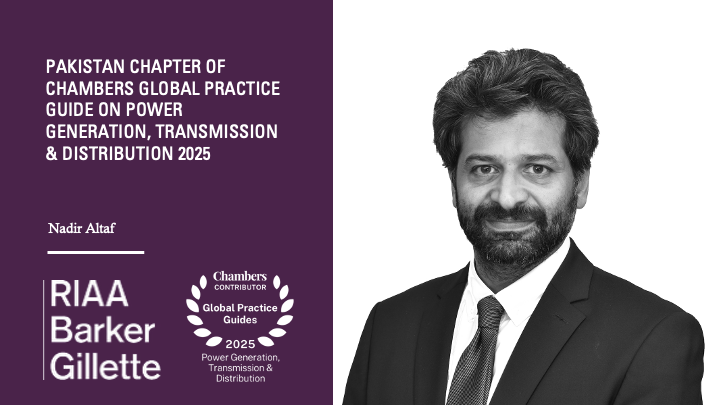
Pakistan Power Sector Legal Framework: 2025 Chambers Guide

Expert legal analysis of Pakistan power sector regulations in the 2025 Chambers Global Practice Guide by RIAA Barker Gillette

RIAA Barker Gillette authored the Pakistan chapter of the Chambers Global Practice Guide: Power Generation, Transmission & Distribution 2025. This comprehensive resource offers essential insights into the legal and regulatory framework governing Pakistan’s dynamic electricity industry. Moreover, it serves as an invaluable resource for businesses and investors navigating the complex regulations shaping Pakistan power sector generation, transmission and distribution.

The chapter examines the Pakistan power sector structure and ownership models in detail. Additionally, it analyses the regulatory regime under the Regulation of Generation, Transmission and Distribution of Electric Power Act 1997 (NEPRA Act) and its recent amendments. The changes were aimed at fostering competition through the Competitive Trading Bilateral Contract Market (CTBCM) model. The guide also covers key state-owned entities like WAPDA and NTDC. It also highlights the growing role of independent power producers in Pakistan’s evolving energy landscape.

Furthermore, our analysis covers the licensing requirements for generation, transmission and distribution facilities. The chapter details tariff determination processes, environmental approvals and the comprehensive framework governing power purchase agreements. Recent regulatory developments receive particular attention. Specifically, the Regulation of Generation, Transmission and Distribution of Electric Power (Amendment) Act 2018 that introduced new license categories for market operators, system operators and power traders. These laid the foundation for the Pakistan power sector to shift from a single buyer model toward a more competitive, deregulated market structure.

The guide also examines the country’s electricity supply mix and import arrangements while highlighting critical challenges facing the Pakistan power sector. These include circular debt issues, dependence on imported fuels, and aging infrastructure requiring modernisation. Further, we address opportunities in renewable energy development under the Alternative & Renewable Energy Policy 2019 and transmission expansion through private sector participation.

Investment protection mechanisms and foreign investment procedures feature prominently in our analysis. The chapter outlines fiscal incentives, repatriation rights, and sovereign guarantees available to Pakistan power sector investors. Special attention is given to the role of facilitative agencies like PPIB and provincial power development boards. These organisations play a crucial role in supporting project development across the country.

“This comprehensive guide provides crucial insights for navigating Pakistan’s power sector at a transformative time when market liberalisation and renewable energy integration are reshaping the regulatory landscape,” noted Nadir Altaf, Partner at RIAA Barker Gillette.

For expert guidance on Pakistan’s power sector regulations, please access the complete chapter here.

This article is not legal advice; it provides information of general interest about current legal issues.

RIAA Barker Gillette is Pakistan’s premier law firm, with an on-the-ground presence in three major cities in Pakistan: Karachi, Islamabad and Lahore and affiliated offices in Dubai (DIFC) and London. 

The firm practices in all areas of corporate, commercial and dispute resolution law. Leading international legal directories consistently recognise the firm as a top-tier law firm in Pakistan.

RIAA Barker Gillette is the exclusive member firm in Pakistan for Lex Mundi, the world's leading network of independent law firms with in-depth experience in over 125 countries worldwide.

RIAA Barker Gillette is the exclusive member firm in Pakistan for Lex Mundi, the world’s leading network of independent law firms with in-depth experience in over 125 countries worldwide.



Pakistan Public Procurement Law

Chambers Pakistan Public Procurement Law Guide 2025

RIAA Barker Gillette authored the Pakistan chapter of the Chambers Global Practice Guide: Public Procurement 2025, providing essential guidance on Pakistan public procurement law for businesses and legal professionals. The comprehensive guide provides an in-depth examination of the legal and regulatory framework governing public procurement at both federal and provincial levels in Pakistan.

The chapter explores Pakistan’s dual regulatory structure, with federal procurement governed by the Public Procurement Regulatory Authority Ordinance 2002 and the Public Procurement Rules 2004, while each province maintains its own distinct procurement laws and regulations. This multi-tiered approach creates unique challenges and opportunities for bidders, particularly as thresholds, timelines, and procedural requirements vary significantly across jurisdictions.

Key topics covered include the various tender procedures permitted under Pakistan public procurement law, from single-stage bidding to complex two-stage processes suitable for technically challenging projects. The guide provides detailed analysis of when procuring agencies may resort to direct contracting, including emergency situations and sole-source procurements, while emphasizing the strict conditions and approval requirements that apply. The chapter also examines transparency obligations, including mandatory standstill periods and the requirement to announce evaluation results at least 15 days before contract awards.

“The procurement landscape in Pakistan has evolved significantly, with courts increasingly scrutinising compliance with procedural requirements,” observed Hasnain Naqvee, Senior Partner at RIAA Barker Gillette (Pakistan). “Recent decisions have reinforced that even partial execution cannot validate contracts awarded through non-transparent means, making strict adherence to procurement rules essential.”

The guide provides crucial insights into Pakistan’s grievance redressal mechanism, outlining how bidders can challenge procurement decisions through Grievance Redressal Committees and the appeal process to the PPRA. Recent landmark court decisions analysed include cases establishing that past litigation cannot grounds for pre-bid exclusion and affirming procuring agencies’ discretion to reject all bids with proper justification.

“This guide is particularly timely as Pakistan reviews its procurement framework, with draft Public Procurement Rules 2024 introducing sustainable procurement provisions and enhanced contract management requirements,” added Bilal Shaukat, Managing Partner at RIAA Barker Gillette (Pakistan). “These reforms signal a shift toward international best practices in public procurement.”

The chapter addresses practical considerations including advertisement requirements based on contract values, minimum response times for national versus international bidding, and the special prerogatives of procuring agencies. With Pakistan’s ongoing regulatory reforms and increasing judicial oversight, this guide serves as an indispensable resource for navigating the evolving procurement landscape.

For expert guidance on Pakistan’s public procurement regulations, contact Bilal Shaukat or Hasnain Naqvee today.

This article is not legal advice; it provides information of general interest about current legal issues.

RIAA Barker Gillette is Pakistan’s premier law firm, with an on-the-ground presence in four major cities in Pakistan: Karachi, Islamabad and Lahore and affiliated offices in Dubai (DIFC) and London. 

The firm practices in all areas of corporate, commercial and dispute resolution law. Leading international legal directories consistently recognise the firm as a top-tier law firm in Pakistan.

RIAA Barker Gillette is the exclusive member firm in Pakistan for Lex Mundi, the world's leading network of independent law firms with in-depth experience in over 125 countries worldwide.
RIAA Barker Gillette is the exclusive member firm in Pakistan for Lex Mundi, the world’s leading network of independent law firms with in-depth experience in over 125 countries worldwide.


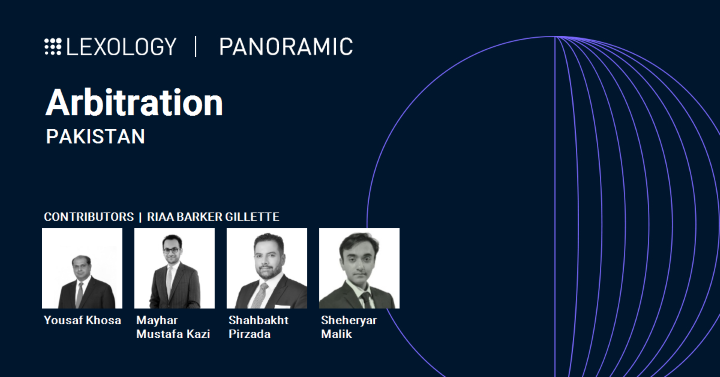
Pakistan’s Arbitration Law: Current Framework & Reform Proposals

Pakistan’s Arbitration Law

We authored the Pakistan Chapter of the Lexology Panoramic Arbitration 2025 publication, providing a comprehensive analysis of Pakistan’s arbitration law framework. The publication examines both domestic and international arbitration regimes, highlighting recent judicial developments and proposed legislative reforms that may reshape Pakistan’s arbitration landscape. It is essential reading for legal practitioners, businesses engaging in cross-border transactions, and foreign investors navigating dispute resolution in Pakistan.

The chapter begins with an exploration of Pakistan’s dual-track arbitration system. Domestic arbitrations remain governed by the Arbitration Act 1940, while international matters fall under the Recognition and Enforcement (Arbitration Agreements and Foreign Arbitral Awards) Act 2011, which incorporates the New York Convention into domestic law.

Partner Yousaf Khosa commented:

“Pakistan’s judiciary has increasingly adopted a pro-enforcement stance toward arbitration awards,”

The publication offers an in-depth examination of domestic arbitration governed by the Arbitration Act 1940, exploring procedural mechanisms, enforcement provisions, and interaction with international arbitration principles. The chapter draws on RIAA Barker Gillette’s extensive experience in Pakistan arbitration to examine current practice, including tribunal constitution, evidence procedures, interim measures, and award enforcement mechanisms under the existing legal framework.

A significant focus of the publication is the draft Arbitration Bill 2024, which proposes substantial modernization of Pakistan’s arbitration framework. If enacted, this legislation would align Pakistan’s regime with UNCITRAL Model Law standards, introducing provisions for emergency arbitrators, expanding tribunal powers regarding interim measures, and streamlining enforcement procedures. However, it remains a proposed bill that has not yet been enacted into law, and its final form and implementation timeline remain uncertain.

Partner Mayhar Kazi observed:

“The proposed legislative reforms, if enacted, would address significant procedural gaps in Pakistan’s arbitration landscape,”

The chapter examines recent Supreme Court jurisprudence that signals a more pro-arbitration approach in Pakistan. Notable decisions like Kausar Rana Resources v Qatar Lubricants Company (2024) and Taisei Corporation v AM Construction Company (2024) have expanded the scope of arbitrable disputes and emphasized minimal judicial interference in arbitration matters.

Partner Shahbakht Pirzada added:

“Recent Supreme Court decisions mark a significant shift in Pakistan’s arbitration jurisprudence, expanding the scope of arbitrable disputes beyond traditional limitations,”

For a comprehensive understanding of Pakistan’s arbitration framework, including recent developments and practical considerations, read the full Pakistan chapter in Lexology Panoramic’s Arbitration 2025.

For expert arbitration advice from Pakistan’s premier dispute resolution team with extensive experience in both domestic proceedings and international arbitration matters, contact our Partners, Yousaf Khosa, Mayhar Kazi or Shahbakht Pirzada today.

This article is not legal advice; it provides information of general interest about current legal issues.


RIAA Barker Gillette is Pakistan’s premier law firm, with an on-the-ground presence in four major cities in Pakistan: Karachi, Islamabad, Lahore, and Peshawar, and affiliated offices in Dubai (DIFC) and London.

The firm practices in all areas of corporate, commercial and dispute resolution law. Leading international legal directories consistently recognize the firm as a top-tier law firm in Pakistan.

Lex Mundi Logo

RIAA Barker Gillette is the exclusive member firm in Pakistan for Lex Mundi, the world’s leading network of independent law firms with in-depth experience in over 125 countries worldwide.  
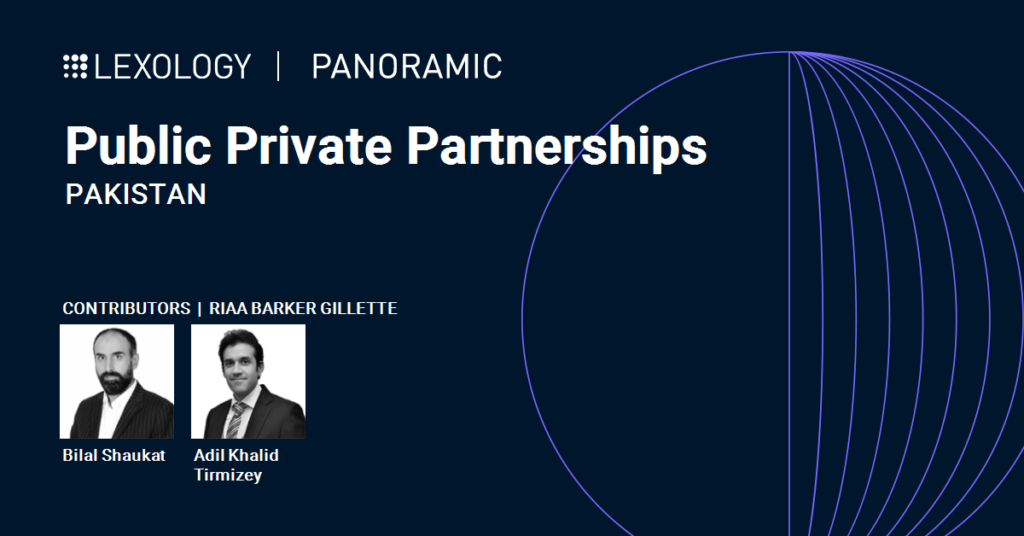

Pakistan Public Private Partnership Laws 2025

Pakistan Public Private Partnership Laws 2025

We authored the Pakistan chapter of the Lexology Panoramic Guide on Public-Private Partnerships 2025, which offers an authoritative overview of the country’s evolving PPP landscape. The guide provides a comprehensive overview of key topics, including the regulatory regime, procurement process, contractual provisions, risk allocation, financing, and dispute resolution applicable to PPP transactions in Pakistan.

Pakistan’s PPP framework has undergone significant development in recent years as the government increasingly turns to private sector participation to address infrastructure gaps and drive economic growth. The Pakistan chapter examines the evolution of the PPP regime, with dedicated federal and provincial laws now providing the primary legal framework, supplemented by sector-specific regulations.

Various PPP models have been successfully implemented in Pakistan, including build-operate-transfer (BOT), build-own-operate-transfer (BOOT), and design-build-finance-operate-transfer (DBFOT). This flexibility has enabled private investment across sectors like transportation, energy, healthcare and education.

The guide analyzes Pakistan’s PPP procurement framework, outlining key stages such as project identification, feasibility studies, bidding, and contract award. Key insights include an analysis of the typical contractual arrangements under PPP agreements, including allocating risks related to design, construction, operation, maintenance, and termination. The guide also discusses the available government support, security, and step-in rights for lenders. The publication examines successful case studies across sectors to offer practical recommendations for structuring bankable PPP projects.

Financing is crucial for PPP viability. The guide explores available structures, including project finance, viability gap funding, and government guarantees. It discusses developments like the Pakistan Infrastructure Bank, which aims to mobilize private capital. Government support mechanisms such as land acquisition assistance, tax incentives, and forex hedging facilities are also covered.

The guide compares PPP approaches across provinces, each with its own PPP laws and policies. Punjab and Sindh have proactively established dedicated PPP units and leveraging PPPs for infrastructure development.

Recent trends include increased adoption of unsolicited proposals, where private sector entities proactively identify and propose PPP projects to the government, and greater emphasis on enhancing public sector capacity to manage PPPs effectively.

A Partner at RIAA Barker Gillette, who co-authored the guide, notes commented:

“As Pakistan accelerates infrastructure development in the energy, transport, social infrastructure, and urban sectors through private participation, this guide is an essential resource for understanding the PPP landscape. Recent developments such as introduction of standardized bidding documents, and increased focus on unsolicited proposals are transforming the PPP landscape. The guide will be particularly useful for investors, developers, and lenders evaluating opportunities in Pakistan’s burgeoning PPP market.”

For more information on public private partnerships in Pakistan, please access The Lexology Panoramic Guide on Public-Private Partnerships or contact Bilal Shaukat, the Managing Partner of RIAA Barker Gillette Pakistan

This article is not legal advice; it provides information of general interest about current legal issues.


RIAA Barker Gillette is Pakistan’s premier law firm, with an on-the-ground presence in four major cities in Pakistan: Karachi, Islamabad, Lahore, and Peshawar, and affiliated offices in Dubai (DIFC) and London.

The firm practices in all areas of corporate, commercial and dispute resolution law. Leading international legal directories consistently recognize the firm as a top-tier law firm in Pakistan.

Lex Mundi Logo

RIAA Barker Gillette is the exclusive member firm in Pakistan for Lex Mundi, the world’s leading network of independent law firms with in-depth experience in over 125 countries worldwide.  

Pakistan Power Generation, Transmission & Distribution 2024

Pakistan Power Generation, Transmission & Distribution 2024

We authored the Pakistan chapter of the Chambers Global Practice Guide: Power Generation, Transmission & Distribution 2024, an essential reference for understanding the legal and regulatory framework governing Pakistan’s dynamic power sector.

The comprehensive guide provides an in-depth look at the laws and policies shaping Pakistan’s power generation, transmission and distribution. It begins with an overview of the power industry’s structure and ownership, highlighting the roles of key state-owned entities like WAPDA, NTDC, and DISCOs and the growing private sector participation through independent power producers (IPPs).

The chapter examines the electricity sector regulatory regime under the NEPRA Act and recent amendments aimed at fostering competition and enabling a deregulated market through the Competitive Trading Bilateral Contract Market (CTBCM) model. It also discusses provincial power sector regulators and the role of the Council of Common Interests.

Pakistan’s electricity supply mix, dominated by thermal and hydro with a growing share of renewables, is analyzed. The guide also delves into the legal and regulatory processes for constructing and operating generation facilities, transmission lines and distribution networks, including licensing, tariff determinations and approvals.

The chapter provides insights into Pakistan’s electricity import arrangements and the framework for cross-border trade. Furthermore, it highlights unique aspects of Pakistan’s power sector, such as attractive returns for investors, the challenge of circular debt, and the push towards indigenous energy resources and competitive procurement.

Recent policies like the Alternative & Renewable Energy Policy 2019 and the Transmission Line Policy 2015 are discussed, underscoring the government’s focus on sustainability, competition and private investment in the power sector’s development.

“This guide is a valuable resource for anyone seeking to navigate Pakistan’s complex power sector regulations and capitalize on the immense opportunities it presents,” commented Nadir Altaf (Partner – Pakistan) at RIAA Barker Gillette.

Please read the Pakistan chapter of the Chambers Global Practice Guide: Power Generation, Transmission & Distribution 2024.

For expert advice on power sector regulations, please contact Nadir Altaf.

This article is not legal advice; it provides information of general interest about current legal issues.


RIAA Barker Gillette is Pakistan’s premier law firm, with an on-the-ground presence in four major cities in Pakistan: Karachi, Islamabad, Lahore, and Peshawar, and affiliated offices in Dubai (DIFC) and London.

The firm practices in all areas of corporate, commercial and dispute resolution law. Leading international legal directories consistently recognize the firm as a top-tier law firm in Pakistan.

Lex Mundi Logo

RIAA Barker Gillette is the exclusive member firm in Pakistan for Lex Mundi, the world’s leading network of independent law firms with in-depth experience in over 125 countries worldwide.  

Doing Business in Pakistan 2024

Doing Business in Pakistan

We authored the Pakistan chapter of the Chambers Global Practice Guide: Doing Business In 2024, an essential reference for businesses and investors seeking to navigate Pakistan’s legal framework.

The comprehensive guide provides an accessible overview of Pakistan’s judicial system and laws relating to foreign investment, companies, employment, tax regime, competition, intellectual property and data protection. It also highlights recent policies and reforms impacting the business environment.

The comprehensive guide highlights the country’s liberal foreign investment regime, with most sectors open to investment with no minimum capital requirements. The guide details the recent establishment of the Special Investment Facilitation Council (SIFC) to attract foreign investment and streamline approval processes and recent investment promotion legislation, including the Foreign Investment (Promotion and Protection) Act, 2022, and the Inter-Governmental Commercial Transactions Act 2022.

The chapter also discusses companies, and outlines incorporation processes, management structure, directors duties and ongoing reporting obligations. Employment law is also thoroughly discussed, including regulations for workers and managers, employment contracts, termination and collective bargaining.

Major federal and provincial taxes applicable to employees and businesses are also examined, including tax credits and incentives available in Special Economic Zones, Special Technology Zones, and Export Processing Zones, as well as rules on tax consolidation, thin capitalization, transfer pricing, and anti-evasion.

Competition law is also addressed, focusing on merger control, cartels, and abuse of dominant position. Furthermore, the chapter provides an overview of intellectual property rights in Pakistan, terms of protection, and enforcement mechanisms. While noting the absence of comprehensive data protection legislation, the guide highlights relevant provisions of the Prevention of Electronic Crimes Act, 2016.

Lastly, the guide discusses upcoming legal reforms, including the draft Arbitration Bill, which aims to modernize Pakistan’s arbitration regime in accordance with the UNCITRAL Model Law on International Commercial Arbitration.

For an in-depth look at Pakistan’s business laws, please consult the Pakistan chapter of the Chambers Global Practice Guide for Doing Business in Pakistan 2024.

For more information, please contact Hasnain Naqvee, Bilal Shaukat, Mayhar Kazi and Shafaq Rehman.

This article is not legal advice; it provides information of general interest about current legal issues.


RIAA Barker Gillette is Pakistan’s premier law firm, with an on-the-ground presence in four major cities in Pakistan: Karachi, Islamabad, Lahore, and Peshawar, and affiliated offices in Dubai (DIFC) and London.

The firm practices in all areas of corporate, commercial and dispute resolution law. Leading international legal directories consistently recognize the firm as a top-tier law firm in Pakistan.

Lex Mundi Logo

RIAA Barker Gillette is the exclusive member firm in Pakistan for Lex Mundi, the world’s leading network of independent law firms with in-depth experience in over 125 countries worldwide.  

Public-Private Partnership Projects in Punjab

Public-Private Partnership Projects in Punjab Graphic

The Government of Punjab is turning a corner in Public Private Partnership projects as it announces a new era of bankable public-private partnership project structures along the lines of the projects developed by the Government of Sindh.

Introduction

At a recent investor conference, the Government of Punjab’s Communications and Works Department (C&W) announced that it plans to tender several new road infrastructure projects under the public-private partnership (PPP) mode.

Background

C&W’s future plans are informed by lessons learned from the first PPP project of the C&W Department, Government of Punjab (GoPb), namely the dualisation of the 43-kilometer Sheikhupura-Gujranwala road, developed by Shajar Roads Limited (the Project). Our team acted as project counsel for Shajar Roads in this landmark project.

Lessons Learnt

In response to the case study on challenges faced by the Project presented by Shajar Roads’ financial advisor, IQ Capital, C&W responded with the following solutions.

Cost Escalation Support: One of the critical issues faced in the Sheikhupura-Gujranwala project was cost overruns due to delays in obtaining the project site. To mitigate such risks in future projects, the GoPb will bear the costs of post-bid price escalations for essential raw materials like cement, steel, and bitumen and may also backstop unforeseeable hikes in interest rates.

Minimum Revenue Guarantees: The GoPB will provide minimum revenue guarantees to address the financial viability of projects with low traffic volumes. This ensures that concessionaires are protected against shortfalls in expected toll revenue.

Provincial Guarantee with Debit Authority: The GoPB will offer a provincial guarantee with a debit authority over its account maintained with the State Bank of Pakistan. Commercial banks now expect this security measure. It will enhance project bankability by providing a reliable backstop for the Government’s termination payment obligations and avoiding project sponsors having to create security over non-project assets.

Amended PPP Law: Additionally, the existing Public-Private Partnership Act 2019 was identified as overly complex, with multiple bodies involved in project conception and execution, leading to delays and inefficiencies. Amendments are being proposed to streamline the process of implementing PPPs, drawing inspiration from the more efficient Sindh PPP law.

Implications and Next Steps

These developments signal a more stable and predictable environment for developers, investors, and lenders to invest in infrastructure projects in Punjab. Introducing cost escalation support and minimum revenue guarantees reduces financial risks, making these projects more attractive to private investors.

The amended PPP law is expected to simplify the regulatory framework, reduce bureaucratic hurdles, and expedite project timelines. This will likely lead to increased participation from both local and international investors, fostering a more competitive and dynamic market.

Businesses interested in participating in these projects should closely monitor the upcoming investor conferences for detailed roadmaps and tendering timelines.

Looking Ahead

The future of PPP projects in Punjab looks promising, with the GoPB’s proactive measures addressing past challenges and setting the stage for more successful collaborations. In the coming months, we anticipate further refinements to the PPP framework and additional investor-friendly policies. We look forward to the next investor conference, at which C&W has promised to provide a roadmap for tendering new projects.

For more information on public-private partnership projects in Punjab or elsewhere in Pakistan, contact the Managing Partner of Pakistan, Bilal Shaukat.

This article is not legal advice; it provides information of general interest about current legal issues.


RIAA Barker Gillette is Pakistan’s premier law firm, with an on-the-ground presence in four major cities in Pakistan: Karachi, Islamabad, Lahore, and Peshawar, and affiliated offices in Dubai (DIFC) and London.

The firm practices in all areas of corporate, commercial and dispute resolution law. Leading international legal directories consistently recognize the firm as a top-tier law firm in Pakistan.

Lex Mundi Logo

RIAA Barker Gillette is the exclusive member firm in Pakistan for Lex Mundi, the world’s leading network of independent law firms with in-depth experience in over 125 countries worldwide.  

Sitara Energy Wins Landmark Appeal Against FESCO After 7-Year Legal Battle

Sitara Energy Wins Landmark Appeal Graphic

Introduction

In a significant win for Sitara Energy Limited, the NEPRA Appellate Tribunal has overturned the National Electric Power Regulatory Authority’s (NEPRA) flawed tariff decision, ordering a fresh review within a strict four-month timeframe.

Background

Amid nationwide electricity shortages in 2005-2006, NEPRA introduced a policy enabling companies like Sitara Energy Limited to sell power directly to distribution companies (DISCOs) like FESCO at mutually agreed rates through Power Purchase Agreements (PPAs). Sitara operated within this framework, supplying electricity until 2015 when the purchase prices became financially unsustainable.

The Dispute

Despite the expiration of the original PPA in 2011, NEPRA directed Sitara to continue supplying power to FESCO at agreed-upon rates while retaining the authority to determine the final tariff. NEPRA, without legal authority, compelled Sitara to provide an undertaking to accept NEPRA’s determined tariff by withholding payments by FECO for past invoices. After a six-year delay, NEPRA retrospectively reduced the unit price of electricity sold, directing Sitara to reimburse FESCO for around Rs. 837 million.

“NEPRA’s tariff decision was fraught with several procedural lapses and substantial factual errors,” noted Nadir Altaf (Partner – Pakistan), the lead counsel from RIAA Barker Gillette representing Sitara. “Notably, NEPRA erroneously presumed that Sitara conducted power sales to FESCO through a 132 kV synchronized grid, rather than the actual 11 kV isolated mode.”

The Outcome

The NEPRA Appellate Tribunal ruled in favour of Sitara, overturning NEPRA’s tariff decision and ordering a fresh evaluation within a strict four-month statutory timeframe. The tribunal also declared the notices issued to Sitara by FESCO invalid, providing substantial financial relief to Sitara. This decision provides substantial financial relief to Sitara and initiates a comprehensive review of the case under the principles of equitable regulatory practice.

Nadir Altaf (Partner-Pakistan) at RIAA Barker Gillette further commented,

“This judgment not only provides financial relief to Sitara but also sets a precedent for equitable regulatory practices in the energy sector. It underscores the necessity of fair adjudication based on accurate information to maintain industry stability and integrity.”

Implications

This case starkly reminds us of the potential consequences of regulatory missteps and highlights the importance of thorough adjudication in regulatory decisions. This ruling sets a significant precedent for companies operating in Pakistan’s power sector, potentially influencing future regulatory practices.

For more information or legal advice on navigating regulatory challenges in the power sector, contact Nadir Altaf (Partner – Pakistan).

This article is not legal advice; it provides information of general interest about current legal issues.


RIAA Barker Gillette is Pakistan’s premier law firm, with an on-the-ground presence in four major cities in Pakistan: Karachi, Islamabad, Lahore, and Peshawar, and affiliated offices in Dubai (DIFC) and London.

The firm practices in all areas of corporate, commercial and dispute resolution law. Leading international legal directories consistently recognize the firm as a top-tier law firm in Pakistan.

Lex Mundi Logo

RIAA Barker Gillette is the exclusive member firm in Pakistan for Lex Mundi, the world’s leading network of independent law firms with in-depth experience in over 125 countries worldwide.  


News/Insight

  • RIAA defeats ship arrest of M/V Lady Ileen amid the Strait of Hormuz crisis

    The Strait of Hormuz crisis has produced a new wave of shipping disputes — diverted voyages, stranded cargoes, war-risk invocations — with Pakistan's admiralty courts at Karachi emerging as a key forum. Against that backdrop, last week the Sindh High Court released M/V Lady Ileen, a Palau-flagged bulk carrier arrested at Karachi since March 2026. The Court acted on a jurisd...


    Read more
  • PTA Anti-Dumping Duties: RIAA Barker Gillette Secures 9.50%

    In July 2025, RIAA Barker Gillette filed an application on behalf of Lotte Chemical Pakistan Limited (LCPL) before the National Tariff Commission (the Commission), seeking anti-dumping duties on imports of purified terephthalic acid (PTA) from China. T...


    Read more
  • Constitutional Challenge to NEPRA Prosumer Regulations

    RIAA Barker Gillette has filed a constitutional petition before the Islamabad High Court challenging the NEPRA Prosumer Regulations 2026. The regulations replaced Pakistan's decade-old net metering regime with a n...


    Read more
  • Force Majeure and the Gulf Conflict: What Pakistani Businesses Need to Know

    On 28 February 2026, the United States and Israel launched strikes on Iran. Iran retaliated across the Gulf, targeting energy infrastructure and effectively closing the Strait of HormuzQatarEnergy, Kuwait Petroleum Corporation and Bahrain’s Bapc...


    Read more
  • RIAA Delivers Comprehensive Airline Regulatory Compliance Roadmap for Pakistan Market Entry

    The KSA office of a Big Four professional services firm engaged RIAA Barker Gillette to develop a comprehensive airline regulatory compliance framework for a major international airline preparing to launch operations in Pakistan. The cross-border mandate — originating from the Middle East and requiring deep Pakistan regulatory expertise — demanded cross-disciplinary analysi...


    Read more

What clients say...

  • Chambers Asia-Pacific 2025

    "RIAA Barker Gillette has always had the most apt ability to handle, manage and steer complex and difficult matters in the right legal direction."

  • Legal 500 2025

    "We have worked with RIAA on a number of complex multi-jurisdictional matters. Throughout, they provided not only exceptional local advice but proved excellent at collaborating with firms across the world. They were instrumental in developing and implementing a comprehensive strategy."

  • Chambers Asia-Pacific 2025

    "Our operation is complex and has many nuances, and they have helped us navigate all of them promptly and professionally."

  • Legal 500 2024

    "Very professional firm, able to provide clear, concise and constructive advice. Proven very astute in formulating overall strategies of engagement."

  • Chambers Asia-Pacific 2024

    "RIAA is highly professional, meeting tight deadlines with the utmost proficiency. They have always come up with out-of-the-box solutions."

Read more